

THE NEAR-SURFACE LAYER OF THE OCEAN
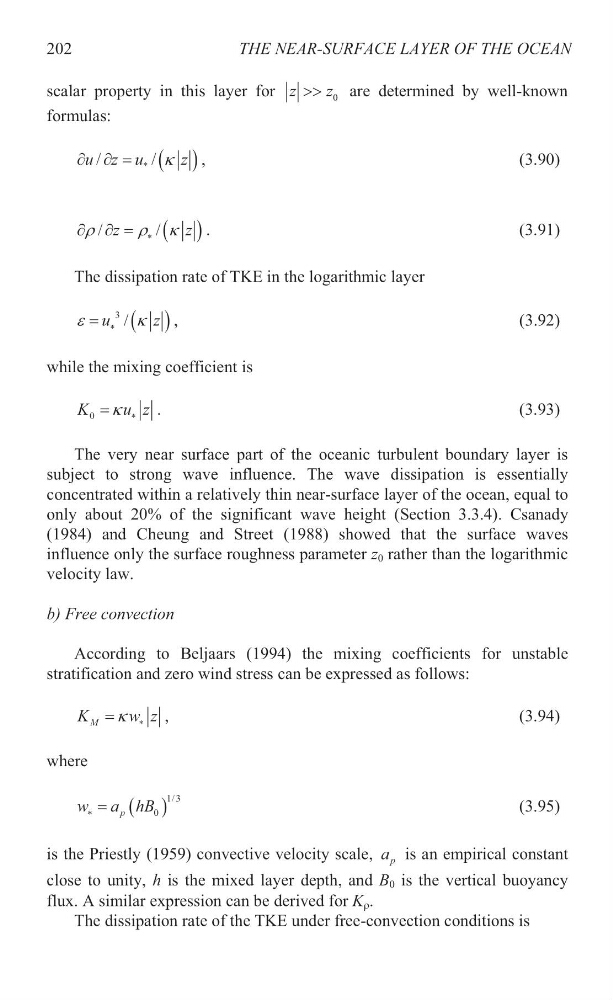
scalar property in this layer for
0
z
z
!!
are determined by well-known
formulas:
*
/
/
u z u
z
N
w w
,
(3.90)
/
/
z
z
U
U N
w w
.
(3.91)
The dissipation rate of TKE in the logarithmic layer
3 /
u
z
H
N
,
(3.92)
while the mixing coefficient is
0
K
u z
N .
(3.93)
The very near surface part of the oceanic turbulent boundary layer is
subject to strong wave influence. The wave dissipation is essentially
concentrated within a relatively thin near-surface layer of the ocean, equal to
only about 20% of the significant wave height (Section 3.3.4). Csanady
(1984) and Cheung and Street (1988) showed that the surface waves
influence only the surface roughness parameter z 0 rather than the logarithmic
velocity law.
b) Free convection
According to Beljaars (1994) the mixing coefficients for unstable
stratification and zero wind stress can be expressed as follows:
M
K
w z
N ,
(3.94)
where
1/ 3
0
p
w a hB
(3.95)
is the Priestly (1959) convective velocity scale, p
a is an empirical constant
close to unity, h is the mixed layer depth, and B 0 is the vertical buoyancy
flux. A similar expression can be derived for K U .
The dissipation rate of the TKE under free-convection conditions is
202
scalar property in this layer for
0
z
z
!!
are determined by well-known
formulas:
*
/
/
u z u
z
N
w w
,
(3.90)
/
/
z
z
U
U N
w w
.
(3.91)
The dissipation rate of TKE in the logarithmic layer
3 /
u
z
H
N
,
(3.92)
while the mixing coefficient is
0
K
u z
N .
(3.93)
The very near surface part of the oceanic turbulent boundary layer is
subject to strong wave influence. The wave dissipation is essentially
concentrated within a relatively thin near-surface layer of the ocean, equal to
only about 20% of the significant wave height (Section 3.3.4). Csanady
(1984) and Cheung and Street (1988) showed that the surface waves
influence only the surface roughness parameter z 0 rather than the logarithmic
velocity law.
b) Free convection
According to Beljaars (1994) the mixing coefficients for unstable
stratification and zero wind stress can be expressed as follows:
M
K
w z
N ,
(3.94)
where
1/ 3
0
p
w a hB
(3.95)
is the Priestly (1959) convective velocity scale, p
a is an empirical constant
close to unity, h is the mixed layer depth, and B 0 is the vertical buoyancy
flux. A similar expression can be derived for K U .
The dissipation rate of the TKE under free-convection conditions is
202