

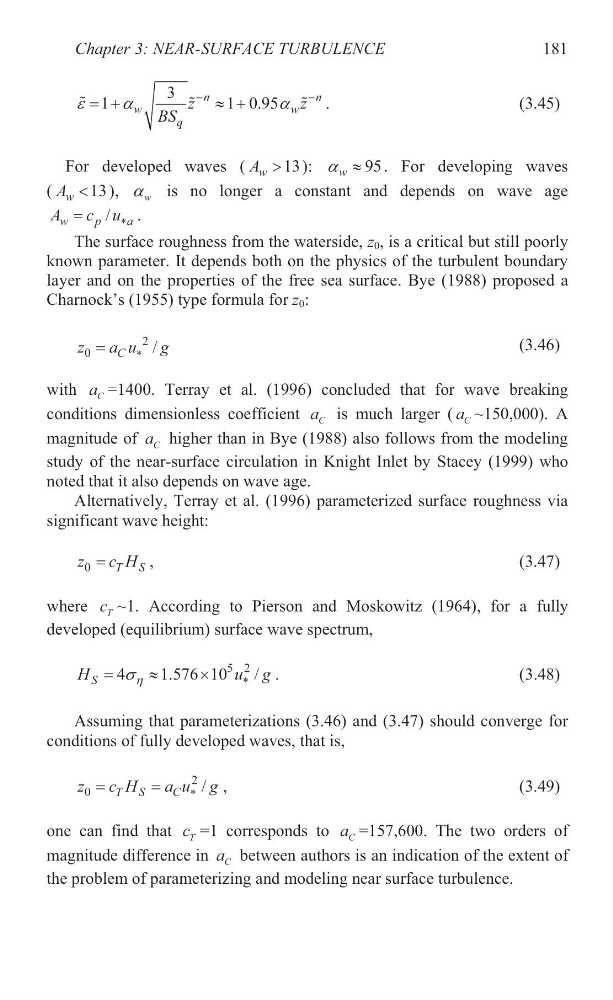
3
1
1 0.95
n
n
w
w
q
z
z
BS
H
D
D
|
.
(3.45)
For developed waves (
13
w
A ! ):
95
w
D | . For developing waves
(
13
w
A ),
w
D is no longer a constant and depends on wave age
/
w
p
a
A c u .
The surface roughness from the waterside, z 0 , is a critical but still poorly
known parameter. It depends both on the physics of the turbulent boundary
layer and on the properties of the free sea surface. Bye (1988) proposed a
Charnock’s (1955) type formula for z 0 :
2
0
/
C
z a u g
(3.46)
with C
a =1400. Terray et al. (1996) concluded that for wave breaking
conditions dimensionless coefficient C
a is much larger ( C
a ~150,000). A
magnitude of C
a higher than in Bye (1988) also follows from the modeling
study of the near-surface circulation in Knight Inlet by Stacey (1999) who
noted that it also depends on wave age.
Alternatively, Terray et al. (1996) parameterized surface roughness via
significant wave height:
0
T S
z c H ,
(3.47)
where T
c ~1. According to Pierson and Moskowitz (1964), for a fully
developed (equilibrium) surface wave spectrum,
5 2
4
1.576 10
/
S
H
u g
K
V
|
u
.
(3.48)
Assuming that parameterizations (3.46) and (3.47) should converge for
conditions of fully developed waves, that is,
2
0
/
T S
C
z c H
a u g
,
(3.49)
one can find that T
c =1 corresponds to C
a =157,600. The two orders of
magnitude difference in C
a between authors is an indication of the extent of
the problem of parameterizing and modeling near surface turbulence.
Chapter 3: NEAR-SURFACE TURBULENCE
181
1
1 0.95
n
n
w
w
q
z
z
BS
H
D
D
|
.
(3.45)
For developed waves (
13
w
A ! ):
95
w
D | . For developing waves
(
13
w
A ),
w
D is no longer a constant and depends on wave age
/
w
p
a
A c u .
The surface roughness from the waterside, z 0 , is a critical but still poorly
known parameter. It depends both on the physics of the turbulent boundary
layer and on the properties of the free sea surface. Bye (1988) proposed a
Charnock’s (1955) type formula for z 0 :
2
0
/
C
z a u g
(3.46)
with C
a =1400. Terray et al. (1996) concluded that for wave breaking
conditions dimensionless coefficient C
a is much larger ( C
a ~150,000). A
magnitude of C
a higher than in Bye (1988) also follows from the modeling
study of the near-surface circulation in Knight Inlet by Stacey (1999) who
noted that it also depends on wave age.
Alternatively, Terray et al. (1996) parameterized surface roughness via
significant wave height:
0
T S
z c H ,
(3.47)
where T
c ~1. According to Pierson and Moskowitz (1964), for a fully
developed (equilibrium) surface wave spectrum,
5 2
4
1.576 10
/
S
H
u g
K
V
|
u
.
(3.48)
Assuming that parameterizations (3.46) and (3.47) should converge for
conditions of fully developed waves, that is,
2
0
/
T S
C
z c H
a u g
,
(3.49)
one can find that T
c =1 corresponds to C
a =157,600. The two orders of
magnitude difference in C
a between authors is an indication of the extent of
the problem of parameterizing and modeling near surface turbulence.
Chapter 3: NEAR-SURFACE TURBULENCE
181