

3.2.4 Dynamics of a free-rising instrument in the near-surface layer
of the ocean
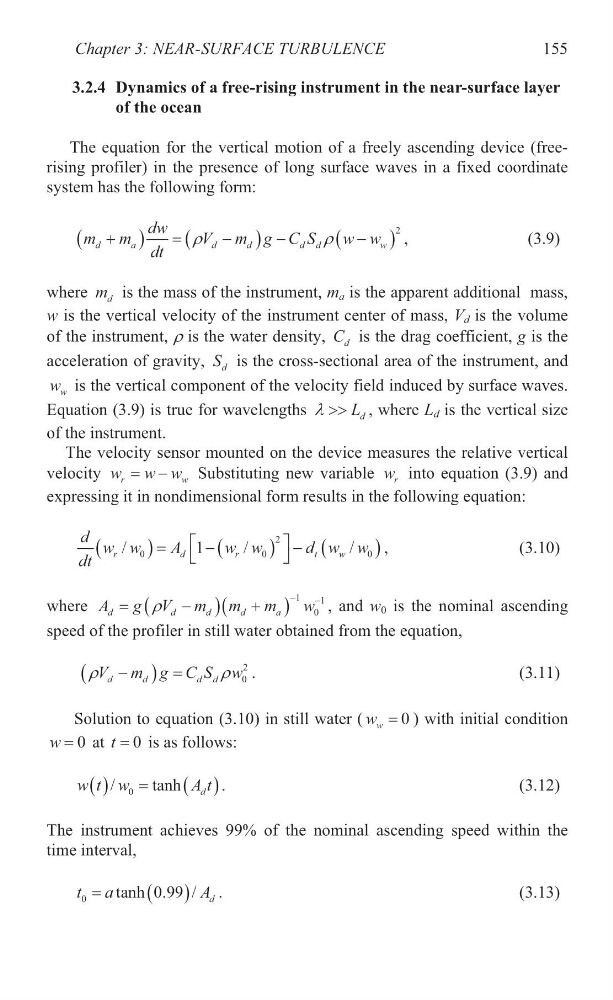
The equation for the vertical motion of a freely ascending device (freerising profiler) in the presence of long surface waves in a fixed coordinate
system has the following form:
2
d
a
d
d
d d
w
dw
m m
V m g C S
w w
dt
U
U
,
(3.9)
where d
m is the mass of the instrument, m a is the apparent additional mass,
w is the vertical velocity of the instrument center of mass, V d is the volume
of the instrument, U is the water density, d
C is the drag coefficient, g is the
acceleration of gravity, d
S is the cross-sectional area of the instrument, and
w
w is the vertical component of the velocity field induced by surface waves.
Equation (3.9) is true for wavelengths
d
L
O !! , where L d is the vertical size
of the instrument.
The velocity sensor mounted on the device measures the relative vertical
velocity r
w
w w w
Substituting new variable r
w into equation (3.9) and
expressing it in nondimensional form results in the following equation:
2
0
0
0
/
1
/
/
r
d
r
t
w
d w w
A
w w
d w w
dt
ª
º
¬
¼
,
(3.10)
where
1
1
0
d
d
d
d
a
A g V m m m
w
U
, and w 0 is the nominal ascending
speed of the profiler in still water obtained from the equation,
2
0
d
d
d d
V m g C S w
U
U
.
(3.11)
Solution to equation (3.10) in still water (
0
w
w
) with initial condition
0
w
at
0
t
is as follows:
0
/
tanh d
w t w
A t .
(3.12)
The instrument achieves 99% of the nominal ascending speed within the
time interval,
0
tanh 0.99 / d
t a
A .
(3.13)
Chapter 3: NEAR-SURFACE TURBULENCE
155
of the ocean
The equation for the vertical motion of a freely ascending device (freerising profiler) in the presence of long surface waves in a fixed coordinate
system has the following form:
2
d
a
d
d
d d
w
dw
m m
V m g C S
w w
dt
U
U
,
(3.9)
where d
m is the mass of the instrument, m a is the apparent additional mass,
w is the vertical velocity of the instrument center of mass, V d is the volume
of the instrument, U is the water density, d
C is the drag coefficient, g is the
acceleration of gravity, d
S is the cross-sectional area of the instrument, and
w
w is the vertical component of the velocity field induced by surface waves.
Equation (3.9) is true for wavelengths
d
L
O !! , where L d is the vertical size
of the instrument.
The velocity sensor mounted on the device measures the relative vertical
velocity r
w
w w w
Substituting new variable r
w into equation (3.9) and
expressing it in nondimensional form results in the following equation:
2
0
0
0
/
1
/
/
r
d
r
t
w
d w w
A
w w
d w w
dt
ª
º
¬
¼
,
(3.10)
where
1
1
0
d
d
d
d
a
A g V m m m
w
U
, and w 0 is the nominal ascending
speed of the profiler in still water obtained from the equation,
2
0
d
d
d d
V m g C S w
U
U
.
(3.11)
Solution to equation (3.10) in still water (
0
w
w
) with initial condition
0
w
at
0
t
is as follows:
0
/
tanh d
w t w
A t .
(3.12)
The instrument achieves 99% of the nominal ascending speed within the
time interval,
0
tanh 0.99 / d
t a
A .
(3.13)
Chapter 3: NEAR-SURFACE TURBULENCE
155