

THE NEAR-SURFACE LAYER OF THE OCEAN
During this time interval the profiler passes the vertical distance,
0
0
1
0
0
0
0
0
0
tanh
ln cosh
t
t
d
d
d
d
w t dt w
A t dt w A
A t
³
³
.
(3.14)
Substituting (3.12) and (3.13) into (3.14) gives:
1
0
0
0.28
d
d
wA
.
(3.15)
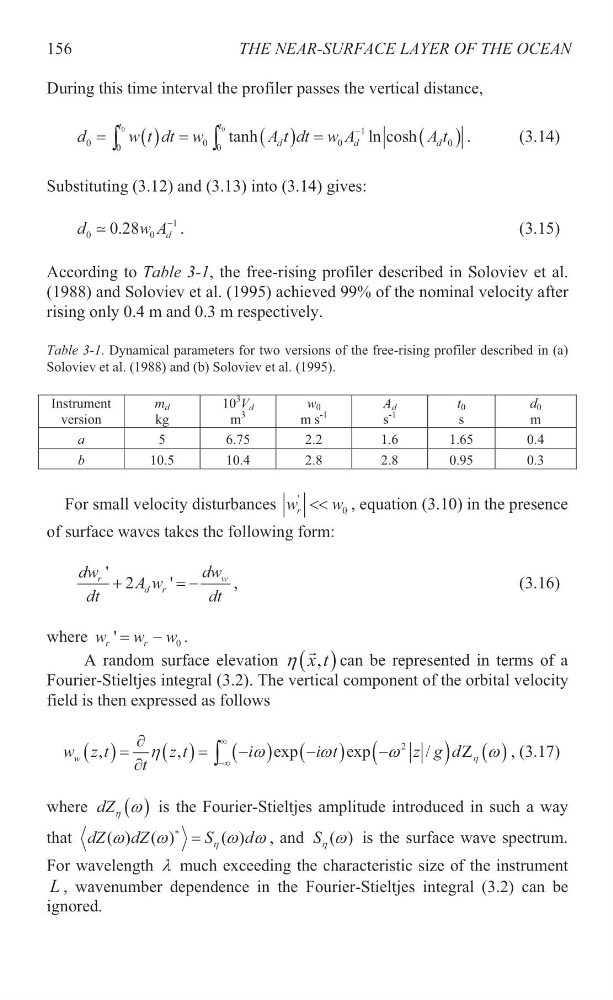
According to Table 3-1, the free-rising profiler described in Soloviev et al.
(1988) and Soloviev et al. (1995) achieved 99% of the nominal velocity after
rising only 0.4 m and 0.3 m respectively.
Table 3-1. Dynamical parameters for two versions of the free-rising profiler described in (a)
Soloviev et al. (1988) and (b) Soloviev et al. (1995).
Instrument
version
m d
kg
10
3 V d
m
3
w 0
m s
-1
A d
s
-1
t 0
s
d 0
m
a
5
6.75
2.2
1.6
1.65
0.4
b
10.5
10.4
2.8
2.8
0.95
0.3
For small velocity disturbances
'
0
r
w
w
, equation (3.10) in the presence
of surface waves takes the following form:
' 2
'
w
r
d r
dw
dw
A w
dt
dt
,
(3.16)
where
0
'
r
r
w
w w
.
A random surface elevation
,
x t
K
G can be represented in terms of a
Fourier-Stieltjes integral (3.2). The vertical component of the orbital velocity
field is then expressed as follows
2
,
,
e x p
e x p
/
w
w z t
z t
i
i t
z g d
t
K
K
Z
Z
Z
Z
f
f
w
=
w
³
, (3.17)
where
dZ K Z is the Fourier-Stieltjes amplitude introduced in such a way
that
( ) ( )
( )
dZ
dZ
S
d
K
Z
Z
Z Z
, and
( )
S K Z is the surface wave spectrum.
For wavelength O much exceeding the characteristic size of the instrument
L , wavenumber dependence in the Fourier-Stieltjes integral (3.2) can be
ignored.
156
During this time interval the profiler passes the vertical distance,
0
0
1
0
0
0
0
0
0
tanh
ln cosh
t
t
d
d
d
d
w t dt w
A t dt w A
A t
³
³
.
(3.14)
Substituting (3.12) and (3.13) into (3.14) gives:
1
0
0
0.28
d
d
wA
.
(3.15)
According to Table 3-1, the free-rising profiler described in Soloviev et al.
(1988) and Soloviev et al. (1995) achieved 99% of the nominal velocity after
rising only 0.4 m and 0.3 m respectively.
Table 3-1. Dynamical parameters for two versions of the free-rising profiler described in (a)
Soloviev et al. (1988) and (b) Soloviev et al. (1995).
Instrument
version
m d
kg
10
3 V d
m
3
w 0
m s
-1
A d
s
-1
t 0
s
d 0
m
a
5
6.75
2.2
1.6
1.65
0.4
b
10.5
10.4
2.8
2.8
0.95
0.3
For small velocity disturbances
'
0
r
w
w
, equation (3.10) in the presence
of surface waves takes the following form:
' 2
'
w
r
d r
dw
dw
A w
dt
dt
,
(3.16)
where
0
'
r
r
w
w w
.
A random surface elevation
,
x t
K
G can be represented in terms of a
Fourier-Stieltjes integral (3.2). The vertical component of the orbital velocity
field is then expressed as follows
2
,
,
e x p
e x p
/
w
w z t
z t
i
i t
z g d
t
K
K
Z
Z
Z
Z
f
f
w
=
w
³
, (3.17)
where
dZ K Z is the Fourier-Stieltjes amplitude introduced in such a way
that
( ) ( )
( )
dZ
dZ
S
d
K
Z
Z
Z Z
, and
( )
S K Z is the surface wave spectrum.
For wavelength O much exceeding the characteristic size of the instrument
L , wavenumber dependence in the Fourier-Stieltjes integral (3.2) can be
ignored.
156