

THE NEAR-SURFACE LAYER OF THE OCEAN
Linear filtering has been widely used to separate waves from turbulence
in mooring or tower-based velocity records (e.g., Benilov and Filyushkin,
1970; Kitaigorodskii et al., 1983). This filtering procedure is capable of
distinguishing turbulence from linear waves, which effectively addresses
problem (a). Problem (b), however, is essentially nonlinear.
In the case of mooring and tower-based measurements, the orbital
velocity fluctuation of surface waves usually exceeds the mean drift current.
Taylor’s frozen field approximation (3.8), which requires that the fluctuation
of the flow is less than 10% of its mean speed, cannot be satisfied for these
types of measurements; the standard techniques of turbulence analysis,
therefore, are not applicable. To address problem (b) for tower-based
observations, Kitaigorodskii et al. (1983) used the RMS fluctuation velocity
in Taylor’s hypothesis of frozen turbulence instead of the mean drift
velocity. The error in calculations of the turbulence dissipation rates using
these alternative techniques is unknown.
Linear filtering cannot remove nonlinear components of surface waves
from the measured signal, however. This may have resulted in an
overestimation of the turbulence dissipation rate calculated from tower
measurements. Not yet mentioned are the flow reversals due to orbital
velocities of surface waves that are typical for tower-based measurements. A
turbulent patch produced by the sensor package or mounting structure can
occasionally get into the sensing area and disturb measurements. All these
circumstances sometimes make tower-based turbulence measurements
difficult to interpret.
It is remarkable that spatial scales of turbulence and surface waves may
differ greatly. Stewart and Grant (1962) and Soloviev et al. (1988)
demonstrated that a fast moving sensor provides an effective separation
between the turbulence and surface waves. As a result no statistical filtering
is required to solve problem (a). Moreover, if the sensor moves fast enough
when compared to the velocity scale of wave orbital motions, problem (b)—
modulation of the relative speed (and direction) of the flow due to surface
wave disturbances—can be solved as well (Drennan et al., 1996; Soloviev et
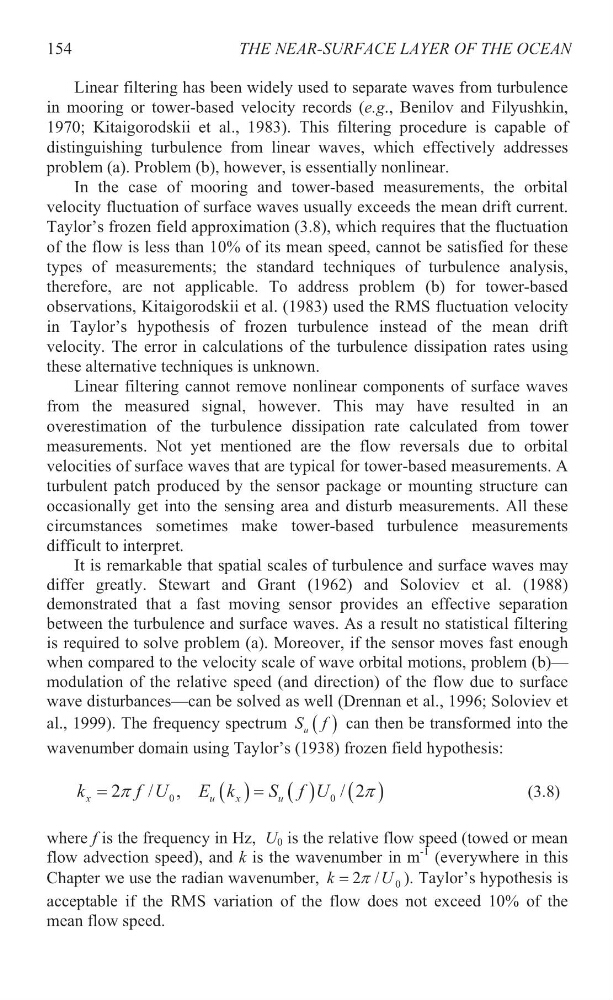
al., 1999). The frequency spectrum
u
S f can then be transformed into the
wavenumber domain using Taylor’s (1938) frozen field hypothesis:
0
0
2 / ,
/ 2
x
u
x
u
k
f U
E k
S f U
S
S
(3.8)
where f is the frequency in Hz, U 0 is the relative flow speed (towed or mean
flow advection speed), and k is the wavenumber in m
-1 (everywhere in this
Chapter we use the radian wavenumber,
0
/
2 U
k
S
). Taylor’s hypothesis is
acceptable if the RMS variation of the flow does not exceed 10% of the
mean flow speed.
154
Linear filtering has been widely used to separate waves from turbulence
in mooring or tower-based velocity records (e.g., Benilov and Filyushkin,
1970; Kitaigorodskii et al., 1983). This filtering procedure is capable of
distinguishing turbulence from linear waves, which effectively addresses
problem (a). Problem (b), however, is essentially nonlinear.
In the case of mooring and tower-based measurements, the orbital
velocity fluctuation of surface waves usually exceeds the mean drift current.
Taylor’s frozen field approximation (3.8), which requires that the fluctuation
of the flow is less than 10% of its mean speed, cannot be satisfied for these
types of measurements; the standard techniques of turbulence analysis,
therefore, are not applicable. To address problem (b) for tower-based
observations, Kitaigorodskii et al. (1983) used the RMS fluctuation velocity
in Taylor’s hypothesis of frozen turbulence instead of the mean drift
velocity. The error in calculations of the turbulence dissipation rates using
these alternative techniques is unknown.
Linear filtering cannot remove nonlinear components of surface waves
from the measured signal, however. This may have resulted in an
overestimation of the turbulence dissipation rate calculated from tower
measurements. Not yet mentioned are the flow reversals due to orbital
velocities of surface waves that are typical for tower-based measurements. A
turbulent patch produced by the sensor package or mounting structure can
occasionally get into the sensing area and disturb measurements. All these
circumstances sometimes make tower-based turbulence measurements
difficult to interpret.
It is remarkable that spatial scales of turbulence and surface waves may
differ greatly. Stewart and Grant (1962) and Soloviev et al. (1988)
demonstrated that a fast moving sensor provides an effective separation
between the turbulence and surface waves. As a result no statistical filtering
is required to solve problem (a). Moreover, if the sensor moves fast enough
when compared to the velocity scale of wave orbital motions, problem (b)—
modulation of the relative speed (and direction) of the flow due to surface
wave disturbances—can be solved as well (Drennan et al., 1996; Soloviev et
al., 1999). The frequency spectrum
u
S f can then be transformed into the
wavenumber domain using Taylor’s (1938) frozen field hypothesis:
0
0
2 / ,
/ 2
x
u
x
u
k
f U
E k
S f U
S
S
(3.8)
where f is the frequency in Hz, U 0 is the relative flow speed (towed or mean
flow advection speed), and k is the wavenumber in m
-1 (everywhere in this
Chapter we use the radian wavenumber,
0
/
2 U
k
S
). Taylor’s hypothesis is
acceptable if the RMS variation of the flow does not exceed 10% of the
mean flow speed.
154