

A Generalization of a Sigma Coordinate Ocean Model
~(q21) = ~[K a q2 1J
az q az
57
(6)
C'/( ) = ~ au (8)
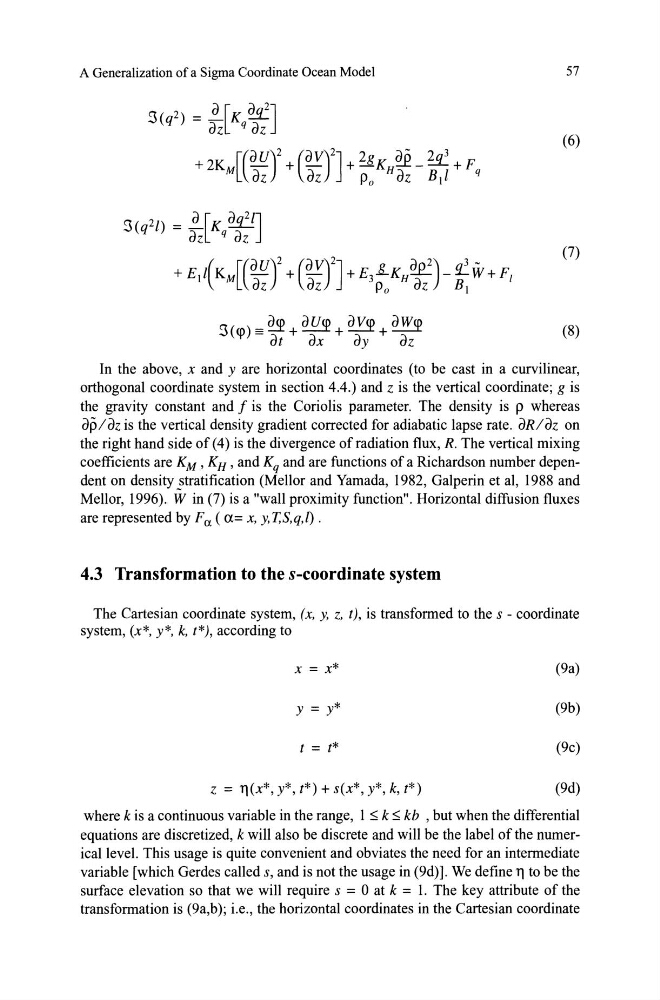
.., In the above, x and y are horizontal coordinates (to be cast in a curvilinear,
orthogonal coordinate system in section 4.4.) and z is the vertical coordinate; g is
the gravity constant and f is the Coriolis parameter. The density is p whereas
ap/az is the vertical density gradient corrected for adiabatic lapse rate. aR/az on
the right hand side of (4) is the divergence of radiation flux, R. The vertical mixing
coefficients are KM , K H ' and Kq and are functions of a Richardson number dependent on density ~tratification (Mellor and Yamada, 1982, Galperin et al, 1988 and
Mellor, 1996). W in (7) is a "wall proximity function". Horizontal diffusion fluxes
are represented by F fi. ( a= x, y,T,S,q,l) .
4.3 Transformation to the s-coordinate system
The Cartesian coordinate system, (x. y. z, t), is transformed to the s - coordinate
system, (x*, y*. k. t*), according to
x = x*
(9a)
y = y*
(9b)
t = t*
(9c)
z = TJ(x*, y*, t*) + s(x*, y*, k, t*)
(9d)
where k is a continuous variable in the range, 1 :5 k :5 kb , but when the differential
equations are discretized, k will also be discrete and will be the labeI of the numericallevel. This usage is quite convenient and obviates the need for an intermediate
variable [which Gerdes called s, and is not the usage in (9d)]. We de fine TJ to be the
surface elevation so that we will require s = O at k = 1. The key attribute of the
transformation is (9a,b); i.e., the horizontal coordinates in the Cartesian coordinate
~(q21) = ~[K a q2 1J
az q az
57
(6)
C'/( ) = ~ au (8)
.., In the above, x and y are horizontal coordinates (to be cast in a curvilinear,
orthogonal coordinate system in section 4.4.) and z is the vertical coordinate; g is
the gravity constant and f is the Coriolis parameter. The density is p whereas
ap/az is the vertical density gradient corrected for adiabatic lapse rate. aR/az on
the right hand side of (4) is the divergence of radiation flux, R. The vertical mixing
coefficients are KM , K H ' and Kq and are functions of a Richardson number dependent on density ~tratification (Mellor and Yamada, 1982, Galperin et al, 1988 and
Mellor, 1996). W in (7) is a "wall proximity function". Horizontal diffusion fluxes
are represented by F fi. ( a= x, y,T,S,q,l) .
4.3 Transformation to the s-coordinate system
The Cartesian coordinate system, (x. y. z, t), is transformed to the s - coordinate
system, (x*, y*. k. t*), according to
x = x*
(9a)
y = y*
(9b)
t = t*
(9c)
z = TJ(x*, y*, t*) + s(x*, y*, k, t*)
(9d)
where k is a continuous variable in the range, 1 :5 k :5 kb , but when the differential
equations are discretized, k will also be discrete and will be the labeI of the numericallevel. This usage is quite convenient and obviates the need for an intermediate
variable [which Gerdes called s, and is not the usage in (9d)]. We de fine TJ to be the
surface elevation so that we will require s = O at k = 1. The key attribute of the
transformation is (9a,b); i.e., the horizontal coordinates in the Cartesian coordinate