

56 George L. Mellor, Sirpa M. Hăkkinen, TaI Ezer and Richard C. Patchen
depth. In this paper we revise POM so that it is basically an s - coordinate system
(although the variable, s, is, for very good reason, different from that used by Gerdes) and the proportionality constraint is removed. However, unlike the Gerdes formulation, the derivation and implementation permit a free surface and the distance
between levels can change in time. Aiso the structure of the numerical algorithm is
designed to support a wide variety of vertical coordinate systems including a z -
level system. The present model generalization permits a z - level representation
everywhere in the model domain or locally in selected regions of the domain.
Song and Haidvogel (1994) have adopted many of the characteristics of POM
but have also generalized to an s - coordinate system. Our formulation and implementation strategy, as described below, differs from theirs and we include the z -
level option. Intercomparisons between different models have been the focus of
recent projects (DYNAMO 1997, Willems et al. 1994, Chassignet et al. 2000).
The intercomparisons of this paper isolate the effect of different vertical grids;
otherwise model physics and numerics are identical.
4.2 The Governing Equations
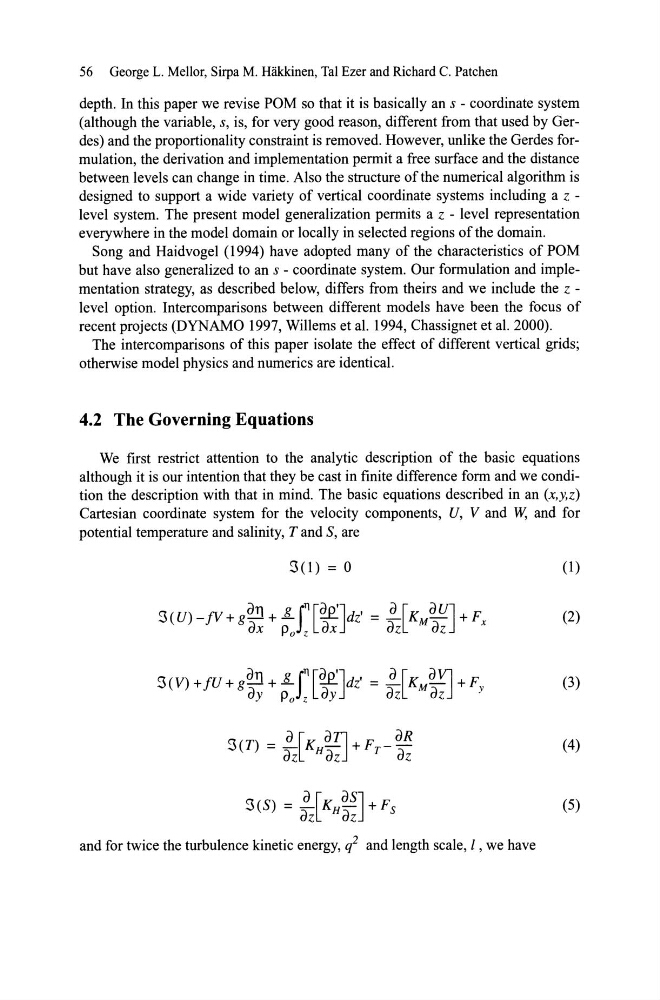
We first re strict attention to the analytic description of the basic equations
although it is our intention that they be cast in finite difference form and we condition the description with that in mind. The basic equations described in an (x,y,z)
Cartesian coordinate system for the velocity components, U, V and W, and for
potential temperature and salinity, T and S, are
3(1) = O
(1)
all g f' 1 [an']
a [ a~
3(U)-jV+g-+:::.r::.. dz' = - K M - +Fx
ax Pa z ax
az az
(2)
(3)
(4)
(5)
and for twice the turbulence kinetic energy, l and length scale, 1 , we have
depth. In this paper we revise POM so that it is basically an s - coordinate system
(although the variable, s, is, for very good reason, different from that used by Gerdes) and the proportionality constraint is removed. However, unlike the Gerdes formulation, the derivation and implementation permit a free surface and the distance
between levels can change in time. Aiso the structure of the numerical algorithm is
designed to support a wide variety of vertical coordinate systems including a z -
level system. The present model generalization permits a z - level representation
everywhere in the model domain or locally in selected regions of the domain.
Song and Haidvogel (1994) have adopted many of the characteristics of POM
but have also generalized to an s - coordinate system. Our formulation and implementation strategy, as described below, differs from theirs and we include the z -
level option. Intercomparisons between different models have been the focus of
recent projects (DYNAMO 1997, Willems et al. 1994, Chassignet et al. 2000).
The intercomparisons of this paper isolate the effect of different vertical grids;
otherwise model physics and numerics are identical.
4.2 The Governing Equations
We first re strict attention to the analytic description of the basic equations
although it is our intention that they be cast in finite difference form and we condition the description with that in mind. The basic equations described in an (x,y,z)
Cartesian coordinate system for the velocity components, U, V and W, and for
potential temperature and salinity, T and S, are
3(1) = O
(1)
all g f' 1 [an']
a [ a~
3(U)-jV+g-+:::.r::.. dz' = - K M - +Fx
ax Pa z ax
az az
(2)
(3)
(4)
(5)
and for twice the turbulence kinetic energy, l and length scale, 1 , we have