

58 George L. Mellor, Sirpa M. Hăkkinen, Tai Ezer and Richard C. Patchen
system are equated to the horizontal coordinates in the sigma system. Otherwise,
the transfonnation is fairly general and includes, for example, a Z - level system, S
= cr(k)(H max + l1(x,y,t» , and the sigma system, S = cr(k)(H(x,y) + l1(x,y,t»; H(x,y)
is the bathymetry and Hmax is its maximum value. In both cases, cr(1) = O and cr(kb)
= -1. In the case of the z - level system (really a quasi z - level system because s is a
function oftime, but it is a weak function oftime since, generally, 11IH «1), levels
near the botiom are masked to approximate the bathymetry and, thus, kb is a function ofthe horizontal coordinates. The distinguishing feature ofboth ofthese limiting cases is that k is functionally separated from x, y and t. In general they need not
be separable as we shall demonstrate.
There are two ways of deriving the s - coordinate equations. The first way is to
apply integral (control volume) equations to a volume element bounded by x* ,y* ,
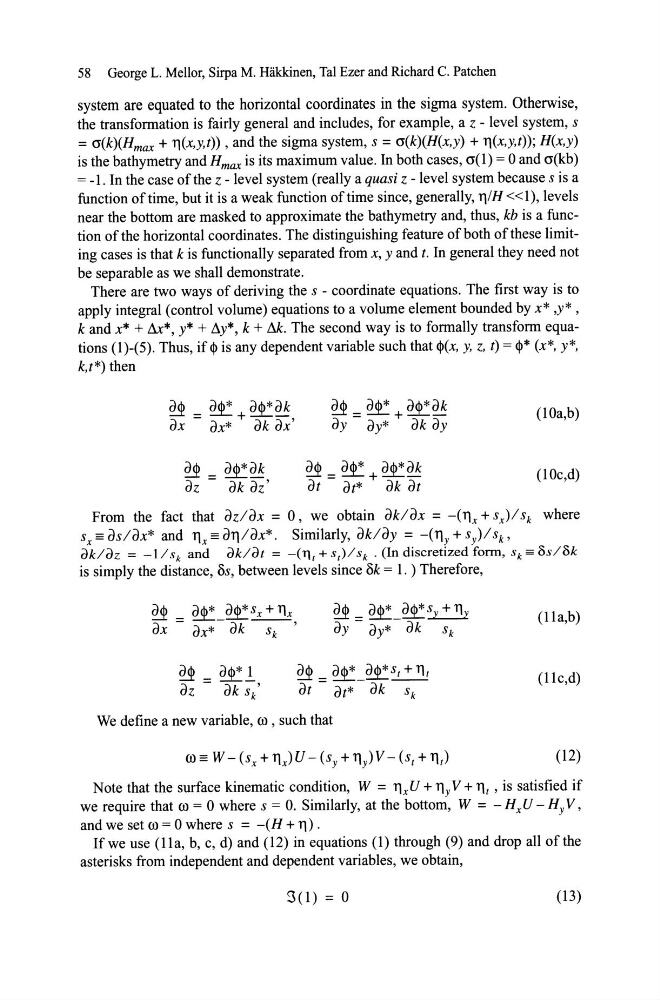
k and x* + &*, y* + ~y*, k + M. The second way is to fonnally transfonn equations (1)-(5). Thus, if <» is any dependent variable such that <»(x, y, Z, t) = <»* (x*, y*,
k,t*) then
~ _ ~ d<»*dk
+ - -
dX - dX*
dk dX'
d<» = ~dk
dZ
dk dZ'
~_~ d<»*dk
-
+ - -
dy dy*
dk dY
(10a,b)
~_~ ~dk
-
+
-
dt
dt*
dk dt
(10c,d)
From the fact that dZ/dX = O, we obtain dk/dX = -(l1 x + sJ/sk where
Sx == dS/dX* and 11x == d11/dx*. Similarly, dk/dy = -(l1 y + Sy)/ sk'
aklaz = -lIs k and aklat = -(11, + s,)/s k • (Indiscretizedfonn, sk=Ss/Sk
is simply the distance, os, between levels since ok = 1. ) Therefore,
(11a,b)
~ = ~.!.
dZ
dk s/
~ = ~_~St+11t
dt
dt* dk sk
(llc,d)
We define a new variable, (O , such that
(12)
Note that the surface kinematic condition, W = 11xU + 11 y V + 11 t , is satisfied if
we require that (O = O where S = O. Similarly, at the bottom, W = - HxU - Hy V,
and we set (O = O where s = -(H + 11) .
Ifwe use (lla, b, c, d) and (12) in equations (1) through (9) and drop all ofthe
asterisks from independent and dependent variables, we obtain,
5(1) = O
(13)
system are equated to the horizontal coordinates in the sigma system. Otherwise,
the transfonnation is fairly general and includes, for example, a Z - level system, S
= cr(k)(H max + l1(x,y,t» , and the sigma system, S = cr(k)(H(x,y) + l1(x,y,t»; H(x,y)
is the bathymetry and Hmax is its maximum value. In both cases, cr(1) = O and cr(kb)
= -1. In the case of the z - level system (really a quasi z - level system because s is a
function oftime, but it is a weak function oftime since, generally, 11IH «1), levels
near the botiom are masked to approximate the bathymetry and, thus, kb is a function ofthe horizontal coordinates. The distinguishing feature ofboth ofthese limiting cases is that k is functionally separated from x, y and t. In general they need not
be separable as we shall demonstrate.
There are two ways of deriving the s - coordinate equations. The first way is to
apply integral (control volume) equations to a volume element bounded by x* ,y* ,
k and x* + &*, y* + ~y*, k + M. The second way is to fonnally transfonn equations (1)-(5). Thus, if <» is any dependent variable such that <»(x, y, Z, t) = <»* (x*, y*,
k,t*) then
~ _ ~ d<»*dk
+ - -
dX - dX*
dk dX'
d<» = ~dk
dZ
dk dZ'
~_~ d<»*dk
-
+ - -
dy dy*
dk dY
(10a,b)
~_~ ~dk
-
+
-
dt
dt*
dk dt
(10c,d)
From the fact that dZ/dX = O, we obtain dk/dX = -(l1 x + sJ/sk where
Sx == dS/dX* and 11x == d11/dx*. Similarly, dk/dy = -(l1 y + Sy)/ sk'
aklaz = -lIs k and aklat = -(11, + s,)/s k • (Indiscretizedfonn, sk=Ss/Sk
is simply the distance, os, between levels since ok = 1. ) Therefore,
(11a,b)
~ = ~.!.
dZ
dk s/
~ = ~_~St+11t
dt
dt* dk sk
(llc,d)
We define a new variable, (O , such that
(12)
Note that the surface kinematic condition, W = 11xU + 11 y V + 11 t , is satisfied if
we require that (O = O where S = O. Similarly, at the bottom, W = - HxU - Hy V,
and we set (O = O where s = -(H + 11) .
Ifwe use (lla, b, c, d) and (12) in equations (1) through (9) and drop all ofthe
asterisks from independent and dependent variables, we obtain,
5(1) = O
(13)