

406 lohn Woods
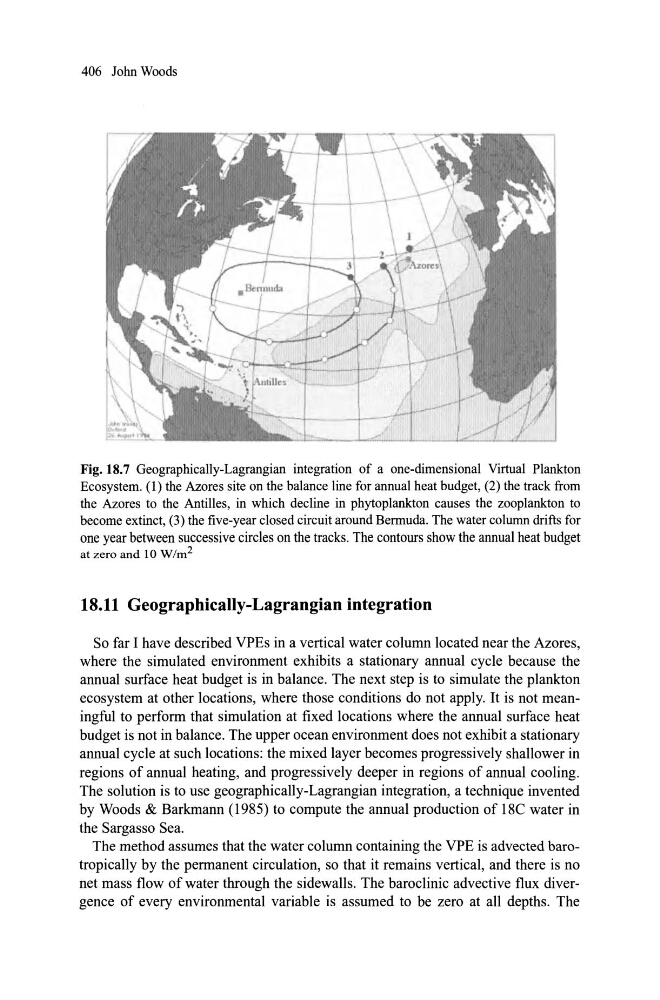
Fig. 18.7 Geographically-Lagrangian integration of a one-dimensional Virtual Plankton
Ecosystem. (1) the Azores site on the balance line for annual heat budget, (2) the track from
the Azores to the Antilles, in which decline in phytoplankton causes the zooplankton to
become extinct, (3) the five-year closed circuit around Bermuda. The water column drifts for
one year between successive circles on the tracks. The contours show the annual heat budget
at zero and 10 W/m 2
18.11 Geographically-Lagrangian integration
So far 1 have described VPEs in a vertical water column located near the Azores,
where the simulated environment exhibits a stationary annual cyc1e because the
annual surf ace heat budget is in balance. The next step is to simulate the plankton
ecosystem at other locations, where those conditions do not apply. It is not meaningful to perform that simulation at fixed locations where the annual surf ace heat
budget is not in balance. The upper ocean environment does not exhibit a stationary
annual cyc1e at such locations: the mixed layer becomes progressively shallower in
regions of annual heating, and progressively deeper in regions of annual cooling.
The solution is to use geographically-Lagrangian integration, a technique invented
by Woods & Barkmann (1985) to compute the annual production of l8C water in
the Sargasso Sea.
The method assumes that the water column containing the VPE is advected barotropically by the permanent circulation, so that it remains vertical, and there is no
net mass flow of water through the sidewalls. The baroc1inic advective flux divergence of every environmental variable is assumed to be zero at alI depths. The
Fig. 18.7 Geographically-Lagrangian integration of a one-dimensional Virtual Plankton
Ecosystem. (1) the Azores site on the balance line for annual heat budget, (2) the track from
the Azores to the Antilles, in which decline in phytoplankton causes the zooplankton to
become extinct, (3) the five-year closed circuit around Bermuda. The water column drifts for
one year between successive circles on the tracks. The contours show the annual heat budget
at zero and 10 W/m 2
18.11 Geographically-Lagrangian integration
So far 1 have described VPEs in a vertical water column located near the Azores,
where the simulated environment exhibits a stationary annual cyc1e because the
annual surf ace heat budget is in balance. The next step is to simulate the plankton
ecosystem at other locations, where those conditions do not apply. It is not meaningful to perform that simulation at fixed locations where the annual surf ace heat
budget is not in balance. The upper ocean environment does not exhibit a stationary
annual cyc1e at such locations: the mixed layer becomes progressively shallower in
regions of annual heating, and progressively deeper in regions of annual cooling.
The solution is to use geographically-Lagrangian integration, a technique invented
by Woods & Barkmann (1985) to compute the annual production of l8C water in
the Sargasso Sea.
The method assumes that the water column containing the VPE is advected barotropically by the permanent circulation, so that it remains vertical, and there is no
net mass flow of water through the sidewalls. The baroc1inic advective flux divergence of every environmental variable is assumed to be zero at alI depths. The