

Primitive Equation Modelling ofPlankton Ecosystems
405
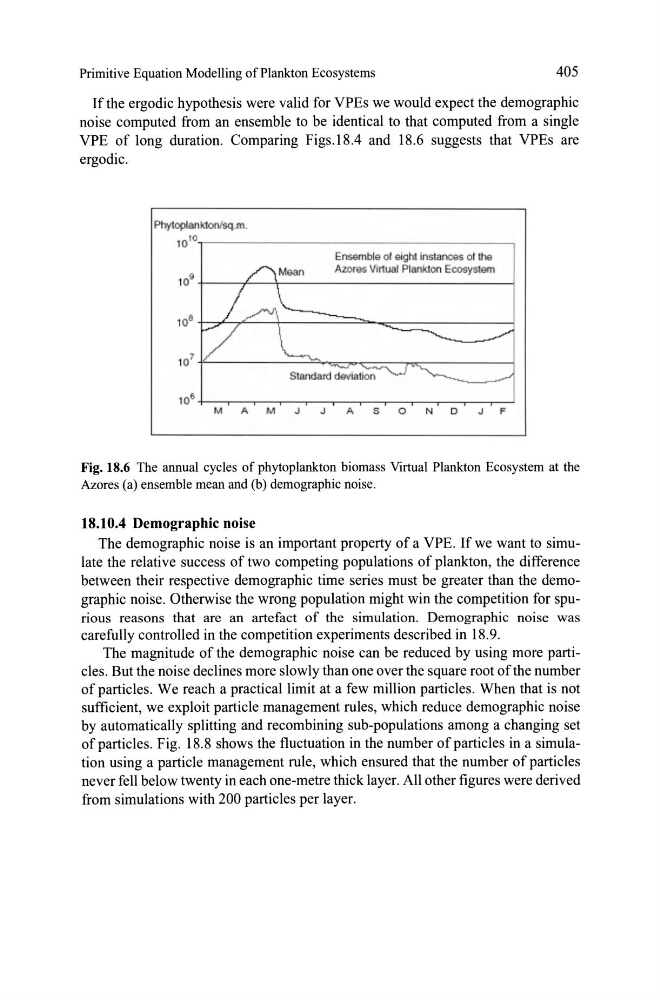
If the ergodic hypothesis were valid for VPEs we would expect the demographic
noise computed from an ensemble to be identical to that computed from a single
VPE of long duration. Comparing Figs.l8.4 and 18.6 suggests that VPEs are
ergodic.
Phoyloplan k1onlsq.m.
10.°,-- -- - - - - - - - - - ----------,
Ensemble oi elght Instanoes 01100
Azoras Vir1ua1 Planklon EOOSYSlOOl
1 09 +-_-,~~._-------------~
106 +-----,~-. __ .--.--r-.--.--r-r--.--r~
M A M J J A S O N D J F
Fig. 18.6 The annual cycles of phytoplankton biomass Virtual Plankton Ecosystem at the
Azores (a) ensemble mean and (b) demographic noise.
18.10.4 Demographic noise
The demographic noise is an important property of a VPE. If we want to simulate the relative success of two competing populations of plankton, the difference
between their respective demographic time series must be greater than the demographic noise. Otherwise the wrong population might win the competition for spurious reasons that are an artefact of the simulation. Demographic noise was
carefully controlled in the competition experiments described in 18.9.
The magnitude of the demographic noi se can be reduced by using more particles. But the noise declines more slowly than one over the square root ofthe number
of particles. We reach a practical limit at a few million particles. When that is not
sufficient, we exploit particle management rules, which reduce demographic noise
by automatically splitting and recombining sub-populations among a changing set
of particles. Fig. 18.8 shows the fluctuation in the number of particles in a simulation using a particle management rule, which ensured that the number of particles
never fell below twenty in each one-metre thick layer. All other figures were derived
from simulations with 200 particles per layer.
405
If the ergodic hypothesis were valid for VPEs we would expect the demographic
noise computed from an ensemble to be identical to that computed from a single
VPE of long duration. Comparing Figs.l8.4 and 18.6 suggests that VPEs are
ergodic.
Phoyloplan k1onlsq.m.
10.°,-- -- - - - - - - - - - ----------,
Ensemble oi elght Instanoes 01100
Azoras Vir1ua1 Planklon EOOSYSlOOl
1 09 +-_-,~~._-------------~
106 +-----,~-. __ .--.--r-.--.--r-r--.--r~
M A M J J A S O N D J F
Fig. 18.6 The annual cycles of phytoplankton biomass Virtual Plankton Ecosystem at the
Azores (a) ensemble mean and (b) demographic noise.
18.10.4 Demographic noise
The demographic noise is an important property of a VPE. If we want to simulate the relative success of two competing populations of plankton, the difference
between their respective demographic time series must be greater than the demographic noise. Otherwise the wrong population might win the competition for spurious reasons that are an artefact of the simulation. Demographic noise was
carefully controlled in the competition experiments described in 18.9.
The magnitude of the demographic noi se can be reduced by using more particles. But the noise declines more slowly than one over the square root ofthe number
of particles. We reach a practical limit at a few million particles. When that is not
sufficient, we exploit particle management rules, which reduce demographic noise
by automatically splitting and recombining sub-populations among a changing set
of particles. Fig. 18.8 shows the fluctuation in the number of particles in a simulation using a particle management rule, which ensured that the number of particles
never fell below twenty in each one-metre thick layer. All other figures were derived
from simulations with 200 particles per layer.