

Toward Marine Environmental Predictions in the Mediterranean Sea Coastal Areas
363
were empirically determined and explicit formulas are given in Rosati and Miyakoda (1988) and Castellari et al. (1998) for the large scale and ZavatareUi et al
(2001) for the coastal scale. The important concept is that T s and So are coming
from the model integration itself while aU the other meteorological parameters are
assigned from independent data. This surface flux formulation is called interactive
since the heat and salt fluxes depend upon the state ofthe ocean directly. Naturally
also the atmospheric parameters should in principle depend upon the surf ace oceanic state and this is in fact how the coupled atmosphere-ocean models work.
We remind that the correct water flux boundary condition should consider the
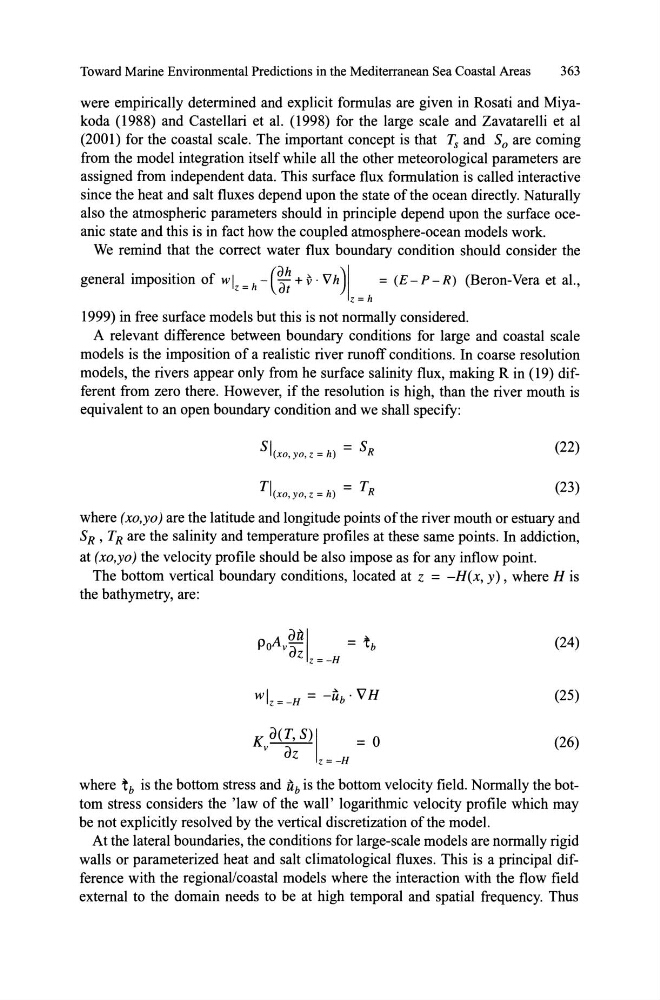
general imposition of WIZ=h-(~~+V'Vh)lz=h = (E-P-R) (Beron-Vera et al.,
1999) in free surface models but this is not normally considered.
A relevant difference between boundary conditions for large and coastal scale
models is the imposition of a realistic river runoff conditions. In coarse resolution
models, the rivers appear only from he surf ace salinity flux, making R in (19) different from zero there. However, if the resolution is high, than the river mouth is
equivalent to an open boundary condition and we shall specify:
SI(xo,yo,Z=h) = SR
(22)
TI(xo,yo,Z=h) = TR
(23)
where (xo,yo) are the latitude and longitude points ofthe river mouth or estuary and
SR' T R are the salinity and temperature profiles at these same points. In addiction,
at (xo,yo) the velocity profile should be also impose as for any inflow point.
The bottom vertical boundary conditions, located at z = -H(x, y), where H is
the bathymetry, are:
(24)
(25)
K (JCT, S)I = O
v
(Jz Z =-H
(26)
where 'tb is the bottom stress and Ub is the bottom velocity field. Normally the bottom stress considers the 'law of the wall' logarithmic velocity profile which may
be not explicitly resolved by the vertical discretization of the model.
At the lateral boundaries, the conditions for large-scale models are normally rigid
walls or parameterized heat and salt climatological fluxes. This is a principal difference with the regional/coastal models where the interaction with the flow field
external to the domain needs to be at high temporal and spatial frequency. Thus
363
were empirically determined and explicit formulas are given in Rosati and Miyakoda (1988) and Castellari et al. (1998) for the large scale and ZavatareUi et al
(2001) for the coastal scale. The important concept is that T s and So are coming
from the model integration itself while aU the other meteorological parameters are
assigned from independent data. This surface flux formulation is called interactive
since the heat and salt fluxes depend upon the state ofthe ocean directly. Naturally
also the atmospheric parameters should in principle depend upon the surf ace oceanic state and this is in fact how the coupled atmosphere-ocean models work.
We remind that the correct water flux boundary condition should consider the
general imposition of WIZ=h-(~~+V'Vh)lz=h = (E-P-R) (Beron-Vera et al.,
1999) in free surface models but this is not normally considered.
A relevant difference between boundary conditions for large and coastal scale
models is the imposition of a realistic river runoff conditions. In coarse resolution
models, the rivers appear only from he surf ace salinity flux, making R in (19) different from zero there. However, if the resolution is high, than the river mouth is
equivalent to an open boundary condition and we shall specify:
SI(xo,yo,Z=h) = SR
(22)
TI(xo,yo,Z=h) = TR
(23)
where (xo,yo) are the latitude and longitude points ofthe river mouth or estuary and
SR' T R are the salinity and temperature profiles at these same points. In addiction,
at (xo,yo) the velocity profile should be also impose as for any inflow point.
The bottom vertical boundary conditions, located at z = -H(x, y), where H is
the bathymetry, are:
(24)
(25)
K (JCT, S)I = O
v
(Jz Z =-H
(26)
where 'tb is the bottom stress and Ub is the bottom velocity field. Normally the bottom stress considers the 'law of the wall' logarithmic velocity profile which may
be not explicitly resolved by the vertical discretization of the model.
At the lateral boundaries, the conditions for large-scale models are normally rigid
walls or parameterized heat and salt climatological fluxes. This is a principal difference with the regional/coastal models where the interaction with the flow field
external to the domain needs to be at high temporal and spatial frequency. Thus