

362 Nadia Pinardi et al.
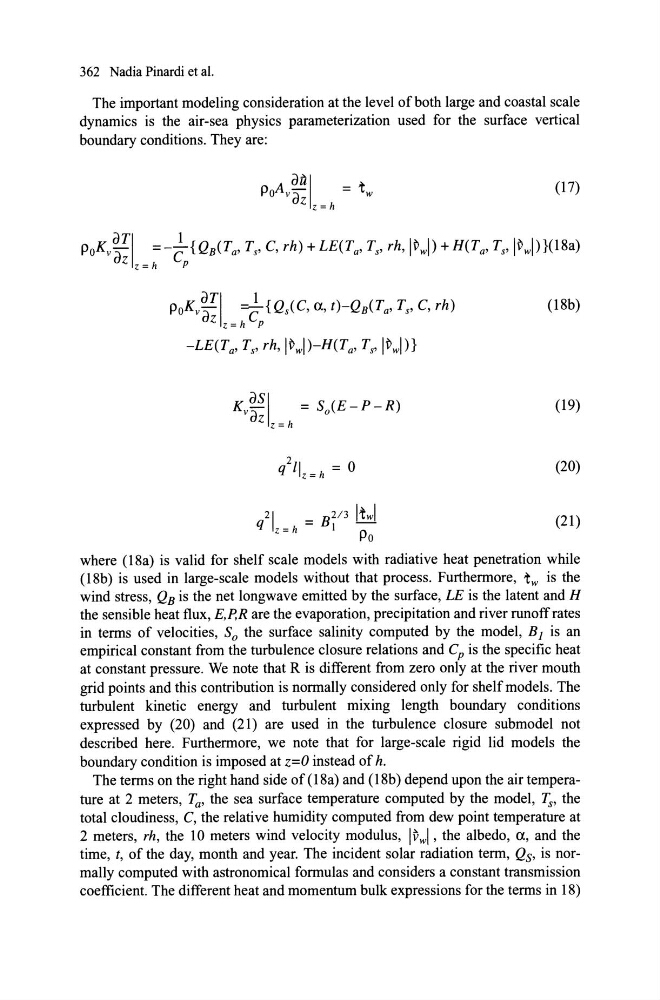
The important modeling consideration at the level ofboth large and coastal scale
dynamics is the air-sea physics parameterization used for the surf ace vertical
boundary conditions. They are:
(17)
(18b)
(19)
(20)
21
- B 2/3 I~wl
q z=h -
1
Pa
(21)
where (18a) is valid for shelf scale models with radiative heat penetration while
(18b) is used in large-scale models without that process. Furthermore, tw is the
wind stress, QB is the net longwave emitted by the surface, LE is the latent and H
the sensible heat flux, E,p,R are the evaporation, precipitation and river runoff rates
in terms of velocities, So the surf ace salinity computed by the model, BI is an
empirical constant from the turbulence closure relations and C p is the specific heat
at constant pressure. We note that R is different from zero only at the river mouth
grid points and this contribution is normally considered only for shelf models. The
turbulent kinetic energy and turbulent mixing length boundary conditions
expressed by (20) and (21) are used in the turbulence closure submodel not
described here. Furthermore, we note that for large-scale rigid lid models the
boundary condition is imposed at z=O instead of h.
The terms on the right hand side of (18a) and (18b) depend upon the air temperature at 2 meters, Ta' the sea surface temperature computed by the model, T s ' the
total cloudiness, C, the relative humidity computed from dew point temperature at
2 meters, rh, the 10 meters wind velocity modulus, Ivwl, the albedo, a, and the
time, t, of the day, month and year. The incident solar radiation term, Qs, is normally computed with astronomical formulas and considers a constant transmis sion
coefficient. The different heat and momentum bulk expressions for the terms in 18)
The important modeling consideration at the level ofboth large and coastal scale
dynamics is the air-sea physics parameterization used for the surf ace vertical
boundary conditions. They are:
(17)
(18b)
(19)
(20)
21
- B 2/3 I~wl
q z=h -
1
Pa
(21)
where (18a) is valid for shelf scale models with radiative heat penetration while
(18b) is used in large-scale models without that process. Furthermore, tw is the
wind stress, QB is the net longwave emitted by the surface, LE is the latent and H
the sensible heat flux, E,p,R are the evaporation, precipitation and river runoff rates
in terms of velocities, So the surf ace salinity computed by the model, BI is an
empirical constant from the turbulence closure relations and C p is the specific heat
at constant pressure. We note that R is different from zero only at the river mouth
grid points and this contribution is normally considered only for shelf models. The
turbulent kinetic energy and turbulent mixing length boundary conditions
expressed by (20) and (21) are used in the turbulence closure submodel not
described here. Furthermore, we note that for large-scale rigid lid models the
boundary condition is imposed at z=O instead of h.
The terms on the right hand side of (18a) and (18b) depend upon the air temperature at 2 meters, Ta' the sea surface temperature computed by the model, T s ' the
total cloudiness, C, the relative humidity computed from dew point temperature at
2 meters, rh, the 10 meters wind velocity modulus, Ivwl, the albedo, a, and the
time, t, of the day, month and year. The incident solar radiation term, Qs, is normally computed with astronomical formulas and considers a constant transmis sion
coefficient. The different heat and momentum bulk expressions for the terms in 18)