

Toward Marine Environmenta1 Predictions in the Mediterranean Sea Coasta1 Areas
361
where now simply ti· V == u.E... + v a a + w a a and C p is the specificnheat ofthe sea
ax y z
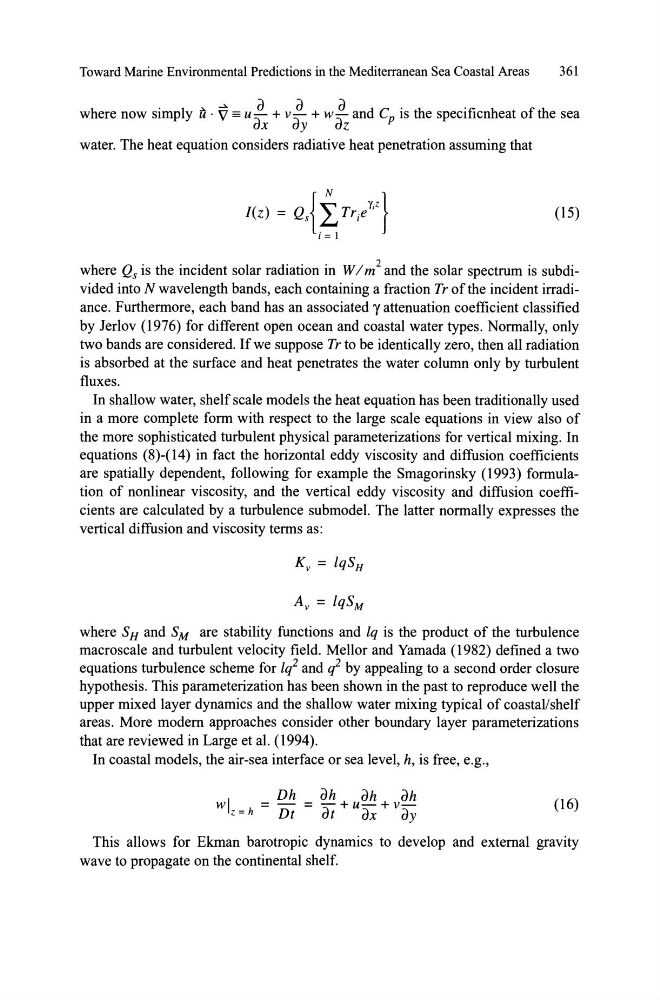
water. The heat equation considers radiative heat penetration assuming that
f(z) = Qs{ITr;eY;Z}
1 = 1
(15)
where Qs is the incident solar radiation in W / m 2 and the solar spectrum is subdivided into N wavelength bands, each containing a fraction Tr of the incident irradiance. Furthermore, each band has an associated ' Y attenuation coefficient classified
by Jerlov (1976) for different open ocean and coastal water types. Normally, only
two bands are considered. If we suppose Tr to be identically zero, then all radiation
is absorbed at the surface and heat penetrates the water column only by turbulent
fluxes.
In shallow water, shelf scale models the heat equation has been traditionally used
in a more complete form with respect to the large scale equations in view also of
the more sophisticated turbulent physical parameterizations for vertical mixing. In
equations (8)-(14) in fact the horizontal eddy viscosity and diffusion coefficients
are spatially dependent, following for example the Smagorinsky (1993) formulation of nonlinear viscosity, and the vertical eddy viscosity and diffusion coefficients are calculated by a turbulence submodel. The latter normally expresses the
vertical diffusion and viscosity terms as:
where SH and SM are stability functions and lq is the product of the turbulence
macroscale and turbulent velocity field. Mellor and Yamada (1982) defined a two
equations turbulence scheme for lq2 and I by appealing to a second order closure
hypothesis. This parameterization has been shown in the past to reproduce well the
upper mixed layer dynamics and the shallow water mixing typical of coastal/shelf
areas. More modem approaches consider other boundary layer parameterizations
that are reviewed in Large et al. (1994).
In coastal models, the air-sea interface or sea level, h, is free, e.g.,
Dh
ah ah ah
wlz=h = Dt = at +u ax +v ay
(16)
This allows for Ekman barotropic dynamics to develop and external gravity
wave to propagate on the continental shelf.
361
where now simply ti· V == u.E... + v a a + w a a and C p is the specificnheat ofthe sea
ax y z
water. The heat equation considers radiative heat penetration assuming that
f(z) = Qs{ITr;eY;Z}
1 = 1
(15)
where Qs is the incident solar radiation in W / m 2 and the solar spectrum is subdivided into N wavelength bands, each containing a fraction Tr of the incident irradiance. Furthermore, each band has an associated ' Y attenuation coefficient classified
by Jerlov (1976) for different open ocean and coastal water types. Normally, only
two bands are considered. If we suppose Tr to be identically zero, then all radiation
is absorbed at the surface and heat penetrates the water column only by turbulent
fluxes.
In shallow water, shelf scale models the heat equation has been traditionally used
in a more complete form with respect to the large scale equations in view also of
the more sophisticated turbulent physical parameterizations for vertical mixing. In
equations (8)-(14) in fact the horizontal eddy viscosity and diffusion coefficients
are spatially dependent, following for example the Smagorinsky (1993) formulation of nonlinear viscosity, and the vertical eddy viscosity and diffusion coefficients are calculated by a turbulence submodel. The latter normally expresses the
vertical diffusion and viscosity terms as:
where SH and SM are stability functions and lq is the product of the turbulence
macroscale and turbulent velocity field. Mellor and Yamada (1982) defined a two
equations turbulence scheme for lq2 and I by appealing to a second order closure
hypothesis. This parameterization has been shown in the past to reproduce well the
upper mixed layer dynamics and the shallow water mixing typical of coastal/shelf
areas. More modem approaches consider other boundary layer parameterizations
that are reviewed in Large et al. (1994).
In coastal models, the air-sea interface or sea level, h, is free, e.g.,
Dh
ah ah ah
wlz=h = Dt = at +u ax +v ay
(16)
This allows for Ekman barotropic dynamics to develop and external gravity
wave to propagate on the continental shelf.