

360 Nadia Pinardi et al.
1) The expect ratio, O = f where L is the horizontallength scale, is small so that
r
terms with w drop out from the velocity equations (Pedlosky, 1979).
2) The horizontal eddy viscosity and diffusivity are scale selective, e.g., biharmonic, and coefficients should be kept small depending on the numerical resolution to allow for along isopycnal transport of water masses.
3) Vertical eddy viscosity and diffusion coefficients are constant but a parameterization of convective adjustment is provided. This assumption is empirical,
however for intermediate and deep water convection events it is found (H.
Buchard, personal communication) that this parameterization gives similar
results to turbulence submodels such as Mellor-Yamada schemes (Mellor and
Yamada, 1982).
Another large-scale modeling assumption is that the model is rigid lid, e.g. w=O,
thus inhibiting external gravity waves effects on the general circulation. This
implies that the free surf ace is a diagnostic quantity (Pinardi et al., 1995) and that
sea surface slope is determined indirectIy by the general circulation forcing.
The coastal scale models normally do not use spherical coordinates since they
apply to limited areas of the ocean basins, these regions being normally nested
within large-scale models. Thus coastal coordinates are rectangular with
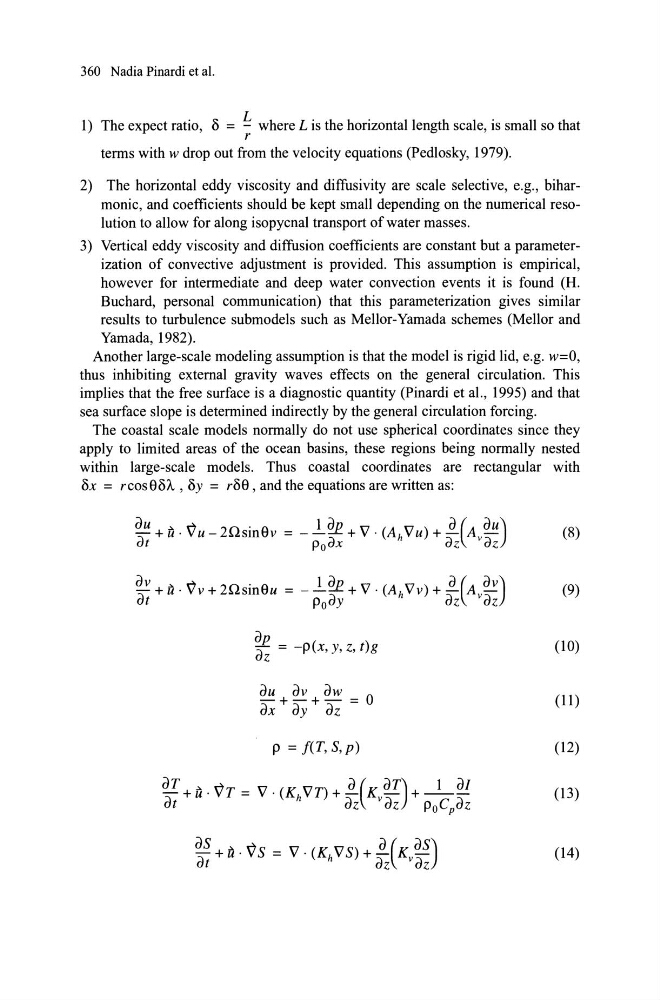
Ox = rcosSOÂ., Oy = rOS, and the equations are written as:
av + ii. Vv + 2QsinSu = _.l~ + V . (Ah Vv) + ~(Av av)
at
poay
az az
ap az = -p(x, y, z, t)g
p = f(T, S,p)
aT n
a (aT) 1 al
- + ti . v T = V . (K h vn + - K - + - -
at
az vaz pocpaz
(8)
(9)
(10)
(11)
(12)
(13)
(14)
1) The expect ratio, O = f where L is the horizontallength scale, is small so that
r
terms with w drop out from the velocity equations (Pedlosky, 1979).
2) The horizontal eddy viscosity and diffusivity are scale selective, e.g., biharmonic, and coefficients should be kept small depending on the numerical resolution to allow for along isopycnal transport of water masses.
3) Vertical eddy viscosity and diffusion coefficients are constant but a parameterization of convective adjustment is provided. This assumption is empirical,
however for intermediate and deep water convection events it is found (H.
Buchard, personal communication) that this parameterization gives similar
results to turbulence submodels such as Mellor-Yamada schemes (Mellor and
Yamada, 1982).
Another large-scale modeling assumption is that the model is rigid lid, e.g. w=O,
thus inhibiting external gravity waves effects on the general circulation. This
implies that the free surf ace is a diagnostic quantity (Pinardi et al., 1995) and that
sea surface slope is determined indirectIy by the general circulation forcing.
The coastal scale models normally do not use spherical coordinates since they
apply to limited areas of the ocean basins, these regions being normally nested
within large-scale models. Thus coastal coordinates are rectangular with
Ox = rcosSOÂ., Oy = rOS, and the equations are written as:
av + ii. Vv + 2QsinSu = _.l~ + V . (Ah Vv) + ~(Av av)
at
poay
az az
ap az = -p(x, y, z, t)g
p = f(T, S,p)
aT n
a (aT) 1 al
- + ti . v T = V . (K h vn + - K - + - -
at
az vaz pocpaz
(8)
(9)
(10)
(11)
(12)
(13)
(14)