

Toward Marine Environrnental Predictions in the Mediterranean Sea Coastal Areas
359
model is the Princeton Ocean Model (POM, Blumberg and Mellor, 1983) which is
free surface and uses finite difference both in vertical and horizontal but with a vertical coordinate transformation, which will be discussed later. Outstanding differences between the two models are: the consideration of metric terms in the basic
equations to account for earth's spherical geometry, the assumption of free and
rigid lid air-sea interface, the usage oftidal forcing. We will describe in detail both
modeling systems outlining the similarities and differences.
The basic model formulation use the hydrostatic, incompressible and Boussinesq
approximation to the Navier-Stokes equations written in a rotating frame. Thermodynamics state variables are temperature, T, and salinity, S, and the first law ofthermodynamics is written neglecting compressible effects. The equation of state for
seawater density, p, is normally a polynomial approximation in T, S and pressure, p,
to the complete equation of state (Fofonoff and Millero, 1993).
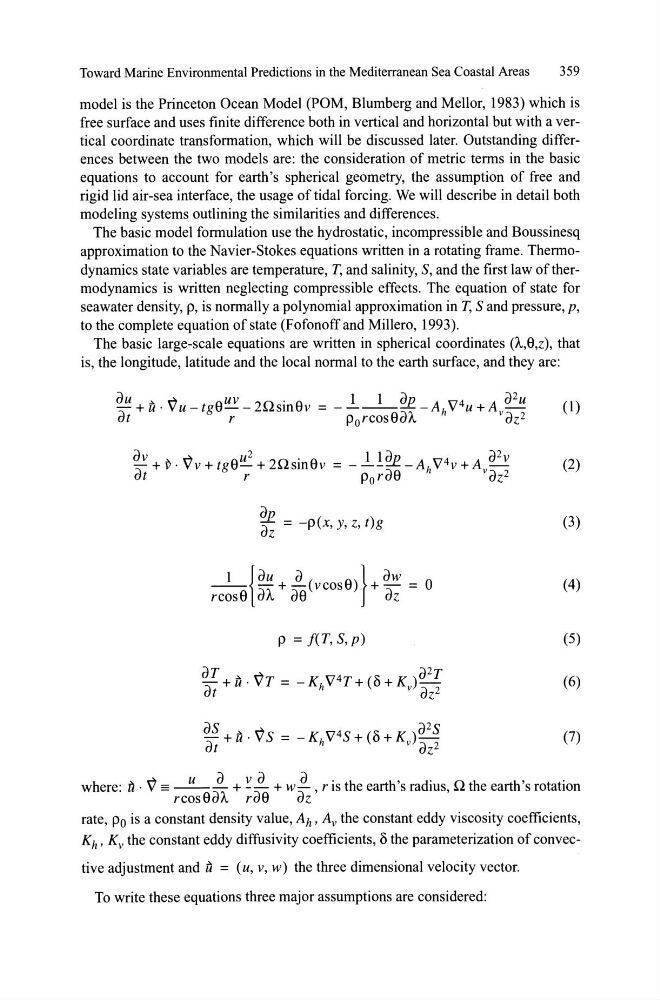
The basic large-scale equations are written in spherical coordinates (A,8,z), that
is, the longitude, latitude and the local normal to the earth surface, and they are:
Op
oz = -p(x, y, Z, t)g
_1_{OU + l.(VCOS8)} + ow = O
rcosS OA as
az
p=f(T,S,p)
oS - ' " M
02S
-=;-+U· vS = -K h V 4 S+(8+K v ) -
ot
OZ2
(1)
(2)
(3)
(4)
(5)
(6)
(7)
where: ti· V == _u_~~ + ~aO + W a O ,r is the earth's radius, Q the earth's rotation
rcosSoll. r 8
z
rate, Po is a constant density value, Ah ' Av the constant eddy viscosity coefficients,
Kh' Kv the constant eddy diffusivity coefficients, 8 the parameterization of convective adjustment and ti = (u, v, w) the three dimensional velocity vector.
To write these equations three major assumptions are considered:
359
model is the Princeton Ocean Model (POM, Blumberg and Mellor, 1983) which is
free surface and uses finite difference both in vertical and horizontal but with a vertical coordinate transformation, which will be discussed later. Outstanding differences between the two models are: the consideration of metric terms in the basic
equations to account for earth's spherical geometry, the assumption of free and
rigid lid air-sea interface, the usage oftidal forcing. We will describe in detail both
modeling systems outlining the similarities and differences.
The basic model formulation use the hydrostatic, incompressible and Boussinesq
approximation to the Navier-Stokes equations written in a rotating frame. Thermodynamics state variables are temperature, T, and salinity, S, and the first law ofthermodynamics is written neglecting compressible effects. The equation of state for
seawater density, p, is normally a polynomial approximation in T, S and pressure, p,
to the complete equation of state (Fofonoff and Millero, 1993).
The basic large-scale equations are written in spherical coordinates (A,8,z), that
is, the longitude, latitude and the local normal to the earth surface, and they are:
Op
oz = -p(x, y, Z, t)g
_1_{OU + l.(VCOS8)} + ow = O
rcosS OA as
az
p=f(T,S,p)
oS - ' " M
02S
-=;-+U· vS = -K h V 4 S+(8+K v ) -
ot
OZ2
(1)
(2)
(3)
(4)
(5)
(6)
(7)
where: ti· V == _u_~~ + ~aO + W a O ,r is the earth's radius, Q the earth's rotation
rcosSoll. r 8
z
rate, Po is a constant density value, Ah ' Av the constant eddy viscosity coefficients,
Kh' Kv the constant eddy diffusivity coefficients, 8 the parameterization of convective adjustment and ti = (u, v, w) the three dimensional velocity vector.
To write these equations three major assumptions are considered: