

A Multivariate Reduced-order Optimal Interpolation Method and its Application
287
domains of validity. Examples of vertical simplification approaches in oceanic
estimation problems, and discussions on those issues, are given in Gavart and De
Mey (1997), Faucher et al. (2000), and Cooper and Haines (1996). We will also
see later that vertical simplification helps make the assimilation "local" in space,
which leads to a better fit to data and straightforward efficient solution on massively parallel computers.
The question of whether purely vertical order reduction would work in areas
such as the Tropics, where the coherent variability and response of the ocean is
non-local, still has to be explored. Other yet unc1ear domains of application are the
coastal areas, shelf se as and upper ocean. In those contexts, a hybrid 3-D/l-D
approach could be envisaged. However the vertical order reduction has been found
useful in the Mediterranean. It is applied in the next sections of this chapter.
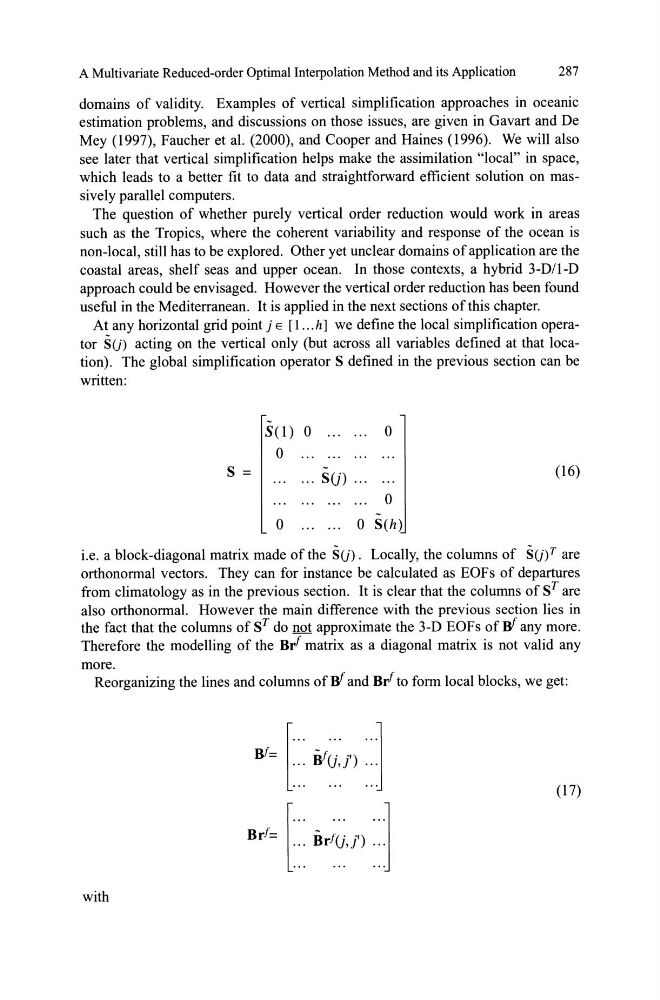
At any horizontal grid point j E [1 ... h 1 we de fine the local simplification operator SU) acting on the vertical only (but across all variables defined at that location). The global simplification operator S defined in the previous section can be
written:
S(1) O
O
O
S
-
(16)
SU)
O
-
O
O S(h)
i.e. a block-diagonal matrix made of the SU). Locally, the columns of SU)T are
orthonormal vectors. They can for instance be calculated as EOFs of departures
from c1imatology as in the previous section. It is c1ear that the columns of ST are
also orthonormal. However the main difference with the previous section lies in
the fact that the columns of ST do not approximate the 3-D EOFs of W any more.
Therefore the modelling of the Brf matrix as a diagonal matri x is not valid any
more.
Reorganizing the lines and columns of Wand Br f to form local blocks, we get:
w= [ WU,j') j
(17)
Br f = [ BrlU,il J
with
287
domains of validity. Examples of vertical simplification approaches in oceanic
estimation problems, and discussions on those issues, are given in Gavart and De
Mey (1997), Faucher et al. (2000), and Cooper and Haines (1996). We will also
see later that vertical simplification helps make the assimilation "local" in space,
which leads to a better fit to data and straightforward efficient solution on massively parallel computers.
The question of whether purely vertical order reduction would work in areas
such as the Tropics, where the coherent variability and response of the ocean is
non-local, still has to be explored. Other yet unc1ear domains of application are the
coastal areas, shelf se as and upper ocean. In those contexts, a hybrid 3-D/l-D
approach could be envisaged. However the vertical order reduction has been found
useful in the Mediterranean. It is applied in the next sections of this chapter.
At any horizontal grid point j E [1 ... h 1 we de fine the local simplification operator SU) acting on the vertical only (but across all variables defined at that location). The global simplification operator S defined in the previous section can be
written:
S(1) O
O
O
S
-
(16)
SU)
O
-
O
O S(h)
i.e. a block-diagonal matrix made of the SU). Locally, the columns of SU)T are
orthonormal vectors. They can for instance be calculated as EOFs of departures
from c1imatology as in the previous section. It is c1ear that the columns of ST are
also orthonormal. However the main difference with the previous section lies in
the fact that the columns of ST do not approximate the 3-D EOFs of W any more.
Therefore the modelling of the Brf matrix as a diagonal matri x is not valid any
more.
Reorganizing the lines and columns of Wand Br f to form local blocks, we get:
w= [ WU,j') j
(17)
Br f = [ BrlU,il J
with