

Forecasting Wind-driven Ocean Waves
271
F(l/f) = f F(2)(j, e)de.
(5)
The shape of the spectrum provides the basic mathematical and physical characterisation of the sea state. One may now wonder what determines this spectral
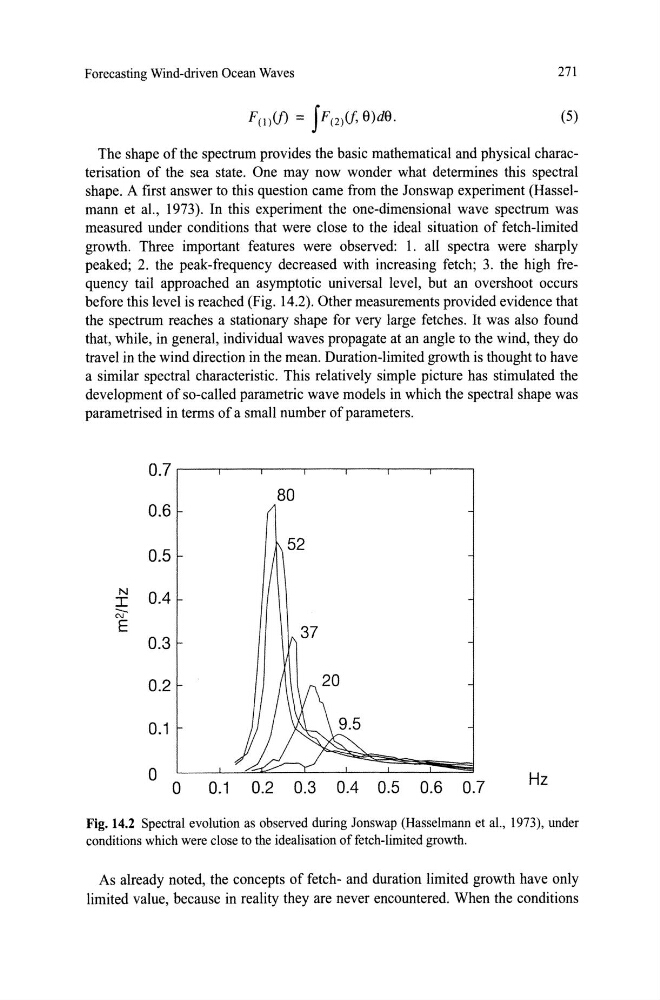
shape. A tirst answer to this question carne from the Jonswap experiment (Hasselmann et al., 1973). In this experiment the one-dimensional wave spectrum was
measured under conditions that were close to the ideal situation of fetch-limited
growth. Three important features were observed: 1. all spectra were sharply
peaked; 2. the peak-frequency decreased with increasing fetch; 3. the high frequency taii approached an asymptotic universal Ievel, but an overshoot occurs
before this Ievel is reached (Fig. 14.2). Other measurements provided evidence that
the spectrum reaches a stationary shape for very large fetches. It was also found
that, while, in general, individual waves propagate at an angle to the wind, they do
travel in the wind direction in the mean. Duration-limited growth is thought to have
a similar spectral characteristic. This relatively simple picture has stimulated the
development of so-called parametric wave models in which the spectral shape was
parametrised in terms of a small number of parameters.
0.7
80
0.6
0.5
N
004
I
NE 0.3
37
0.2
0.1
o
o 0.1 0.2 0.3 0.4 0.5 0.6 0.7
Hz
Fig. 14.2 Spectral evolution as observed during Jonswap (Hasselmann et al., 1973), under
conditions which were close to the idealisation offetch-limited growth.
As already noted, the concepts of fetch- and duration limited growth have only
limited value, because in reality they are never encountered. When the conditions
271
F(l/f) = f F(2)(j, e)de.
(5)
The shape of the spectrum provides the basic mathematical and physical characterisation of the sea state. One may now wonder what determines this spectral
shape. A tirst answer to this question carne from the Jonswap experiment (Hasselmann et al., 1973). In this experiment the one-dimensional wave spectrum was
measured under conditions that were close to the ideal situation of fetch-limited
growth. Three important features were observed: 1. all spectra were sharply
peaked; 2. the peak-frequency decreased with increasing fetch; 3. the high frequency taii approached an asymptotic universal Ievel, but an overshoot occurs
before this Ievel is reached (Fig. 14.2). Other measurements provided evidence that
the spectrum reaches a stationary shape for very large fetches. It was also found
that, while, in general, individual waves propagate at an angle to the wind, they do
travel in the wind direction in the mean. Duration-limited growth is thought to have
a similar spectral characteristic. This relatively simple picture has stimulated the
development of so-called parametric wave models in which the spectral shape was
parametrised in terms of a small number of parameters.
0.7
80
0.6
0.5
N
004
I
NE 0.3
37
0.2
0.1
o
o 0.1 0.2 0.3 0.4 0.5 0.6 0.7
Hz
Fig. 14.2 Spectral evolution as observed during Jonswap (Hasselmann et al., 1973), under
conditions which were close to the idealisation offetch-limited growth.
As already noted, the concepts of fetch- and duration limited growth have only
limited value, because in reality they are never encountered. When the conditions