

270 Gerbrand 1. Komen
Another problem arises from the choice ofwind speed parameter. Scaling with u
is disputable, because there is another quantity with the dimension of ve1ocity,
which is probably more relevant for wave growth, namely the friction ve10city u •.
This parameter is defined as the square root of the (kinematic) surface stress. It can
be measured, although not easily. One has found that the drag coefficient C D'
defined by
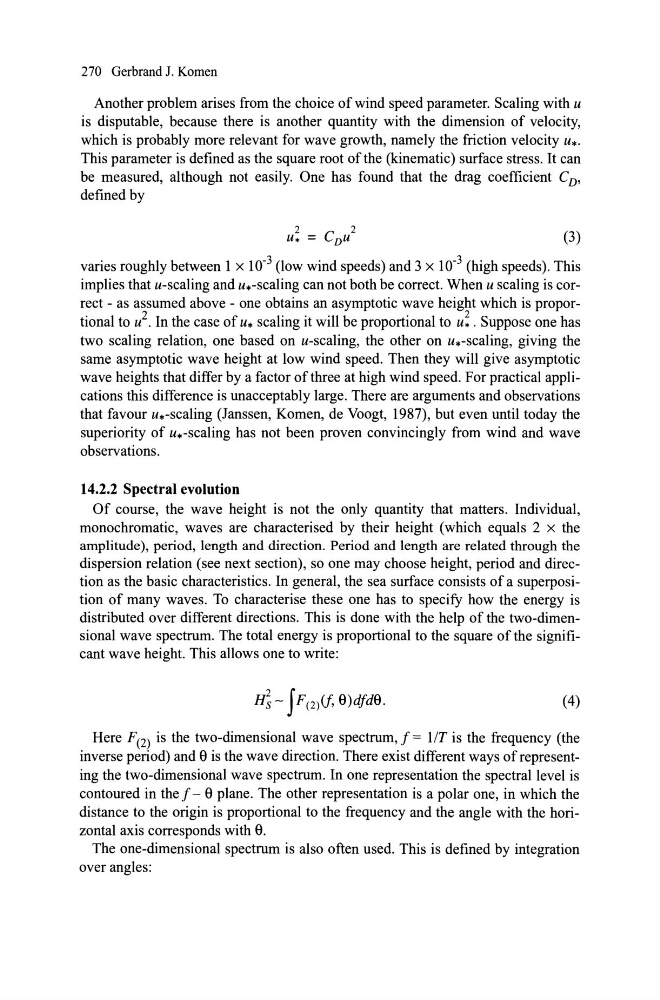
(3)
varies roughly between 1 x 10- 3 (low wind speeds) and 3 x 10- 3 (high speeds). This
implies that u-scaling and u*-scaling can not both be correct. When u scaling is correct - as assumed above - one obtains an asymptotic wave height which is proportional to i. In the case of u. scaling it will be proportional to u; . Suppose one has
two scaling relation, one based on u-scaling, the other on u.-scaling, giving the
same asymptotic wave height at low wind speed. Then they will give asymptotic
wave heights that differ by a factor ofthree at high wind speed. For practic al applications this difference is unacceptably large. There are arguments and observations
that favour u.-scaling (Janssen, Komen, de Voogt, 1987), but even until today the
superiority of u*-scaling has not been proven convincingly from wind and wave
observations.
14.2.2 Spectral evolution
Of course, the wave height is not the only quantity that matters. Individual,
monochromatic, waves are characterised by their height (which equals 2 x the
amplitude), period, length and direction. Period and length are related through the
dispersion relation (see next section), so one may choose height, period and direction as the basic characteristics. In general, the sea surface consists of a superposition of many waves. To characterise these one has to specify how the energy is
distributed over different directions. This is done with the help of the two-dimensional wave spectrum. The total energy is proportional to the square of the significant wave height. This allows one to write:
(4)
Here F(2) is the two-dimensional wave spectrum, f = l/T is the frequency (the
inverse period) and e is the wave direction. There exist different ways ofrepresenting the two-dimensional wave spectrum. In one representation the spectrallevel is
contoured in the f - e plane. The other representation is a polar one, in which the
distance to the origin is proportional to the frequency and the angle with the horizontal axis corresponds with e.
The one-dimensional spectrum is also often used. This is defined by integration
over angles:
Another problem arises from the choice ofwind speed parameter. Scaling with u
is disputable, because there is another quantity with the dimension of ve1ocity,
which is probably more relevant for wave growth, namely the friction ve10city u •.
This parameter is defined as the square root of the (kinematic) surface stress. It can
be measured, although not easily. One has found that the drag coefficient C D'
defined by
(3)
varies roughly between 1 x 10- 3 (low wind speeds) and 3 x 10- 3 (high speeds). This
implies that u-scaling and u*-scaling can not both be correct. When u scaling is correct - as assumed above - one obtains an asymptotic wave height which is proportional to i. In the case of u. scaling it will be proportional to u; . Suppose one has
two scaling relation, one based on u-scaling, the other on u.-scaling, giving the
same asymptotic wave height at low wind speed. Then they will give asymptotic
wave heights that differ by a factor ofthree at high wind speed. For practic al applications this difference is unacceptably large. There are arguments and observations
that favour u.-scaling (Janssen, Komen, de Voogt, 1987), but even until today the
superiority of u*-scaling has not been proven convincingly from wind and wave
observations.
14.2.2 Spectral evolution
Of course, the wave height is not the only quantity that matters. Individual,
monochromatic, waves are characterised by their height (which equals 2 x the
amplitude), period, length and direction. Period and length are related through the
dispersion relation (see next section), so one may choose height, period and direction as the basic characteristics. In general, the sea surface consists of a superposition of many waves. To characterise these one has to specify how the energy is
distributed over different directions. This is done with the help of the two-dimensional wave spectrum. The total energy is proportional to the square of the significant wave height. This allows one to write:
(4)
Here F(2) is the two-dimensional wave spectrum, f = l/T is the frequency (the
inverse period) and e is the wave direction. There exist different ways ofrepresenting the two-dimensional wave spectrum. In one representation the spectrallevel is
contoured in the f - e plane. The other representation is a polar one, in which the
distance to the origin is proportional to the frequency and the angle with the horizontal axis corresponds with e.
The one-dimensional spectrum is also often used. This is defined by integration
over angles: