

Forecasting Wind-driven Ocean Waves
269
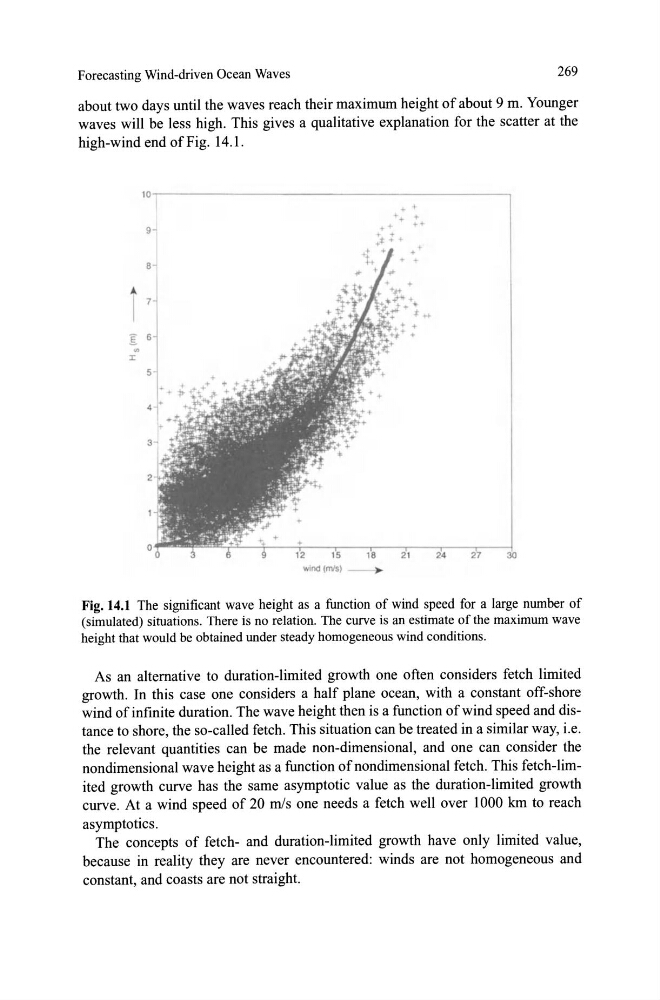
about two days until the waves reach their maximum height of about 9 m. Younger
waves will be less high. This gives a qualitative explanation for the scatter at the
high-wind end of Fig. 14.1.
g ol
f 6
.,
J:
5
4
Fig. 14.1 The significant wave height as a function of wind speed for a Iarge number of
(simulated) situations. There is no relation. The curve is an estimate ofthe maximum wave
height that would be obtained under steady homogeneous wind conditions.
As an alternative to duration-limited growth one of ten considers fetch limited
growth. In this case one considers a half plane ocean, with a constant off-shore
wind of infinite duration. The wave height then is a function ofwind speed and distance to shore, the so-called fetch. This situation can be treated in a similar way, i.e.
the relevant quantities can be made non-dimensional, and one can consider the
nondimensional wave height as a function ofnondimensional fetch. This fetch-limited growth curve has the same asymptotic value as the duration-limited growth
curve. At a wind speed of 20 m1s one needs a fetch well over 1000 km to reach
asymptotics.
The concepts of fetch- and duration-limited growth have only limited value,
because in reality they are never encountered: winds are not homogeneous and
constant, and coasts are not straight.
269
about two days until the waves reach their maximum height of about 9 m. Younger
waves will be less high. This gives a qualitative explanation for the scatter at the
high-wind end of Fig. 14.1.
g ol
f 6
.,
J:
5
4
Fig. 14.1 The significant wave height as a function of wind speed for a Iarge number of
(simulated) situations. There is no relation. The curve is an estimate ofthe maximum wave
height that would be obtained under steady homogeneous wind conditions.
As an alternative to duration-limited growth one of ten considers fetch limited
growth. In this case one considers a half plane ocean, with a constant off-shore
wind of infinite duration. The wave height then is a function ofwind speed and distance to shore, the so-called fetch. This situation can be treated in a similar way, i.e.
the relevant quantities can be made non-dimensional, and one can consider the
nondimensional wave height as a function ofnondimensional fetch. This fetch-limited growth curve has the same asymptotic value as the duration-limited growth
curve. At a wind speed of 20 m1s one needs a fetch well over 1000 km to reach
asymptotics.
The concepts of fetch- and duration-limited growth have only limited value,
because in reality they are never encountered: winds are not homogeneous and
constant, and coasts are not straight.