

250 David Prandle
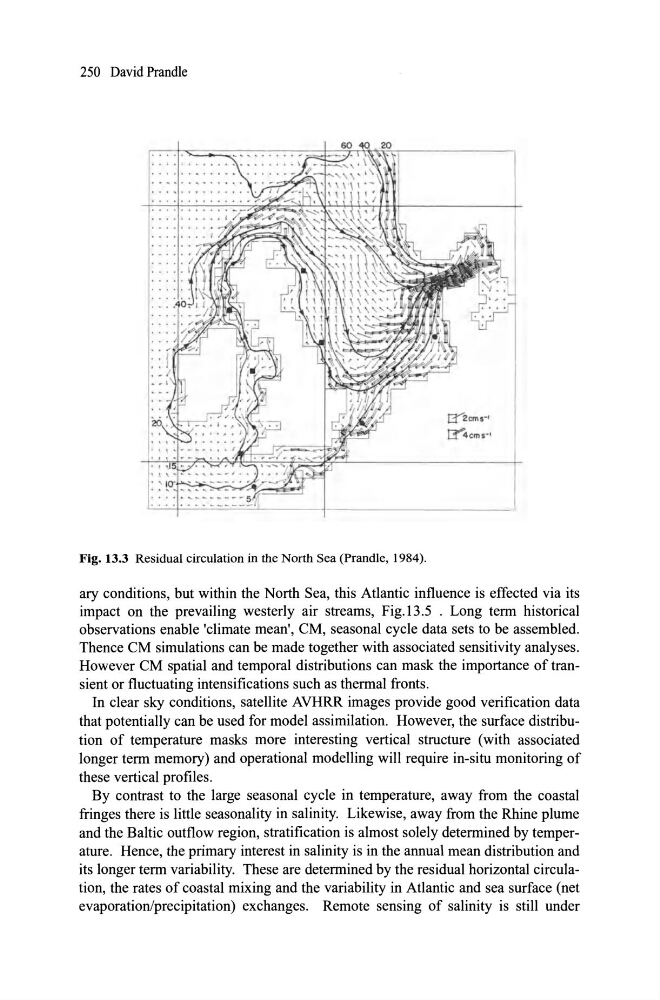
Fig. 13.3 Residual circulation in the North Sea (Prandle, 1984).
ary conditions, but within the North Sea, this Atlantic influence is effected via its
impact on the prevailing westerly air streams, Fig.13.5 . Long term historical
observations enable 'climate mean', CM, seasonal cyc1e data sets to be assembled.
Thence CM simulations can be made together with associated sensitivity analyses.
However CM spatial and temporal distributions can mask the importance of transient or fluctuating intensifications such as thermal fronts.
In clear sky conditions, satellite AVHRR images provide good verification data
that potentially can be used for model assimilation. However, the surface distribution of temperature masks more interesting vertical structure (with associated
longer term memory) and operational modelling will require in-situ monitoring of
these vertical profiles.
By contrast to the large seasonal cycle in temperature, away from the coastal
fringes there is little seasonality in salinity. Likewise, away from the Rhine plume
and the Baltic outflow region, stratification is almost solely determined by temperature. Hence, the primary interest in salinity is in the annual mean distribution and
its longer term variability. These are determined by the residual horizontal circulation, the rates of coastal mixing and the variability in Atlantic and sea surface (net
evaporation/precipitation) exchanges. Remote sens ing of salinity is still under
Fig. 13.3 Residual circulation in the North Sea (Prandle, 1984).
ary conditions, but within the North Sea, this Atlantic influence is effected via its
impact on the prevailing westerly air streams, Fig.13.5 . Long term historical
observations enable 'climate mean', CM, seasonal cyc1e data sets to be assembled.
Thence CM simulations can be made together with associated sensitivity analyses.
However CM spatial and temporal distributions can mask the importance of transient or fluctuating intensifications such as thermal fronts.
In clear sky conditions, satellite AVHRR images provide good verification data
that potentially can be used for model assimilation. However, the surface distribution of temperature masks more interesting vertical structure (with associated
longer term memory) and operational modelling will require in-situ monitoring of
these vertical profiles.
By contrast to the large seasonal cycle in temperature, away from the coastal
fringes there is little seasonality in salinity. Likewise, away from the Rhine plume
and the Baltic outflow region, stratification is almost solely determined by temperature. Hence, the primary interest in salinity is in the annual mean distribution and
its longer term variability. These are determined by the residual horizontal circulation, the rates of coastal mixing and the variability in Atlantic and sea surface (net
evaporation/precipitation) exchanges. Remote sens ing of salinity is still under