

Predictions in the North Sea
249
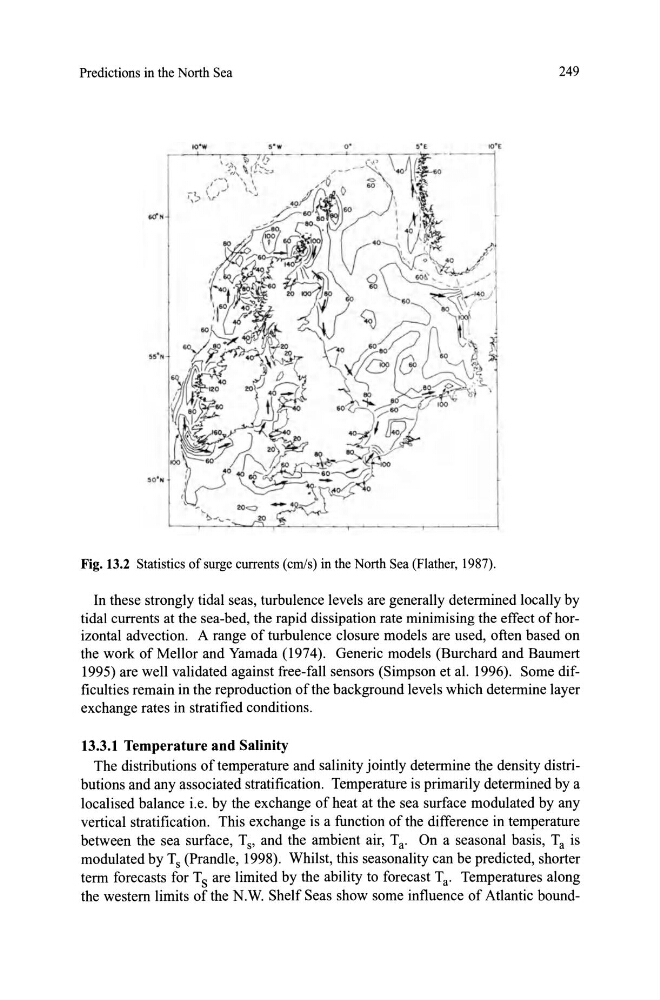
Fig. 13.2 Statistics ofsurge currents (cmls) in the North Sea (Flather, 1987).
In these strongly tidal seas, turbulence levels are generally determined locally by
tidal currents at the sea-bed, the rapid dissipation rate minimising the effect of horizontal advection. A range of turbulence c10sure models are used, often based on
the work of Mellor and Yamada (1974). Generic models (Burchard and Baumert
1995) are well validated against free-fall sensors (Simpson et al. 1996). Some difficulties remain in the reproduction ofthe background levels which determine layer
exchange rates in stratified conditions.
13.3.1 Temperature aRd Salinity
The distributions of temperature and salinity jointly determine the density distributions and any associated stratification. Temperature is primarily determined by a
locali sed balance i.e. by the exchange of heat at the sea surf ace modulated by any
vertical stratification. This exchange is a function of the difference in temperature
between the sea surface, T 8 , and the ambient air, Ta' On a seasonal basis, Ta is
modulated by T 8 (Prandle, 1998). Whilst, this seasonality can be predicted, shorter
term forecasts for T s are limited by the ability to forecast Ta' Temperatures along
the westem limits of the N.W. Shelf Seas show some influence of Atlantic bound-
249
Fig. 13.2 Statistics ofsurge currents (cmls) in the North Sea (Flather, 1987).
In these strongly tidal seas, turbulence levels are generally determined locally by
tidal currents at the sea-bed, the rapid dissipation rate minimising the effect of horizontal advection. A range of turbulence c10sure models are used, often based on
the work of Mellor and Yamada (1974). Generic models (Burchard and Baumert
1995) are well validated against free-fall sensors (Simpson et al. 1996). Some difficulties remain in the reproduction ofthe background levels which determine layer
exchange rates in stratified conditions.
13.3.1 Temperature aRd Salinity
The distributions of temperature and salinity jointly determine the density distributions and any associated stratification. Temperature is primarily determined by a
locali sed balance i.e. by the exchange of heat at the sea surf ace modulated by any
vertical stratification. This exchange is a function of the difference in temperature
between the sea surface, T 8 , and the ambient air, Ta' On a seasonal basis, Ta is
modulated by T 8 (Prandle, 1998). Whilst, this seasonality can be predicted, shorter
term forecasts for T s are limited by the ability to forecast Ta' Temperatures along
the westem limits of the N.W. Shelf Seas show some influence of Atlantic bound-