

248 David Prandle
60"N
5s"N
56"N
500N ~~---.----.---~----,----.----,----.~
0°
4°E
S"E
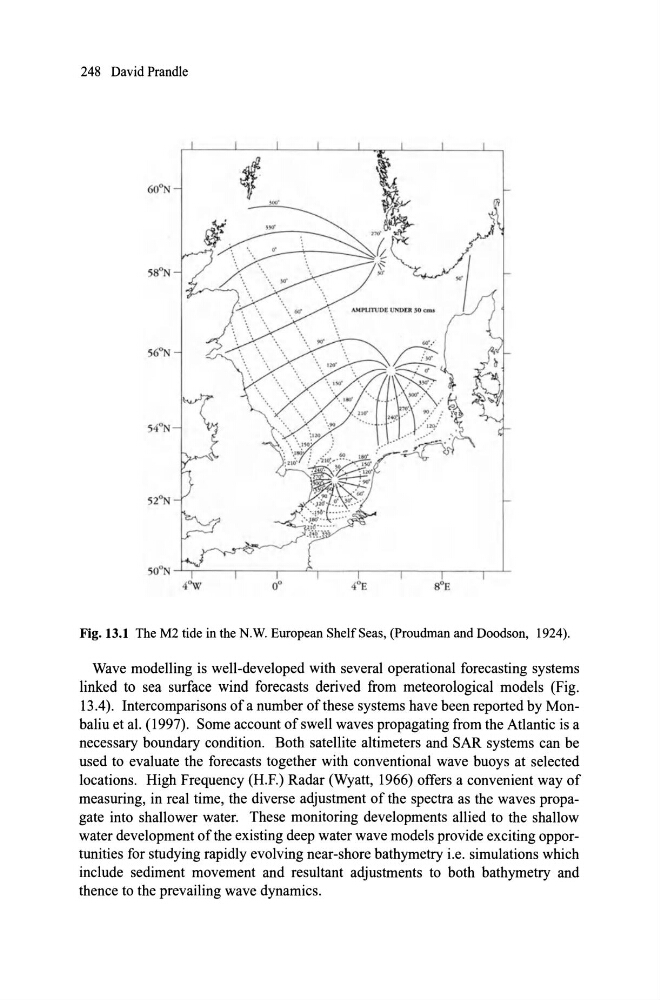
Fig. 13.1 The M2 tîde in the N.W. European She1fSeas, (Proudman and Doodson, 1924).
Wave modeiling is welI-developed with several operational forecasting systems
linked to sea surf ace wind forecasts derived from meteorological models (Fig.
13.4). Intercomparisons of a number ofthese systems have been reported by Monbaliu et aL (1997). Some account of sweil waves propagating from the Atlantic is a
necessary boundary condition. Both satellite altimeters and SAR systems can be
used to evaluate the forecasts together with conventional wave buoys at selected
locations. High Frequency (H.P.) Radar (Wyatt, 1966) offers a convenient way of
measuring, in real time, the diverse adjustment of the spectra as the waves propagate into shallower water. These monitoring developments alI ied to the shallow
water development ofthe existing deep water wave models provide exciting opportunities for studying rapidly evolving near-shore bathymetry i.e. simulations which
include sediment movement and resultant adjustments to both bathymetry and
thence to the prevailing wave dynamics.
60"N
5s"N
56"N
500N ~~---.----.---~----,----.----,----.~
0°
4°E
S"E
Fig. 13.1 The M2 tîde in the N.W. European She1fSeas, (Proudman and Doodson, 1924).
Wave modeiling is welI-developed with several operational forecasting systems
linked to sea surf ace wind forecasts derived from meteorological models (Fig.
13.4). Intercomparisons of a number ofthese systems have been reported by Monbaliu et aL (1997). Some account of sweil waves propagating from the Atlantic is a
necessary boundary condition. Both satellite altimeters and SAR systems can be
used to evaluate the forecasts together with conventional wave buoys at selected
locations. High Frequency (H.P.) Radar (Wyatt, 1966) offers a convenient way of
measuring, in real time, the diverse adjustment of the spectra as the waves propagate into shallower water. These monitoring developments alI ied to the shallow
water development ofthe existing deep water wave models provide exciting opportunities for studying rapidly evolving near-shore bathymetry i.e. simulations which
include sediment movement and resultant adjustments to both bathymetry and
thence to the prevailing wave dynamics.