

an North Atlantic Intedecadal Variability: A Stochastic View
157
Spectra computed from atmospheric and oceanic observations taken at ocean
weather ship '1' (60.8°N, 20.6°W) support the stochastic climate model idea (e g.
Frankignoul and Hasselmann (1977), Hall and Manabe (1997)). This is visualized
by Fig. 9.6 which shows spectra of anomalous SST and sea surface salinity (SSS)
taken at weather ship '1'. By and large the two spectra are consistent with the stochastic climate model, and a perfect red noise spectrum is not an unreasonable fit
over the entire frequency range.
We expect according to the stochastic climate model that the spectrum of the
SST anomalies flatens at a higher frequency relative to that of the SSS anomalies.
The damping for SSS anomalies is considerably weaker than that for SST anomalies, which is due to the fact that the anomalous fresh water flux does not depend
directly on the SSS anomalies, while the anomalous surf ace heat flux does usually
depend critically on the SST and tends to damp its anomalies (a counter example,
however, will be shown in section 9.3). A spectral analysis from the North Pacific
(Hall and Manabe (1997)), for instance, confirms this. Since the decay time scales
for SST and SSS anomalies in the North Atlantic are not different (Fig. 9.6) and the
variations in SST and SSS coherent beyond frequencies of about 1 yr- 1 (Hall and
Manabe (1997), not shown), one may conclude that non-local processes are also
important in generating low-frequency variability in the North Atlantic. Such processes may be associated with changes in the large-scale ocean circulation and
resultant changes in the advection of heat and salt, as described below.
In contrast to the spectra shown in Fig. 9.5 which result from the simplest version
of the stochastic climate model, some spectra computed from observations in the
North Atlantic region show also peaks (e.g. Deser and Blackmon (1993)). These
peaks can be also explained by the stochastic climate model concept (e.g. Mikolajewicz and Maier-Reimer (1990)), and resonant interactions between the ocean and
the atmosphere play a key role. The ocean or the coupled ocean-atmosphere system
may support damped eigenoscillations that are excited by the noise (i.e. stochastic
forcing) in the system (like a swing in the wind). A good prototype for such a scenario, according to which damped oscillations are excited by the stochastic forcing
inherent to the system, is the stochastically forced harmonic oscillator
y"(t) + Ay'(t) + ffi~y(t) = 1;(t)
(3)
Here ffiO is the eigenfrequency, and the meaning ofthe other symbols is as in (1).
The oceanic response G( ffi) is given by
2
2
22
22
G(ffi) = cr /[(ffi - ffio) + ffi A ]
(4)
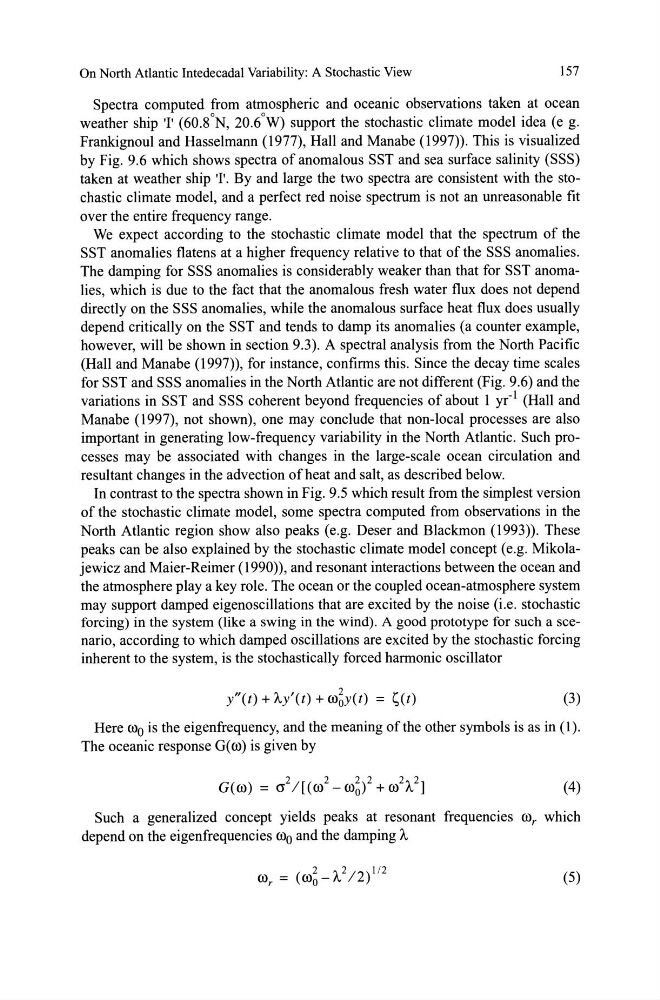
Such a generalized concept yields peaks at resonant frequencies ffi r which
depend on the eigenfrequencies ffiO and the damping A
(5)
157
Spectra computed from atmospheric and oceanic observations taken at ocean
weather ship '1' (60.8°N, 20.6°W) support the stochastic climate model idea (e g.
Frankignoul and Hasselmann (1977), Hall and Manabe (1997)). This is visualized
by Fig. 9.6 which shows spectra of anomalous SST and sea surface salinity (SSS)
taken at weather ship '1'. By and large the two spectra are consistent with the stochastic climate model, and a perfect red noise spectrum is not an unreasonable fit
over the entire frequency range.
We expect according to the stochastic climate model that the spectrum of the
SST anomalies flatens at a higher frequency relative to that of the SSS anomalies.
The damping for SSS anomalies is considerably weaker than that for SST anomalies, which is due to the fact that the anomalous fresh water flux does not depend
directly on the SSS anomalies, while the anomalous surf ace heat flux does usually
depend critically on the SST and tends to damp its anomalies (a counter example,
however, will be shown in section 9.3). A spectral analysis from the North Pacific
(Hall and Manabe (1997)), for instance, confirms this. Since the decay time scales
for SST and SSS anomalies in the North Atlantic are not different (Fig. 9.6) and the
variations in SST and SSS coherent beyond frequencies of about 1 yr- 1 (Hall and
Manabe (1997), not shown), one may conclude that non-local processes are also
important in generating low-frequency variability in the North Atlantic. Such processes may be associated with changes in the large-scale ocean circulation and
resultant changes in the advection of heat and salt, as described below.
In contrast to the spectra shown in Fig. 9.5 which result from the simplest version
of the stochastic climate model, some spectra computed from observations in the
North Atlantic region show also peaks (e.g. Deser and Blackmon (1993)). These
peaks can be also explained by the stochastic climate model concept (e.g. Mikolajewicz and Maier-Reimer (1990)), and resonant interactions between the ocean and
the atmosphere play a key role. The ocean or the coupled ocean-atmosphere system
may support damped eigenoscillations that are excited by the noise (i.e. stochastic
forcing) in the system (like a swing in the wind). A good prototype for such a scenario, according to which damped oscillations are excited by the stochastic forcing
inherent to the system, is the stochastically forced harmonic oscillator
y"(t) + Ay'(t) + ffi~y(t) = 1;(t)
(3)
Here ffiO is the eigenfrequency, and the meaning ofthe other symbols is as in (1).
The oceanic response G( ffi) is given by
2
2
22
22
G(ffi) = cr /[(ffi - ffio) + ffi A ]
(4)
Such a generalized concept yields peaks at resonant frequencies ffi r which
depend on the eigenfrequencies ffiO and the damping A
(5)