

Ensembles, Forecasts and Predictability
137
The classic paradigm is elegantly illustrated in the book by Pedlosky (1979) and
some ofthe landmark papers are collected in the Chamey volume (Lindzen, 1990).
The baroclinic instability theory became the instrument of choice to investigate
and understand the dynamics of the extratropical cyclones. The theory was
expanded to the spherical geometry both for the primitive equations case and the
quasigeostrophic case (Simmons and Hoskins, 1976) using numeric al techniques.
A comprehensive review of the development of the theory is avaiIable (Hoskins,
1990).
In the late 80's, sufficient data were becoming available for detailed analysis of
atmospheric variability at a global scale. Using both numeric al simulations (Lau
and Holopainen, 1984) and observations (Blackmon, 1976, 1977) the atmospheric
variability was investigated in detail from time scales of a few days to the seasonal
scale. The basic components of the classical paradigm however failed to emerge
from the extensive diagnostic studies conducted at that time, In particular, the signature ofthe structure ofthe normal modes was nowhere to be found in real observations or in model simulations.
8.4 Finite time instabilities
At the end of 80s a series of studies (Lacarra and Talagrand, 1988; Farrell, 1985,
1989, 1990) indicated that the normal mode analysis suffered from severe problems when it was applied to the understanding of a real turbulent flow. The most
important finding was that finite time transient growth can be present even if the
flow is asymptotically stable, namely that there are no growing normal modes. This
intriguing result is linked to the deep structure of the operators that can be obtained
from the linearization ofthe equation ofmotion. Unless a very special basic state is
chosen, e.g. a solid rotation, the operators will have no particular structure.
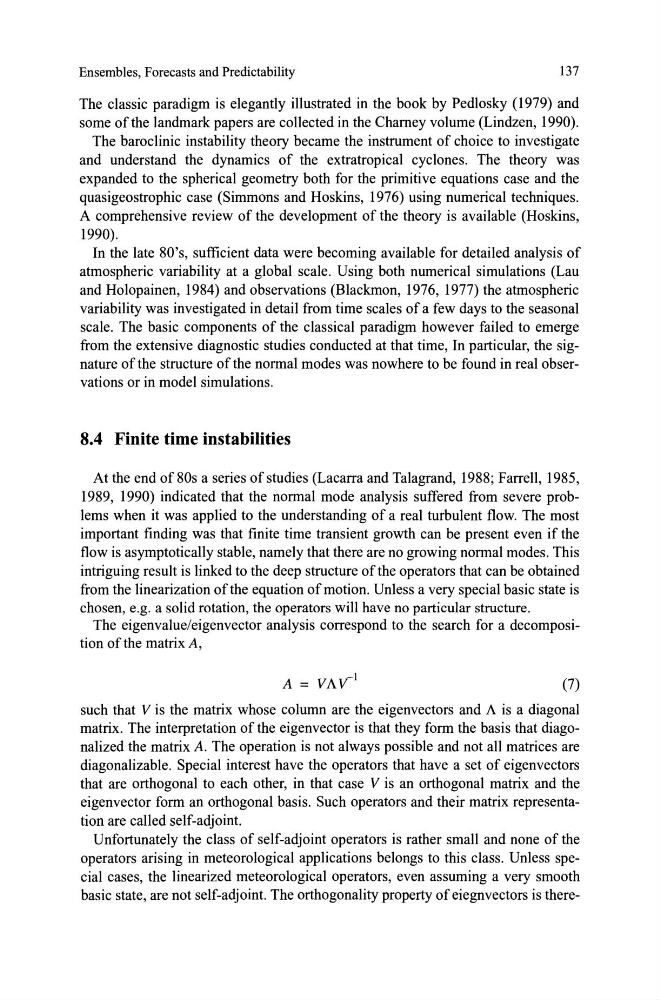
The eigenvalue/eigenvector analysis correspond to the search for a decomposition of the matrix A,
(7)
such that V is the matrix whose column are the eigenvectors and A is a diagonal
matrix. The interpretation of the eigenvector is that they form the basis that diagonalized the matrix A. The operation is not always possible and not ali matrices are
diagonalizable. Special interest have the operators that have a set of eigenvectors
that are orthogonal to each other, in that case V is an orthogonal matrix and the
eigenvector form an orthogonal basis. Such operators and their matrix representation are called self-adjoint.
Unfortunately the class of self-adjoint operators is rather small and none of the
operators arising in meteorologic al applications belongs to this class. Unless special cases, the linearized meteorologic al operators, even assuming a very smooth
basic state, are not self-adjoint. The orthogonality property of eiegnvectors is there-
137
The classic paradigm is elegantly illustrated in the book by Pedlosky (1979) and
some ofthe landmark papers are collected in the Chamey volume (Lindzen, 1990).
The baroclinic instability theory became the instrument of choice to investigate
and understand the dynamics of the extratropical cyclones. The theory was
expanded to the spherical geometry both for the primitive equations case and the
quasigeostrophic case (Simmons and Hoskins, 1976) using numeric al techniques.
A comprehensive review of the development of the theory is avaiIable (Hoskins,
1990).
In the late 80's, sufficient data were becoming available for detailed analysis of
atmospheric variability at a global scale. Using both numeric al simulations (Lau
and Holopainen, 1984) and observations (Blackmon, 1976, 1977) the atmospheric
variability was investigated in detail from time scales of a few days to the seasonal
scale. The basic components of the classical paradigm however failed to emerge
from the extensive diagnostic studies conducted at that time, In particular, the signature ofthe structure ofthe normal modes was nowhere to be found in real observations or in model simulations.
8.4 Finite time instabilities
At the end of 80s a series of studies (Lacarra and Talagrand, 1988; Farrell, 1985,
1989, 1990) indicated that the normal mode analysis suffered from severe problems when it was applied to the understanding of a real turbulent flow. The most
important finding was that finite time transient growth can be present even if the
flow is asymptotically stable, namely that there are no growing normal modes. This
intriguing result is linked to the deep structure of the operators that can be obtained
from the linearization ofthe equation ofmotion. Unless a very special basic state is
chosen, e.g. a solid rotation, the operators will have no particular structure.
The eigenvalue/eigenvector analysis correspond to the search for a decomposition of the matrix A,
(7)
such that V is the matrix whose column are the eigenvectors and A is a diagonal
matrix. The interpretation of the eigenvector is that they form the basis that diagonalized the matrix A. The operation is not always possible and not ali matrices are
diagonalizable. Special interest have the operators that have a set of eigenvectors
that are orthogonal to each other, in that case V is an orthogonal matrix and the
eigenvector form an orthogonal basis. Such operators and their matrix representation are called self-adjoint.
Unfortunately the class of self-adjoint operators is rather small and none of the
operators arising in meteorologic al applications belongs to this class. Unless special cases, the linearized meteorologic al operators, even assuming a very smooth
basic state, are not self-adjoint. The orthogonality property of eiegnvectors is there-