

138 Antonio Navarra .
fore lost together with the capability of using them as a basis. If the matrix Vis not
orthogonal then it cannot be used to project on the eigenvectors.
The complicated situation described demands a modification of the classical paradigm. As we have seen in the preceding section, the assessment of instability is
based on the existence of growing normal modes, corresponding to growing amplitudes at all times. A more general requirement is to require that the amplitude
grows (in some sense) at a specific time, in more precise terms we are looking for
the conditions that allow a norm greater than one at some time (assuming normalized initial perturbation) without requiring exponential shape. The conditions can
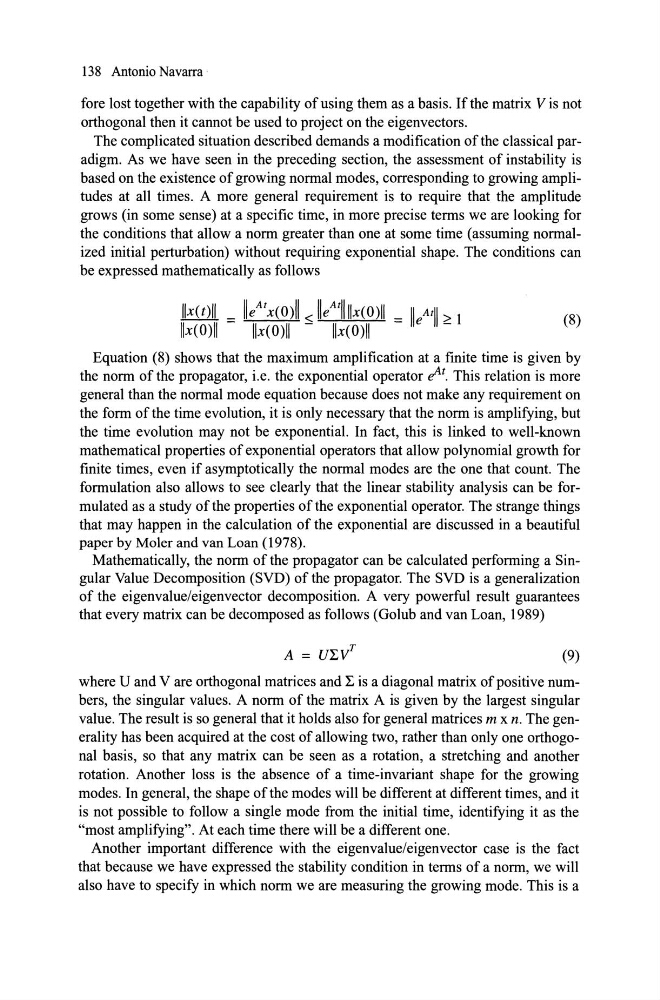
be expressed mathematically as follows
(8)
Equation (8) shows that the maximum amplification at a finite time is given by
the norm of the propagator, i.e. the exponential operator e4 t . This relation is more
general than the normal mode equation because does not make any requirement on
the form of the time evolution, it is only necessary that the norm is amplifying, but
the time evolution may not be exponential. In fact, this is linked to well-known
mathematical properties of exponential operators that allow polynomial growth for
finite times, even if asymptotically the normal modes are the one that count. The
formulation also allows to see clearly that the linear stability analysis can be formulated as a study of the properties of the exponential operator. The strange things
that may happen in the calculation of the exponential are discussed in a beautiful
paper by Moler and van Loan (1978).
Mathematically, the norm of the propagator can be calculated performing a Singular Value Decomposition (SVD) of the propagator. The SVD is a generalization
of the eigenvalue/eigenvector decomposition. A very powerful re suit guarantees
that every matrix can be decomposed as follows (Golub and van Loan, 1989)
(9)
where U and V are orthogonal matrices and 1: is a diagonal matrix of positive numbers, the singular values. A norm of the matrix A is given by the largest singular
value. The result is so general that it holds also for general matrices m x n. The generality has been acquired at the cost of allowing two, rather than only one orthogonal basis, so that any matrix can be seen as a rotation, a stretching and another
rotation. Another loss is the absence of a time-invariant shape for the growing
modes. In general, the shape ofthe modes will be different at different times, and it
is not possible to follow a single mode from the initial time, identifying it as the
"most amplifying". At each time there will be a different one.
Another important difference with the eigenvalue/eigenvector case is the fact
that because we have expres sed the stability condition in terms of a norm, we will
also have to specify in which norm we are measuring the growing mode. This is a
fore lost together with the capability of using them as a basis. If the matrix Vis not
orthogonal then it cannot be used to project on the eigenvectors.
The complicated situation described demands a modification of the classical paradigm. As we have seen in the preceding section, the assessment of instability is
based on the existence of growing normal modes, corresponding to growing amplitudes at all times. A more general requirement is to require that the amplitude
grows (in some sense) at a specific time, in more precise terms we are looking for
the conditions that allow a norm greater than one at some time (assuming normalized initial perturbation) without requiring exponential shape. The conditions can
be expressed mathematically as follows
(8)
Equation (8) shows that the maximum amplification at a finite time is given by
the norm of the propagator, i.e. the exponential operator e4 t . This relation is more
general than the normal mode equation because does not make any requirement on
the form of the time evolution, it is only necessary that the norm is amplifying, but
the time evolution may not be exponential. In fact, this is linked to well-known
mathematical properties of exponential operators that allow polynomial growth for
finite times, even if asymptotically the normal modes are the one that count. The
formulation also allows to see clearly that the linear stability analysis can be formulated as a study of the properties of the exponential operator. The strange things
that may happen in the calculation of the exponential are discussed in a beautiful
paper by Moler and van Loan (1978).
Mathematically, the norm of the propagator can be calculated performing a Singular Value Decomposition (SVD) of the propagator. The SVD is a generalization
of the eigenvalue/eigenvector decomposition. A very powerful re suit guarantees
that every matrix can be decomposed as follows (Golub and van Loan, 1989)
(9)
where U and V are orthogonal matrices and 1: is a diagonal matrix of positive numbers, the singular values. A norm of the matrix A is given by the largest singular
value. The result is so general that it holds also for general matrices m x n. The generality has been acquired at the cost of allowing two, rather than only one orthogonal basis, so that any matrix can be seen as a rotation, a stretching and another
rotation. Another loss is the absence of a time-invariant shape for the growing
modes. In general, the shape ofthe modes will be different at different times, and it
is not possible to follow a single mode from the initial time, identifying it as the
"most amplifying". At each time there will be a different one.
Another important difference with the eigenvalue/eigenvector case is the fact
that because we have expres sed the stability condition in terms of a norm, we will
also have to specify in which norm we are measuring the growing mode. This is a