

136 Antonio Navarra
The linear equation (3) is valid for small amplitudes ofthe state vector x and so it
describes small departures from the basic state vector. The solution of the problem
can be written as
At
x(t) = e x(O) = S(t)x(O)
(5)
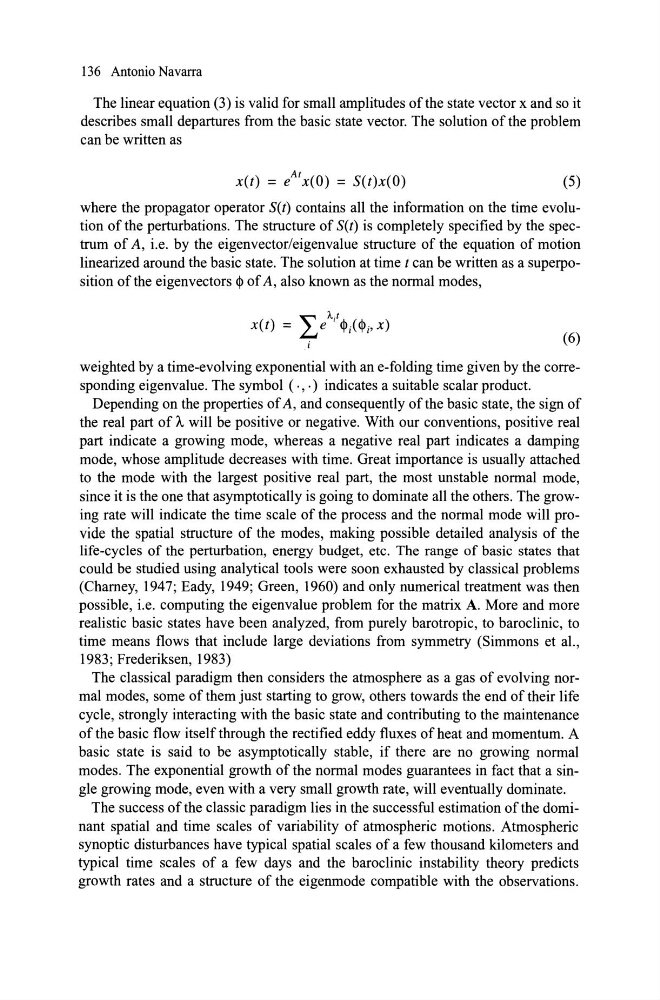
where the propagator operator S(t) contains alI the information on the time evolution of the perturbations. The structure of S(t) is completely specified by the spectrum of A, i.e. by the eigenvector/eigenvalue structure of the equation of motion
linearized around the basic state. The solution at time t can be written as a superposition of the eigenvectors <1> of A, also known as the normal modes,
' " At
x(t) = ~e 'i(i'x)
.i
(6)
weighted by a time-evolving exponential with an e-folding time given by the corresponding eigenvalue. The symbol ( ., .) indicates a suitable scalar product.
Depending on the properties of A, and consequently ofthe basic state, the sign of
the real part of  will be positive or negative. With our conventions, positive real
part indicate a growing mode, whereas a negative real part indicates a damping
mode, whose amplitude decreases with time. Great importance is usualIy attached
to the mode with the largest positive real part, the most unstable normal mode,
since it is the one that asymptoticalIy is going to dominate alI the others. The growing rate will indicate the time scale of the process and the normal mode will provide the spatial structure of the modes, making possible detailed analysis of the
life-cycles of the perturbation, energy budget, etc. The range of basic states that
could be studied using analytical tools were soon exhausted by classical problems
(Chamey, 1947; Eady, 1949; Green, 1960) and only numerical treatment was then
possible, i.e. computing the eigenvalue problem for the matrix A. More and more
realistic basic states have been analyzed, from purely barotropic, to baroclinic, to
time means flows that include large deviations from symmetry (Simmons et al.,
1983; Frederiksen, 1983)
The classical paradigm then considers the atmosphere as a gas of evolving normal modes, some of them just starting to grow, others towards the end of their life
cycle, strongly interacting with the basic state and contributing to the maintenance
of the basic flow itself through the rectified eddy fluxes of heat and momentum. A
basic state is said to be asymptotically stable, if there are no growing normal
modes. The exponential growth of the normal modes guarantees in fact that a single growing mode, even with a very small growth rate, will eventualIy dominate.
The success ofthe classic paradigm lies in the successful estimation ofthe dominant spatial and time scales of variability of atmospheric motions. Atmospheric
synoptic disturbances have typical spatial scales of a few thousand kilometers and
typical time scales of a few days and the baroclinic instability theory predicts
growth rates and a structure of the eigenmode compatible with the observations.
The linear equation (3) is valid for small amplitudes ofthe state vector x and so it
describes small departures from the basic state vector. The solution of the problem
can be written as
At
x(t) = e x(O) = S(t)x(O)
(5)
where the propagator operator S(t) contains alI the information on the time evolution of the perturbations. The structure of S(t) is completely specified by the spectrum of A, i.e. by the eigenvector/eigenvalue structure of the equation of motion
linearized around the basic state. The solution at time t can be written as a superposition of the eigenvectors <1> of A, also known as the normal modes,
' " At
x(t) = ~e 'i(i'x)
.i
(6)
weighted by a time-evolving exponential with an e-folding time given by the corresponding eigenvalue. The symbol ( ., .) indicates a suitable scalar product.
Depending on the properties of A, and consequently ofthe basic state, the sign of
the real part of  will be positive or negative. With our conventions, positive real
part indicate a growing mode, whereas a negative real part indicates a damping
mode, whose amplitude decreases with time. Great importance is usualIy attached
to the mode with the largest positive real part, the most unstable normal mode,
since it is the one that asymptoticalIy is going to dominate alI the others. The growing rate will indicate the time scale of the process and the normal mode will provide the spatial structure of the modes, making possible detailed analysis of the
life-cycles of the perturbation, energy budget, etc. The range of basic states that
could be studied using analytical tools were soon exhausted by classical problems
(Chamey, 1947; Eady, 1949; Green, 1960) and only numerical treatment was then
possible, i.e. computing the eigenvalue problem for the matrix A. More and more
realistic basic states have been analyzed, from purely barotropic, to baroclinic, to
time means flows that include large deviations from symmetry (Simmons et al.,
1983; Frederiksen, 1983)
The classical paradigm then considers the atmosphere as a gas of evolving normal modes, some of them just starting to grow, others towards the end of their life
cycle, strongly interacting with the basic state and contributing to the maintenance
of the basic flow itself through the rectified eddy fluxes of heat and momentum. A
basic state is said to be asymptotically stable, if there are no growing normal
modes. The exponential growth of the normal modes guarantees in fact that a single growing mode, even with a very small growth rate, will eventualIy dominate.
The success ofthe classic paradigm lies in the successful estimation ofthe dominant spatial and time scales of variability of atmospheric motions. Atmospheric
synoptic disturbances have typical spatial scales of a few thousand kilometers and
typical time scales of a few days and the baroclinic instability theory predicts
growth rates and a structure of the eigenmode compatible with the observations.