

100 Geir Evensen
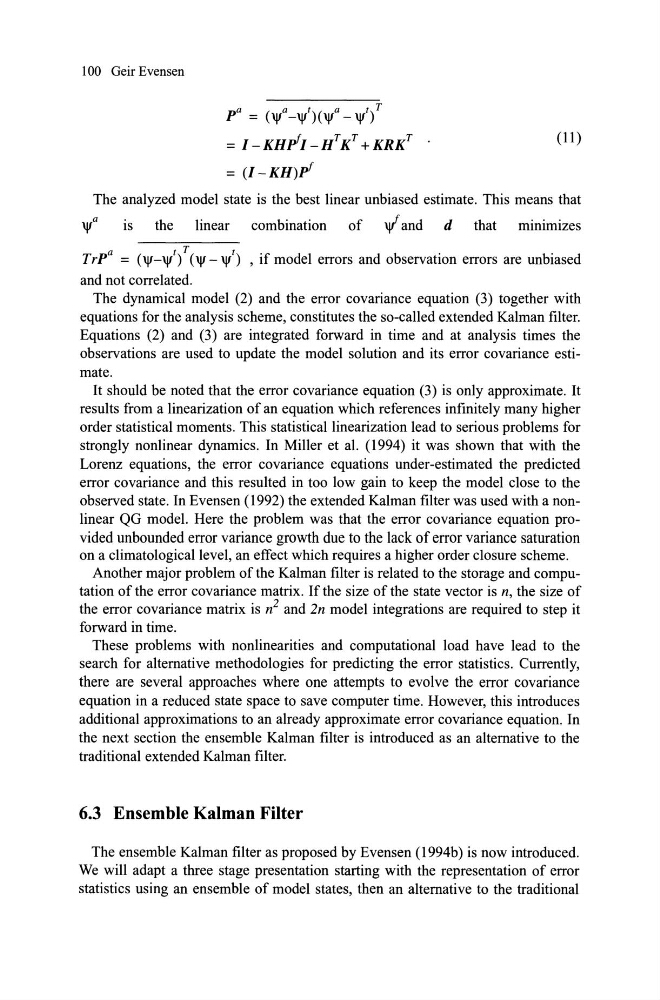
pa = ("l -"l)('l'a _ 'l't{
= 1 -KHPI _HTK T +KRK T
= (1 -KH)pf
(11)
The analyzed model state is the best linear unbiased estimate. This means that
'l'a
is the
linear combination
of "" and d that minimizes
a
t T
t
TrP = ('l'-'l') ('l' - 'l') ,if model errors and observation errors are unbiased
and not correlated.
The dynamical model (2) and the error covariance equation (3) together with
equations for the analysis scheme, constitutes the so-called extended Kalman filter.
Equations (2) and (3) are integrated forward in time and at analysis times the
observations are used to update the model solution and its error covariance estimate.
It should be noted that the error covariance equation (3) is only approximate. It
results from a linearization of an equation which references infinitely many higher
order statistical moments. This statisticallinearization lead to serious problems for
strongly nonlinear dynamics. In Miller et al. (1994) it was shown that with the
Lorenz equations, the error covariance equations under-estimated the predicted
error covariance and this resulted in too low gain to keep the model close to the
observed state. In Evensen (1992) the extended Kalman filter was used with a nonlinear QG model. Here the problem was that the error covariance equation provided unbounded error variance growth due to the lack of error variance saturation
on a climat010gica1level, an effect which requires a higher order c10sure scheme.
Another major problem ofthe Kalman filter is related to the storage and computation of the error covariance matrix. If the size of the state vector is n, the size of
the error covariance matrix is n 2 and 2n model integrations are required to step it
forward in time.
These problems with nonlinearities and computational load have lead to the
search for alternative methodologies for predicting the error statistics. Currently,
there are several approaches where one attempts to evolve the error covariance
equation in a reduced state space to save computer time. However, this introduces
additional approximations to an already approximate error covariance equation. In
the next section the ensemble Kalman filter is introduced as an alternative to the
traditional extended Kalman filter.
6.3 Ensemble Kalman Filter
The ensemble Kalman filter as proposed by Evensen (1994b) is now introduced.
We will adapt a three stage presentation starting with the representation of error
statistics using an ensemble of model states, then an alternative to the traditional
pa = ("l -"l)('l'a _ 'l't{
= 1 -KHPI _HTK T +KRK T
= (1 -KH)pf
(11)
The analyzed model state is the best linear unbiased estimate. This means that
'l'a
is the
linear combination
of "" and d that minimizes
a
t T
t
TrP = ('l'-'l') ('l' - 'l') ,if model errors and observation errors are unbiased
and not correlated.
The dynamical model (2) and the error covariance equation (3) together with
equations for the analysis scheme, constitutes the so-called extended Kalman filter.
Equations (2) and (3) are integrated forward in time and at analysis times the
observations are used to update the model solution and its error covariance estimate.
It should be noted that the error covariance equation (3) is only approximate. It
results from a linearization of an equation which references infinitely many higher
order statistical moments. This statisticallinearization lead to serious problems for
strongly nonlinear dynamics. In Miller et al. (1994) it was shown that with the
Lorenz equations, the error covariance equations under-estimated the predicted
error covariance and this resulted in too low gain to keep the model close to the
observed state. In Evensen (1992) the extended Kalman filter was used with a nonlinear QG model. Here the problem was that the error covariance equation provided unbounded error variance growth due to the lack of error variance saturation
on a climat010gica1level, an effect which requires a higher order c10sure scheme.
Another major problem ofthe Kalman filter is related to the storage and computation of the error covariance matrix. If the size of the state vector is n, the size of
the error covariance matrix is n 2 and 2n model integrations are required to step it
forward in time.
These problems with nonlinearities and computational load have lead to the
search for alternative methodologies for predicting the error statistics. Currently,
there are several approaches where one attempts to evolve the error covariance
equation in a reduced state space to save computer time. However, this introduces
additional approximations to an already approximate error covariance equation. In
the next section the ensemble Kalman filter is introduced as an alternative to the
traditional extended Kalman filter.
6.3 Ensemble Kalman Filter
The ensemble Kalman filter as proposed by Evensen (1994b) is now introduced.
We will adapt a three stage presentation starting with the representation of error
statistics using an ensemble of model states, then an alternative to the traditional