

Atmospheric Data Assimilation and Quality Control
91
quality of weather ship observations by reduc ing their observational error Va' we
found that this resulted in more being rejected:- not what we wanted. (It was this
behaviour, and the subjective tolerance in what was otherwise an objective analysis, that induced me to study the Bayesian approach.) It is shown in Lorenc and
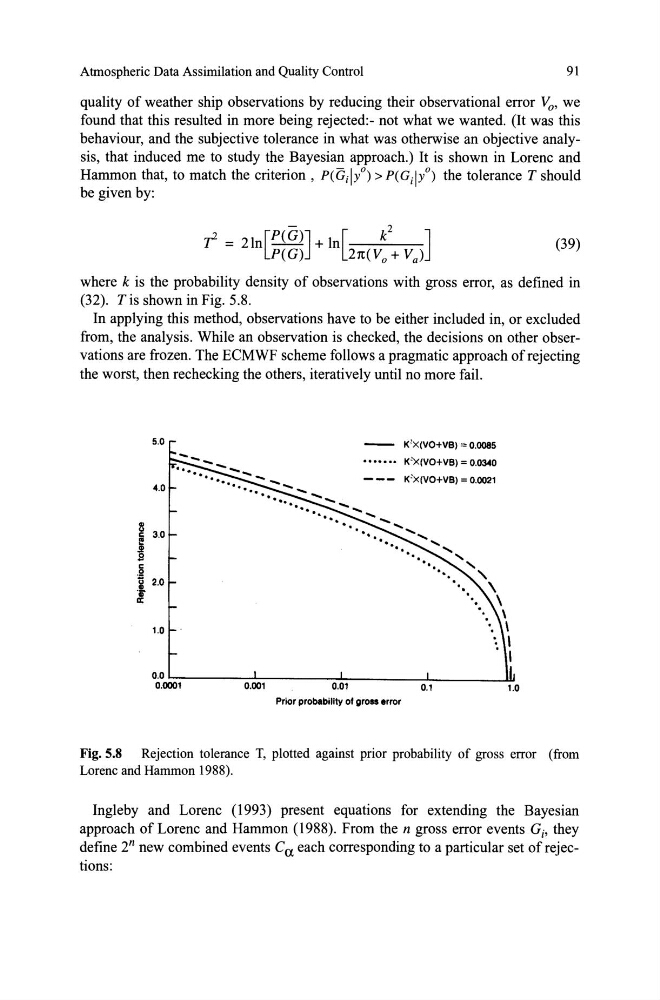
Hammon that, to match the criterion , P(Gd/) > P(G;I/) the tolerance T should
be given by:
-
2
r = 2In[P(G)] + ln[ k ]
P(G)
21t(V o + Va)
(39)
where k is the probability density of observations with gross error, as detined in
(32). T is shown in Fig. 5.8.
In applying this method, observations have to be either included in, or excluded
from, the analysis. While an observation is checked, the decisions on other observations are frozen. The ECMWF scheme follows a pragmatic approach of rejecting
the worst, then rechecking the others, iteratively until no more faiI.
5.0
4.0
8 3.0
c:
i s
!i
2 2.0
'i&'
a:
1.0
0.0
0.0001
0.001
.......... .....
0.01
- - K'X(VO+VB) '" 0.0085
K'X(VO+VB) '" 0.0340
K'X(VO+VB) = 0.0021
.........
............... , ...........
......... ..... ..... " \ \
0.
\
0.. \
0.1
, ,
1.0
Prior probabilily of groas error
Fig. 5.8 Rejection tolerance T, plotted against prior probability of gross eITor (from
Lorenc and Hammon 1988).
Ingleby and Lorenc (1993) present equations for extending the Bayesian
approach of Lorenc and Hammon (1988). From the n gross error events G i , they
detine 2 n new combined events Ca each corresponding to a particular set of rejections:
91
quality of weather ship observations by reduc ing their observational error Va' we
found that this resulted in more being rejected:- not what we wanted. (It was this
behaviour, and the subjective tolerance in what was otherwise an objective analysis, that induced me to study the Bayesian approach.) It is shown in Lorenc and
Hammon that, to match the criterion , P(Gd/) > P(G;I/) the tolerance T should
be given by:
-
2
r = 2In[P(G)] + ln[ k ]
P(G)
21t(V o + Va)
(39)
where k is the probability density of observations with gross error, as detined in
(32). T is shown in Fig. 5.8.
In applying this method, observations have to be either included in, or excluded
from, the analysis. While an observation is checked, the decisions on other observations are frozen. The ECMWF scheme follows a pragmatic approach of rejecting
the worst, then rechecking the others, iteratively until no more faiI.
5.0
4.0
8 3.0
c:
i s
!i
2 2.0
'i&'
a:
1.0
0.0
0.0001
0.001
.......... .....
0.01
- - K'X(VO+VB) '" 0.0085
K'X(VO+VB) '" 0.0340
K'X(VO+VB) = 0.0021
.........
............... , ...........
......... ..... ..... " \ \
0.
\
0.. \
0.1
, ,
1.0
Prior probabilily of groas error
Fig. 5.8 Rejection tolerance T, plotted against prior probability of gross eITor (from
Lorenc and Hammon 1988).
Ingleby and Lorenc (1993) present equations for extending the Bayesian
approach of Lorenc and Hammon (1988). From the n gross error events G i , they
detine 2 n new combined events Ca each corresponding to a particular set of rejections: