

60
Homogeneous Models of the Ocean Circulation
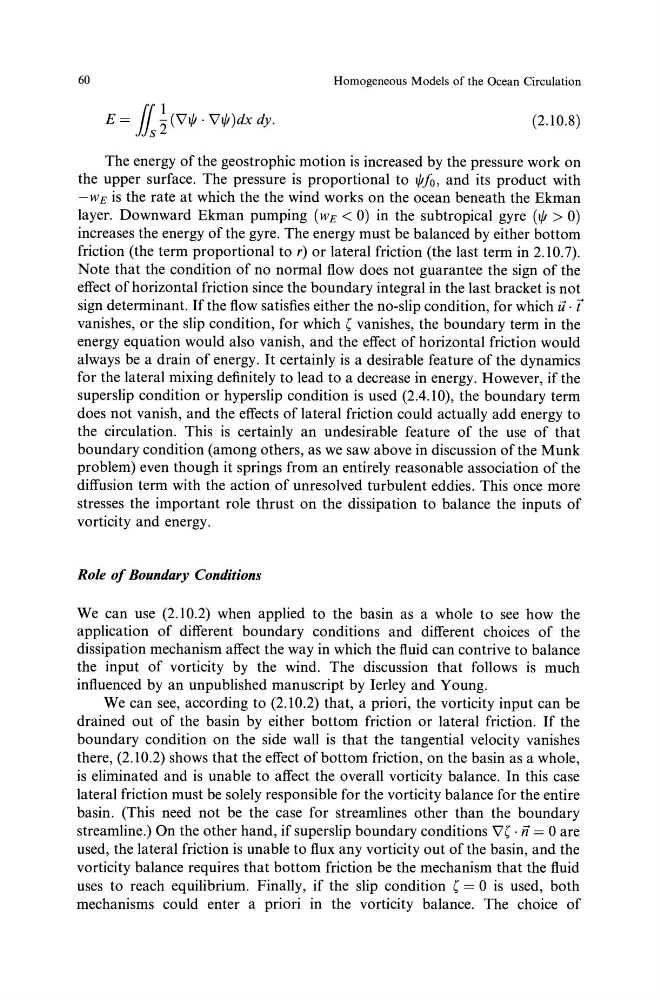
E = Jl ~C"Jt/1 · \lt/f)dx dy.
(2.10.8)
The energy of the geostrophic motion is increased by the pressure work on
the upper surface. The pressure is proportional to t/Jfo, and its product with
-wE is the rate at which the the wind works on the ocean beneath the Ekman
layer. Downward Ekman pumping (wE< 0) in the subtropical gyre (t/1 > 0)
increases the energy of the gyre. The energy must be balanced by either bottom
friction (the term proportional to r) or lateral friction (the last term in 2.10. 7).
Note that the condition of no normal flow does not guarantee the sign of the
effect of horizontal friction since the boundary integral in the last bracket is not
sign determinant. If the flow satisfies either the no-slip condition, for which u · t
vanishes, or the slip condition, for which ( vanishes, the boundary term in the
energy equation would also vanish, and the effect of horizontal friction would
always be a drain of energy. It certainly is a desirable feature of the dynamics
for the lateral mixing definitely to lead to a decrease in energy. However, if the
superslip condition or hyperslip condition is used (2.4.10), the boundary term
does not vanish, and the effects of lateral friction could actually add energy to
the circulation. This is certainly an undesirable feature of the use of that
boundary condition (among others, as we saw above in discussion of the Munk
problem) even though it springs from an entirely reasonable association of the
diffusion term with the action of unresolved turbulent eddies. This once more
stresses the important role thrust on the dissipation to balance the inputs of
vorticity and energy.
Role of Boundary Conditions
We can use (2.10.2) when applied to the basin as a whole to see how the
application of different boundary conditions and different choices of the
dissipation mechanism affect the way in which the fluid can contrive to balance
the input of vorticity by the wind. The discussion that follows is much
influenced by an unpublished manuscript by Ierley and Young.
We can see, according to (2.1 0.2) that, a priori, the vorticity input can be
drained out of the basin by either bottom friction or lateral friction. If the
boundary condition on the side wall is that the tangential velocity vanishes
there, (2.10.2) shows that the effect of bottom friction, on the basin as a whole,
is eliminated and is unable to affect the overall vorticity balance. In this case
lateral friction must be solely responsible for the vorticity balance for the entire
basin. (This need not be the case for streamlines other than the boundary
streamline.) On the other hand, if superslip boundary conditions V( · ii = 0 are
used, the lateral friction is unable to flux any vorticity out of the basin, and the
vorticity balance requires that bottom friction be the mechanism that the fluid
uses to reach equilibrium. Finally, if the slip condition ( = 0 is used, both
mechanisms could enter a priori in the vorticity balance. The choice of
Homogeneous Models of the Ocean Circulation
E = Jl ~C"Jt/1 · \lt/f)dx dy.
(2.10.8)
The energy of the geostrophic motion is increased by the pressure work on
the upper surface. The pressure is proportional to t/Jfo, and its product with
-wE is the rate at which the the wind works on the ocean beneath the Ekman
layer. Downward Ekman pumping (wE< 0) in the subtropical gyre (t/1 > 0)
increases the energy of the gyre. The energy must be balanced by either bottom
friction (the term proportional to r) or lateral friction (the last term in 2.10. 7).
Note that the condition of no normal flow does not guarantee the sign of the
effect of horizontal friction since the boundary integral in the last bracket is not
sign determinant. If the flow satisfies either the no-slip condition, for which u · t
vanishes, or the slip condition, for which ( vanishes, the boundary term in the
energy equation would also vanish, and the effect of horizontal friction would
always be a drain of energy. It certainly is a desirable feature of the dynamics
for the lateral mixing definitely to lead to a decrease in energy. However, if the
superslip condition or hyperslip condition is used (2.4.10), the boundary term
does not vanish, and the effects of lateral friction could actually add energy to
the circulation. This is certainly an undesirable feature of the use of that
boundary condition (among others, as we saw above in discussion of the Munk
problem) even though it springs from an entirely reasonable association of the
diffusion term with the action of unresolved turbulent eddies. This once more
stresses the important role thrust on the dissipation to balance the inputs of
vorticity and energy.
Role of Boundary Conditions
We can use (2.10.2) when applied to the basin as a whole to see how the
application of different boundary conditions and different choices of the
dissipation mechanism affect the way in which the fluid can contrive to balance
the input of vorticity by the wind. The discussion that follows is much
influenced by an unpublished manuscript by Ierley and Young.
We can see, according to (2.1 0.2) that, a priori, the vorticity input can be
drained out of the basin by either bottom friction or lateral friction. If the
boundary condition on the side wall is that the tangential velocity vanishes
there, (2.10.2) shows that the effect of bottom friction, on the basin as a whole,
is eliminated and is unable to affect the overall vorticity balance. In this case
lateral friction must be solely responsible for the vorticity balance for the entire
basin. (This need not be the case for streamlines other than the boundary
streamline.) On the other hand, if superslip boundary conditions V( · ii = 0 are
used, the lateral friction is unable to flux any vorticity out of the basin, and the
vorticity balance requires that bottom friction be the mechanism that the fluid
uses to reach equilibrium. Finally, if the slip condition ( = 0 is used, both
mechanisms could enter a priori in the vorticity balance. The choice of