

Integral Conditions
59
represents the departure from the average. Note that the time average of a
linear primed quantity is zero.
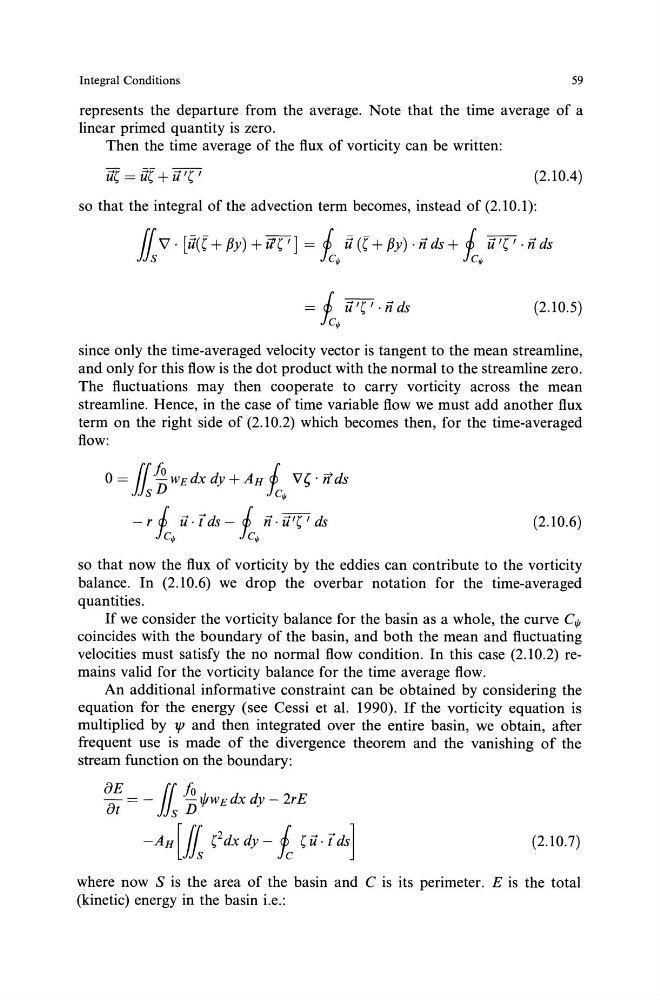
Then the time average of the flux of vorticity can be written:
(2.10.4)
so that the integral of the advection term becomes, instead of (2.10.1):
ffv. [U'((+Py)+il'C'] = 1 U'((+PY)·iids+ 1 i1'C'·iids
~
~
~
= 1 i1'('·iids
!c.,
(2.10.5)
since only the time-averaged velocity vector is tangent to the mean streamline,
and only for this flow is the dot product with the normal to the streamline zero.
The fluctuations may then cooperate to carry vorticity across the mean
streamline. Hence, in the case of time variable flow we must add another flux
term on the right side of (2.10.2) which becomes then, for the time-averaged
flow:
0= f{!owEdxdy+AH1 Vt;·nds
J}sD
!c.;
- r 1 u· t ds- 1 ii · i1'(' ds
!c.,
!c.,
(2.10.6)
so that now the flux of vorticity by the eddies can contribute to the vorticity
balance. In (2.10.6) we drop the overbar notation for the time-averaged
quantities.
If we consider the vorticity balance for the basin as a whole, the curve C"'
coincides with the boundary of the basin, and both the mean and fluctuating
velocities must satisfy the no normal flow condition. In this case (2.10.2) remains valid for the vorticity balance for the time average flow.
An additional informative constraint can be obtained by considering the
equation for the energy (see Cessi et al. 1990). If the vorticity equation is
multiplied by tp and then integrated over the entire basin, we obtain, after
frequent use is made of the divergence theorem and the vanishing of the
stream function on the boundary:
(2.10.7)
where now S is the area of the basin and C is its perimeter. E is the total
(kinetic) energy in the basin i.e.:
59
represents the departure from the average. Note that the time average of a
linear primed quantity is zero.
Then the time average of the flux of vorticity can be written:
(2.10.4)
so that the integral of the advection term becomes, instead of (2.10.1):
ffv. [U'((+Py)+il'C'] = 1 U'((+PY)·iids+ 1 i1'C'·iids
~
~
~
= 1 i1'('·iids
!c.,
(2.10.5)
since only the time-averaged velocity vector is tangent to the mean streamline,
and only for this flow is the dot product with the normal to the streamline zero.
The fluctuations may then cooperate to carry vorticity across the mean
streamline. Hence, in the case of time variable flow we must add another flux
term on the right side of (2.10.2) which becomes then, for the time-averaged
flow:
0= f{!owEdxdy+AH1 Vt;·nds
J}sD
!c.;
- r 1 u· t ds- 1 ii · i1'(' ds
!c.,
!c.,
(2.10.6)
so that now the flux of vorticity by the eddies can contribute to the vorticity
balance. In (2.10.6) we drop the overbar notation for the time-averaged
quantities.
If we consider the vorticity balance for the basin as a whole, the curve C"'
coincides with the boundary of the basin, and both the mean and fluctuating
velocities must satisfy the no normal flow condition. In this case (2.10.2) remains valid for the vorticity balance for the time average flow.
An additional informative constraint can be obtained by considering the
equation for the energy (see Cessi et al. 1990). If the vorticity equation is
multiplied by tp and then integrated over the entire basin, we obtain, after
frequent use is made of the divergence theorem and the vanishing of the
stream function on the boundary:
(2.10.7)
where now S is the area of the basin and C is its perimeter. E is the total
(kinetic) energy in the basin i.e.: