

Integral Balances for the Boundary Layer
61
boundary condition therefore determines a priori the mechanism of global
vorticity balance.
Some models use one or the other, but not both of the dissipation mechanisms. For example, the study of Veronis (1966) employed only bottom
friction. In this case there is no second boundary condition because in the
absence of lateral friction the order of the differential equation is reduced. This
implies that the dissipation of vorticity depends entirely on the magnitude of
the velocity along the boundary, and that if r is small, the boundary velocity
must be correspondingly large.
2.11 Integral Balances for the Boundary Layer
Over most of the basin the role of dissipation is locally negligible. This is, after
all, one of the principal ingredients of the Sverdrup balance. It follows that we
expect that the western boundary layer is a principal location for dissipation to
take place although the results of Ierley and Ruehr (1986) and lerley (1987)
suggest that in the inertial regime the representation of this domain as a simple
boundary-layer structure may not be sufficient. It is illuminating in this regard
to examine the integral balance for the vorticity, integrating over the open
region that stretches eastward from the western boundary and covers the
boundary-layer region, as shown in Fig. 2.11.1. The right edge of the region R
in the figure is assumed to lie outside the western boundary layer so that at this
edge all of the boundary-layer processes involving nonlinearity and friction are
negligible.
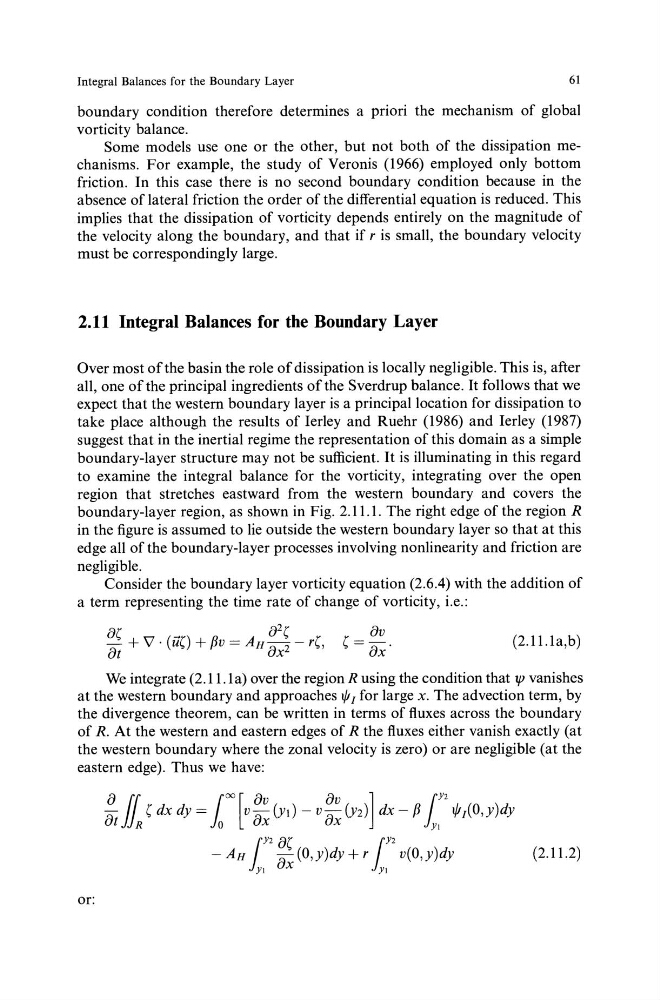
Consider the boundary layer vorticity equation (2.6.4) with the addition of
a term representing the time rate of change of vorticity, i.e.:
(2.11.la,b)
We integrate (2.11.1a) over the region R using the condition that 1p vanishes
at the western boundary and approaches t/1 1 for large x. The advection term, by
the divergence theorem, can be written in terms of fluxes across the boundary
of R. At the western and eastern edges of R the fluxes either vanish exactly (at
the western boundary where the zonal velocity is zero) or are negligible (at the
eastern edge). Thus we have:
(2.11.2)
or:
61
boundary condition therefore determines a priori the mechanism of global
vorticity balance.
Some models use one or the other, but not both of the dissipation mechanisms. For example, the study of Veronis (1966) employed only bottom
friction. In this case there is no second boundary condition because in the
absence of lateral friction the order of the differential equation is reduced. This
implies that the dissipation of vorticity depends entirely on the magnitude of
the velocity along the boundary, and that if r is small, the boundary velocity
must be correspondingly large.
2.11 Integral Balances for the Boundary Layer
Over most of the basin the role of dissipation is locally negligible. This is, after
all, one of the principal ingredients of the Sverdrup balance. It follows that we
expect that the western boundary layer is a principal location for dissipation to
take place although the results of Ierley and Ruehr (1986) and lerley (1987)
suggest that in the inertial regime the representation of this domain as a simple
boundary-layer structure may not be sufficient. It is illuminating in this regard
to examine the integral balance for the vorticity, integrating over the open
region that stretches eastward from the western boundary and covers the
boundary-layer region, as shown in Fig. 2.11.1. The right edge of the region R
in the figure is assumed to lie outside the western boundary layer so that at this
edge all of the boundary-layer processes involving nonlinearity and friction are
negligible.
Consider the boundary layer vorticity equation (2.6.4) with the addition of
a term representing the time rate of change of vorticity, i.e.:
(2.11.la,b)
We integrate (2.11.1a) over the region R using the condition that 1p vanishes
at the western boundary and approaches t/1 1 for large x. The advection term, by
the divergence theorem, can be written in terms of fluxes across the boundary
of R. At the western and eastern edges of R the fluxes either vanish exactly (at
the western boundary where the zonal velocity is zero) or are negligible (at the
eastern edge). Thus we have:
(2.11.2)
or: