

The Inertial Boundary Layer
45
southern portion of the subtropical gyre where the interior flow is westward
and into the boundary layer. We have demonstrated this in the simple example
of (2.8.5) and (2.8.6). The general proof for arbitrary interior flows external to
the boundary layer is due to Greenspan (1962). The inertial theory simply
cannot be used where the flow must leave the boundary layer and hook on to
the region of eastward interior flow. The property of vorticity conservation
which we used to integrate (2.8.1) and obtain (2.8.2) is exactly the property
which physically disallows the inertial model to hold along the whole path of
the parcel's transit of the boundary layer for the physical reasons associated
with the necessary dissipation of vorticity that we describe above, and which
the purely inertial model ignores.
The second inadequacy of the purely inertial model is its inability to satisfy
the second boundary condition on x = 0, either (2.4.5), (2.4.6), or (2.4.10).
These two limitations are of course connected since the purely inertial limit
represents a singular perturbation of the vorticity equation by neglecting the
diffusion of vorticity. Note that retaining bottom friction while ignoring horizontal vorticity diffusion is also a singular perturbation of the vorticity
equation. Although it retains dissipation, it lowers the mathematical order of
the differential equation.
The Sublayer
In order to satisfy either the no-slip, no-stress, or no-flux (of vorticity)
condition, friction must enter the problem. If (h ~ DM, a viscous sublayer must
exist within the inertial layer, next to the wall, in which viscous forces are
important due to the locally strong gradient in the meridional velocity.
Consider the situation shown schematically in Fig. 2.8.1. The interior flow
enters the inertial boundary layer, which has a width (>1, with a westward
velocity 0( U1). In the inertial boundary layer the fluid is turned northward and
has a characteristic speed, by simple mass balance, v; = UI(L/DI), where the
subscript i refers to quantities in the inertial boundary layer.
For the lateral friction terms to enter in the boundary-layer equation the
scale of the sublayer must be sufficiently small so that the relatively large
number of derivatives in the frictional terms compensate for the relative
smallness of AH. That is, if the scale of the sublayer is (>*' to obtain a balance
between the nonlinear terms and the linear viscous terms we must have:
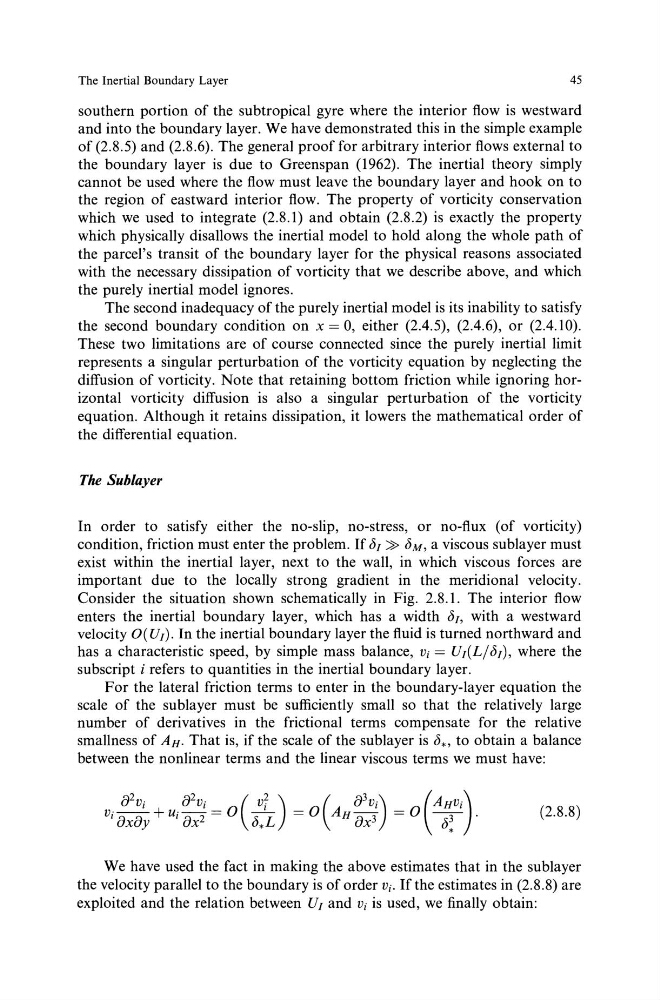
(2.8.8)
We have used the fact in making the above estimates that in the sublayer
the velocity parallel to the boundary is of order v;. If the estimates in (2.8.8) are
exploited and the relation between U1 and v; is used, we finally obtain:
45
southern portion of the subtropical gyre where the interior flow is westward
and into the boundary layer. We have demonstrated this in the simple example
of (2.8.5) and (2.8.6). The general proof for arbitrary interior flows external to
the boundary layer is due to Greenspan (1962). The inertial theory simply
cannot be used where the flow must leave the boundary layer and hook on to
the region of eastward interior flow. The property of vorticity conservation
which we used to integrate (2.8.1) and obtain (2.8.2) is exactly the property
which physically disallows the inertial model to hold along the whole path of
the parcel's transit of the boundary layer for the physical reasons associated
with the necessary dissipation of vorticity that we describe above, and which
the purely inertial model ignores.
The second inadequacy of the purely inertial model is its inability to satisfy
the second boundary condition on x = 0, either (2.4.5), (2.4.6), or (2.4.10).
These two limitations are of course connected since the purely inertial limit
represents a singular perturbation of the vorticity equation by neglecting the
diffusion of vorticity. Note that retaining bottom friction while ignoring horizontal vorticity diffusion is also a singular perturbation of the vorticity
equation. Although it retains dissipation, it lowers the mathematical order of
the differential equation.
The Sublayer
In order to satisfy either the no-slip, no-stress, or no-flux (of vorticity)
condition, friction must enter the problem. If (h ~ DM, a viscous sublayer must
exist within the inertial layer, next to the wall, in which viscous forces are
important due to the locally strong gradient in the meridional velocity.
Consider the situation shown schematically in Fig. 2.8.1. The interior flow
enters the inertial boundary layer, which has a width (>1, with a westward
velocity 0( U1). In the inertial boundary layer the fluid is turned northward and
has a characteristic speed, by simple mass balance, v; = UI(L/DI), where the
subscript i refers to quantities in the inertial boundary layer.
For the lateral friction terms to enter in the boundary-layer equation the
scale of the sublayer must be sufficiently small so that the relatively large
number of derivatives in the frictional terms compensate for the relative
smallness of AH. That is, if the scale of the sublayer is (>*' to obtain a balance
between the nonlinear terms and the linear viscous terms we must have:
(2.8.8)
We have used the fact in making the above estimates that in the sublayer
the velocity parallel to the boundary is of order v;. If the estimates in (2.8.8) are
exploited and the relation between U1 and v; is used, we finally obtain: