

44
Homogeneous Models of the Ocean Circulation
entering the boundary layer possesses at its entry point, where the relative
vorticity is negligible, both a known value of ljJ and a value of py. The latter is
the vorticity, aside from the constant fo, that is assigned to the fluid element as
it enters the boundary layer. One can therefore associate ljJ with the vorticity at
the entry point in terms of the position of the entry point. Each entry point y
corresponds to an interior value of l/J. At the same time py yields the vorticity,
and the vorticity can therefore be linked to the value of ljJ at the entry point of
the streamline into the western boundary layer. That relationship between
stream function and total vorticity is then maintained throughout the
dissipation-free portion of the fluid element's path in the boundary layer.
Thus for large x (compared to ?h) the sought after relation is determined by
inverting ljJ = ljJ(y) i.e.:
y = y(l/J)
(2.8.3)
so that:
py = py(t/1) = Q(l/J).
(2.8.4)
This determines the function Q(l/1), and (2.8.2) becomes, generally, a nonlinear
ordinary differential equation for ljJ.
A simple often quoted example (see Pedlosky 1987) is for the case where
the interior streamfunction near the western boundary (at x = 0) can be locally
approximated by ljJ 1 = Uy, representing a uniform westward flow. In this case
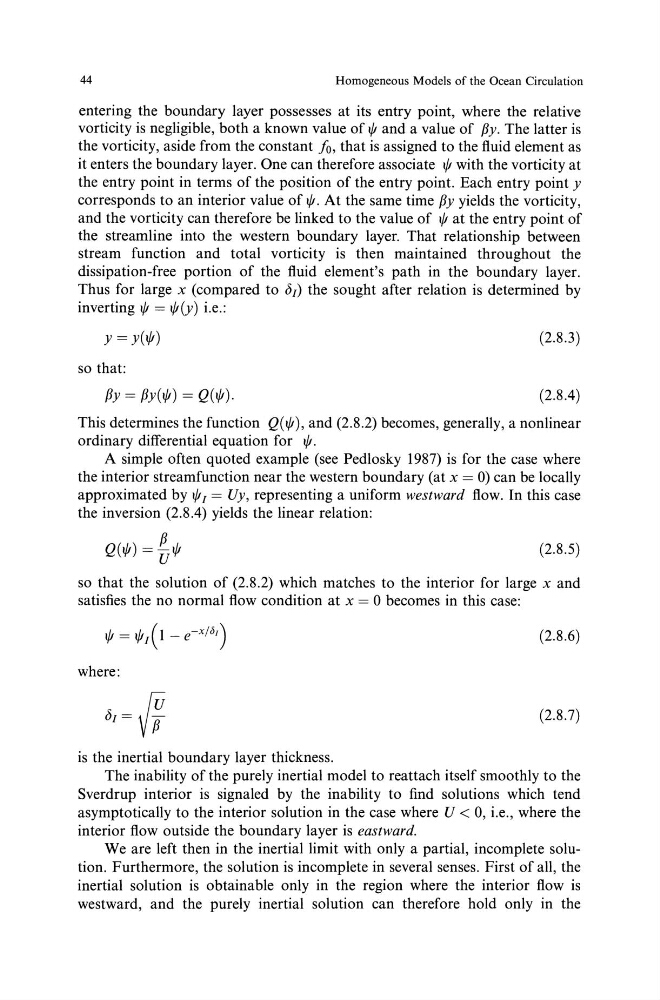
the inversion (2.8.4) yields the linear relation:
(2.8.5)
so that the solution of (2.8.2) which matches to the interior for large x and
satisfies the no normal flow condition at x = 0 becomes in this case:
(2.8.6)
where:
(2.8.7)
is the inertial boundary layer thickness.
The inability of the purely inertial model to reattach itself smoothly to the
Sverdrup interior is signaled by the inability to find solutions which tend
asymptotically to the interior solution in the case where U < 0, i.e., where the
interior flow outside the boundary layer is eastward.
We are left then in the inertial limit with only a partial, incomplete solution. Furthermore, the solution is incomplete in several senses. First of all, the
inertial solution is obtainable only in the region where the interior flow is
westward, and the purely inertial solution can therefore hold only in the
Homogeneous Models of the Ocean Circulation
entering the boundary layer possesses at its entry point, where the relative
vorticity is negligible, both a known value of ljJ and a value of py. The latter is
the vorticity, aside from the constant fo, that is assigned to the fluid element as
it enters the boundary layer. One can therefore associate ljJ with the vorticity at
the entry point in terms of the position of the entry point. Each entry point y
corresponds to an interior value of l/J. At the same time py yields the vorticity,
and the vorticity can therefore be linked to the value of ljJ at the entry point of
the streamline into the western boundary layer. That relationship between
stream function and total vorticity is then maintained throughout the
dissipation-free portion of the fluid element's path in the boundary layer.
Thus for large x (compared to ?h) the sought after relation is determined by
inverting ljJ = ljJ(y) i.e.:
y = y(l/J)
(2.8.3)
so that:
py = py(t/1) = Q(l/J).
(2.8.4)
This determines the function Q(l/1), and (2.8.2) becomes, generally, a nonlinear
ordinary differential equation for ljJ.
A simple often quoted example (see Pedlosky 1987) is for the case where
the interior streamfunction near the western boundary (at x = 0) can be locally
approximated by ljJ 1 = Uy, representing a uniform westward flow. In this case
the inversion (2.8.4) yields the linear relation:
(2.8.5)
so that the solution of (2.8.2) which matches to the interior for large x and
satisfies the no normal flow condition at x = 0 becomes in this case:
(2.8.6)
where:
(2.8.7)
is the inertial boundary layer thickness.
The inability of the purely inertial model to reattach itself smoothly to the
Sverdrup interior is signaled by the inability to find solutions which tend
asymptotically to the interior solution in the case where U < 0, i.e., where the
interior flow outside the boundary layer is eastward.
We are left then in the inertial limit with only a partial, incomplete solution. Furthermore, the solution is incomplete in several senses. First of all, the
inertial solution is obtainable only in the region where the interior flow is
westward, and the purely inertial solution can therefore hold only in the