

442
Abyssal Circulation
1
Yn 1Xe
SoH=
wodxdy.
Ys
Xw
(7.7.40)
On the other hand, the baroclinic structure of the eastern pressure anomaly
is not a simple reflection of the overall source-sink balance but instead is a
consequence of the Kelvin wave propagation of the perturbation induced by
the baroclinicity of the source. As (7.7.38) demonstrates, this depends on the
overall source structure and the distribution of the upwelling in the interior.
The anomaly itself on the eastern boundary is the heritage, in the steady state,
of the prior passage of the Kelvin wave carrying information about the source
strength.
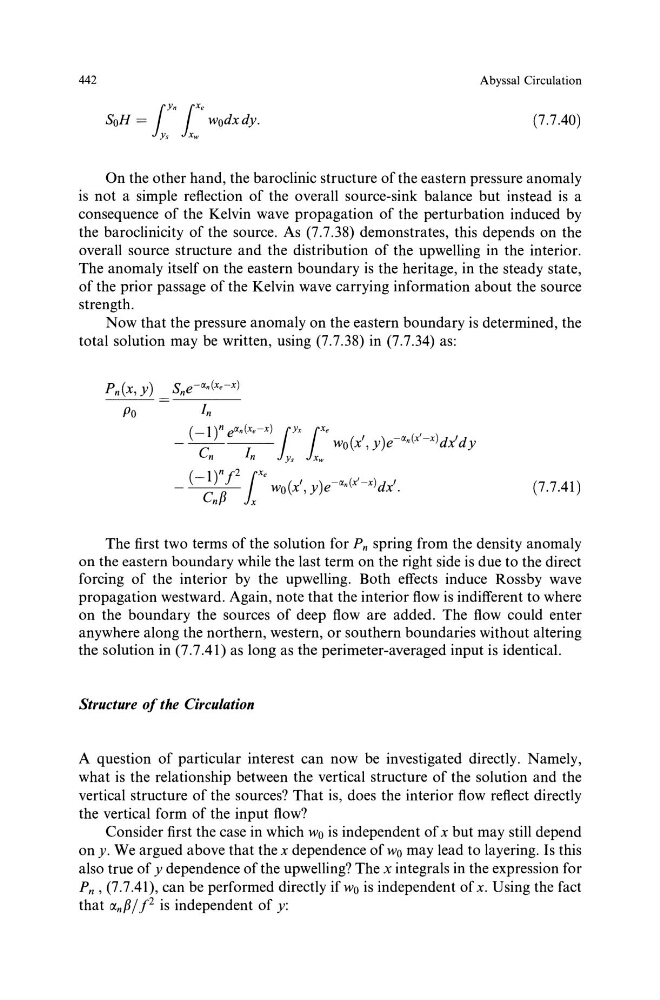
Now that the pressure anomaly on the eastern boundary is determined, the
total solution may be written, using (7.7.38) in (7.7.34) as:
(7.7.41)
The first two terms of the solution for Pn spring from the density anomaly
on the eastern boundary while the last term on the right side is due to the direct
forcing of the interior by the upwelling. Both effects induce Rossby wave
propagation westward. Again, note that the interior flow is indifferent to where
on the boundary the sources of deep flow are added. The flow could enter
anywhere along the northern, western, or southern boundaries without altering
the solution in (7. 7.41) as long as the perimeter-averaged input is identical.
Structure of the Circulation
A question of particular interest can now be investigated directly. Namely,
what is the relationship between the vertical structure of the solution and the
vertical structure of the sources? That is, does the interior flow reflect directly
the vertical form of the input flow?
Consider first the case in which wo is independent of x but may still depend
on y. We argued above that the x dependence of w0 may lead to layering. Is this
also true of y dependence of the upwelling? The x integrals in the expression for
Pn, (7.7.41), can be performed directly ifwo is independent ofx. Using the fact
that a.nP // 2 is independent of y:
Abyssal Circulation
1
Yn 1Xe
SoH=
wodxdy.
Ys
Xw
(7.7.40)
On the other hand, the baroclinic structure of the eastern pressure anomaly
is not a simple reflection of the overall source-sink balance but instead is a
consequence of the Kelvin wave propagation of the perturbation induced by
the baroclinicity of the source. As (7.7.38) demonstrates, this depends on the
overall source structure and the distribution of the upwelling in the interior.
The anomaly itself on the eastern boundary is the heritage, in the steady state,
of the prior passage of the Kelvin wave carrying information about the source
strength.
Now that the pressure anomaly on the eastern boundary is determined, the
total solution may be written, using (7.7.38) in (7.7.34) as:
(7.7.41)
The first two terms of the solution for Pn spring from the density anomaly
on the eastern boundary while the last term on the right side is due to the direct
forcing of the interior by the upwelling. Both effects induce Rossby wave
propagation westward. Again, note that the interior flow is indifferent to where
on the boundary the sources of deep flow are added. The flow could enter
anywhere along the northern, western, or southern boundaries without altering
the solution in (7. 7.41) as long as the perimeter-averaged input is identical.
Structure of the Circulation
A question of particular interest can now be investigated directly. Namely,
what is the relationship between the vertical structure of the solution and the
vertical structure of the sources? That is, does the interior flow reflect directly
the vertical form of the input flow?
Consider first the case in which wo is independent of x but may still depend
on y. We argued above that the x dependence of w0 may lead to layering. Is this
also true of y dependence of the upwelling? The x integrals in the expression for
Pn, (7.7.41), can be performed directly ifwo is independent ofx. Using the fact
that a.nP // 2 is independent of y: