

Vertical Structure of the Abyssal Circulation
441
This adjustment, or equivalently Pn(xe), can be determined from the mass
balance constraint (7.7.27). If each term in (7.7.27) is represented in a cosine
series:
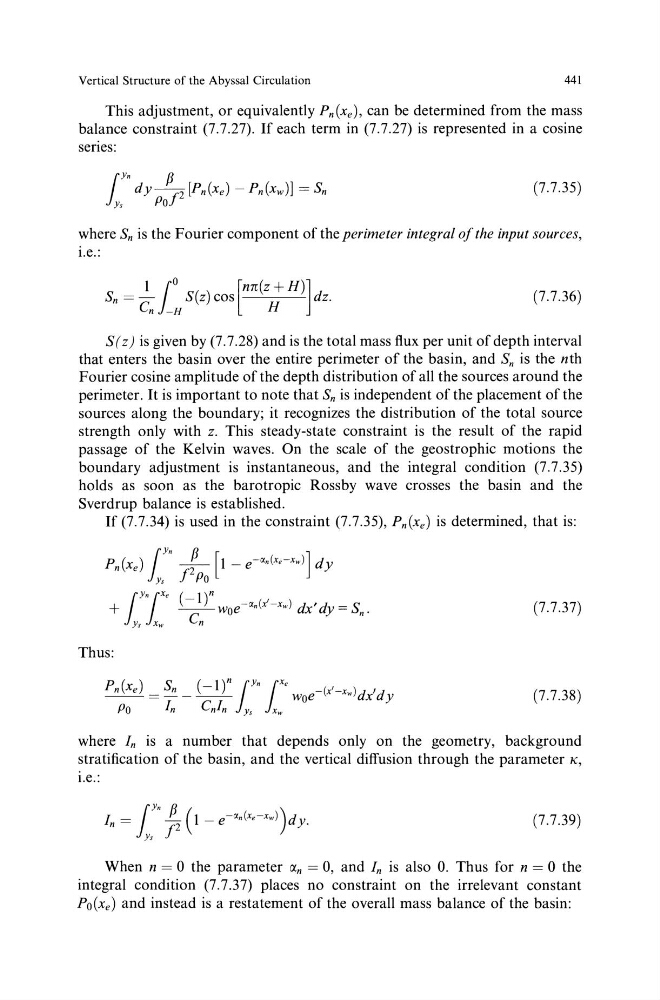
(7.7.35)
where Sn is the Fourier component of the perimeter integral of the input sources,
i.e.:
1 1° [nn(z +H)]
Sn = -
S(z) cos
dz.
Cn -H
H
(7.7.36)
S(z) is given by (7.7.28) and is the total mass flux per unit of depth interval
that enters the basin over the entire perimeter of the basin, and sn is the nth
Fourier cosine amplitude of the depth distribution of all the sources around the
perimeter. It is important to note that Sn is independent of the placement of the
sources along the boundary; it recognizes the distribution of the total source
strength only with z. This steady-state constraint is the result of the rapid
passage of the Kelvin waves. On the scale of the geostrophic motions the
boundary adjustment is instantaneous, and the integral condition (7.7.35)
holds as soon as the barotropic Rossby wave crosses the basin and the
Sverdrup balance is established.
If (7.7.34) is used in the constraint (7.7.35), Pn(xe) is determined, that is:
(-It
--woe-lln(x'-xw) dx' dy = S
Cn
n·
(7.7.37)
Thus:
(7.7.38)
where In is a number that depends only on the geometry, background
stratification of the basin, and the vertical diffusion through the parameter K,
i.e.:
(7.7.39)
When n = 0 the parameter rxn = 0, and In is also 0. Thus for n = 0 the
integral condition (7.7.37) places no constraint on the irrelevant constant
Po(xe) and instead is a restatement of the overall mass balance of the basin:
441
This adjustment, or equivalently Pn(xe), can be determined from the mass
balance constraint (7.7.27). If each term in (7.7.27) is represented in a cosine
series:
(7.7.35)
where Sn is the Fourier component of the perimeter integral of the input sources,
i.e.:
1 1° [nn(z +H)]
Sn = -
S(z) cos
dz.
Cn -H
H
(7.7.36)
S(z) is given by (7.7.28) and is the total mass flux per unit of depth interval
that enters the basin over the entire perimeter of the basin, and sn is the nth
Fourier cosine amplitude of the depth distribution of all the sources around the
perimeter. It is important to note that Sn is independent of the placement of the
sources along the boundary; it recognizes the distribution of the total source
strength only with z. This steady-state constraint is the result of the rapid
passage of the Kelvin waves. On the scale of the geostrophic motions the
boundary adjustment is instantaneous, and the integral condition (7.7.35)
holds as soon as the barotropic Rossby wave crosses the basin and the
Sverdrup balance is established.
If (7.7.34) is used in the constraint (7.7.35), Pn(xe) is determined, that is:
(-It
--woe-lln(x'-xw) dx' dy = S
Cn
n·
(7.7.37)
Thus:
(7.7.38)
where In is a number that depends only on the geometry, background
stratification of the basin, and the vertical diffusion through the parameter K,
i.e.:
(7.7.39)
When n = 0 the parameter rxn = 0, and In is also 0. Thus for n = 0 the
integral condition (7.7.37) places no constraint on the irrelevant constant
Po(xe) and instead is a restatement of the overall mass balance of the basin: