

440
Abyssal Circulation
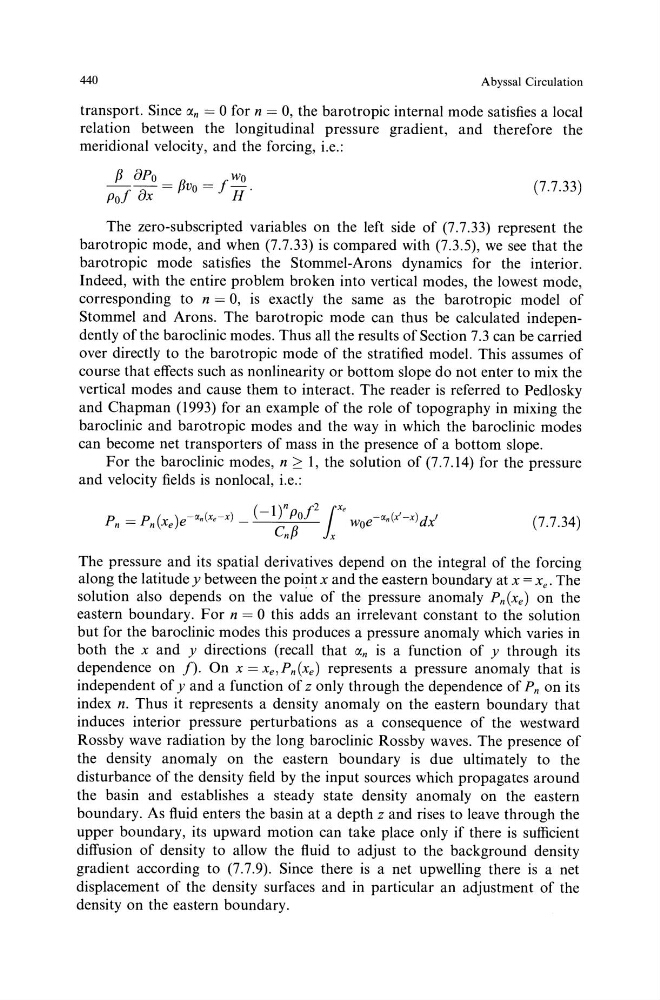
transport. Since an = 0 for n = 0, the barotropic internal mode satisfies a local
relation between the longitudinal pressure gradient, and therefore the
meridional velocity, and the forcing, i.e.:
(7.7.33)
The zero-subscripted variables on the left side of (7. 7 .33) represent the
barotropic mode, and when (7.7.33) is compared with (7.3.5), we see that the
barotropic mode satisfies the Stommel-Arons dynamics for the interior.
Indeed, with the entire problem broken into vertical modes, the lowest mode,
corresponding to n = 0, is exactly the same as the barotropic model of
Stommel and Arons. The barotropic mode can thus be calculated independently of the baroclinic modes. Thus all the results of Section 7.3 can be carried
over directly to the barotropic mode of the stratified model. This assumes of
course that effects such as nonlinearity or bottom slope do not enter to mix the
vertical modes and cause them to interact. The reader is referred to Pedlosky
and Chapman (1993) for an example of the role of topography in mixing the
baroclinic and barotropic modes and the way in which the baroclinic modes
can become net transporters of mass in the presence of a bottom slope.
For the baroclinic modes, n:;:. 1, the solution of (7.7.14) for the pressure
and velocity fields is nonlocal, i.e.:
(7. 7.34)
The pressure and its spatial derivatives depend on the integral of the forcing
along the latitude y between the point x and the eastern boundary at x = xe. The
solution also depends on the value of the pressure anomaly Pn(xe) on the
eastern boundary. For n = 0 this adds an irrelevant constant to the solution
but for the baroclinic modes this produces a pressure anomaly which varies in
both the x and y directions (recall that an is a function of y through its
dependence on f). On x = xe,Pn(xe) represents a pressure anomaly that is
independent of y and a function of z only through the dependence of Pn on its
index n. Thus it represents a density anomaly on the eastern boundary that
induces interior pressure perturbations as a consequence of the westward
Rossby wave radiation by the long baroclinic Rossby waves. The presence of
the density anomaly on the eastern boundary is due ultimately to the
disturbance of the density field by the input sources which propagates around
the basin and establishes a steady state density anomaly on the eastern
boundary. As fluid enters the basin at a depth z and rises to leave through the
upper boundary, its upward motion can take place only if there is sufficient
diffusion of density to allow the fluid to adjust to the background density
gradient according to (7.7.9). Since there is a net upwelling there is a net
displacement of the density surfaces and in particular an adjustment of the
density on the eastern boundary.
Abyssal Circulation
transport. Since an = 0 for n = 0, the barotropic internal mode satisfies a local
relation between the longitudinal pressure gradient, and therefore the
meridional velocity, and the forcing, i.e.:
(7.7.33)
The zero-subscripted variables on the left side of (7. 7 .33) represent the
barotropic mode, and when (7.7.33) is compared with (7.3.5), we see that the
barotropic mode satisfies the Stommel-Arons dynamics for the interior.
Indeed, with the entire problem broken into vertical modes, the lowest mode,
corresponding to n = 0, is exactly the same as the barotropic model of
Stommel and Arons. The barotropic mode can thus be calculated independently of the baroclinic modes. Thus all the results of Section 7.3 can be carried
over directly to the barotropic mode of the stratified model. This assumes of
course that effects such as nonlinearity or bottom slope do not enter to mix the
vertical modes and cause them to interact. The reader is referred to Pedlosky
and Chapman (1993) for an example of the role of topography in mixing the
baroclinic and barotropic modes and the way in which the baroclinic modes
can become net transporters of mass in the presence of a bottom slope.
For the baroclinic modes, n:;:. 1, the solution of (7.7.14) for the pressure
and velocity fields is nonlocal, i.e.:
(7. 7.34)
The pressure and its spatial derivatives depend on the integral of the forcing
along the latitude y between the point x and the eastern boundary at x = xe. The
solution also depends on the value of the pressure anomaly Pn(xe) on the
eastern boundary. For n = 0 this adds an irrelevant constant to the solution
but for the baroclinic modes this produces a pressure anomaly which varies in
both the x and y directions (recall that an is a function of y through its
dependence on f). On x = xe,Pn(xe) represents a pressure anomaly that is
independent of y and a function of z only through the dependence of Pn on its
index n. Thus it represents a density anomaly on the eastern boundary that
induces interior pressure perturbations as a consequence of the westward
Rossby wave radiation by the long baroclinic Rossby waves. The presence of
the density anomaly on the eastern boundary is due ultimately to the
disturbance of the density field by the input sources which propagates around
the basin and establishes a steady state density anomaly on the eastern
boundary. As fluid enters the basin at a depth z and rises to leave through the
upper boundary, its upward motion can take place only if there is sufficient
diffusion of density to allow the fluid to adjust to the background density
gradient according to (7.7.9). Since there is a net upwelling there is a net
displacement of the density surfaces and in particular an adjustment of the
density on the eastern boundary.