

Vertical Structure of the Abyssal Circulation
439
1
h
p
i
- 12 [p(xe)- p(xw)]dy =
s(r,z)d£
~ ~
c
(7.7.27)
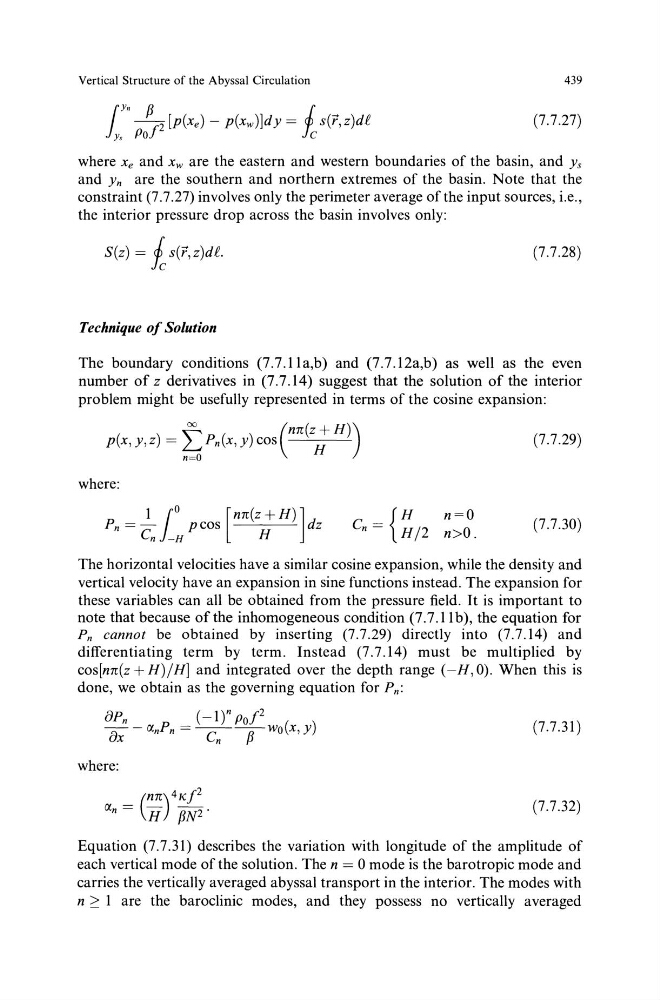
where Xe and xw are the eastern and western boundaries of the basin, and Ys
and Yn are the southern and northern extremes of the basin. Note that the
constraint (7.7.27) involves only the perimeter average of the input sources, i.e.,
the interior pressure drop across the basin involves only:
S(z) = £ s(r,z)d£.
(7.7.28)
Technique of Solution
The boundary conditions (7.7.11a,b) and (7.7.12a,b) as well as the even
number of z derivatives in (7.7.14) suggest that the solution of the interior
problem might be usefully represented in terms of the cosine expansion:
~
(nn(z+H))
p(x, y,z) = ~Pn(x, y) cos
H
(7.7.29)
where:
_ 1 1° [mr:(z+H)]d
Pn -C
pcos
H
z
n -H
{
H
n=O
c- n - H/2 n>O.
(7.7.30)
The horizontal velocities have a similar cosine expansion, while the density and
vertical velocity have an expansion in sine functions instead. The expansion for
these variables can all be obtained from the pressure field. It is important to
note that because of the inhomogeneous condition (7. 7.11 b), the equation for
Pn cannot be obtained by inserting (7.7.29) directly into (7.7.14) and
differentiating term by term. Instead (7.7.14) must be multiplied by
cos[nn(z + H)/H] and integrated over the depth range ( -H, 0). When this is
done, we obtain as the governing equation for Pn:
8Pn
( -1 t Pof 2
ox - ~nPn = c;:-pwo(x, y)
(7.7.31)
where:
- (nn)4Kf2
~n- H PN2 .
(7.7.32)
Equation (7.7.31) describes the variation with longitude of the amplitude of
each vertical mode of the solution. The n = 0 mode is the barotropic mode and
carries the vertically averaged abyssal transport in the interior. The modes with
n ~ 1 are the baroclinic modes, and they possess no vertically averaged
439
1
h
p
i
- 12 [p(xe)- p(xw)]dy =
s(r,z)d£
~ ~
c
(7.7.27)
where Xe and xw are the eastern and western boundaries of the basin, and Ys
and Yn are the southern and northern extremes of the basin. Note that the
constraint (7.7.27) involves only the perimeter average of the input sources, i.e.,
the interior pressure drop across the basin involves only:
S(z) = £ s(r,z)d£.
(7.7.28)
Technique of Solution
The boundary conditions (7.7.11a,b) and (7.7.12a,b) as well as the even
number of z derivatives in (7.7.14) suggest that the solution of the interior
problem might be usefully represented in terms of the cosine expansion:
~
(nn(z+H))
p(x, y,z) = ~Pn(x, y) cos
H
(7.7.29)
where:
_ 1 1° [mr:(z+H)]d
Pn -C
pcos
H
z
n -H
{
H
n=O
c- n - H/2 n>O.
(7.7.30)
The horizontal velocities have a similar cosine expansion, while the density and
vertical velocity have an expansion in sine functions instead. The expansion for
these variables can all be obtained from the pressure field. It is important to
note that because of the inhomogeneous condition (7. 7.11 b), the equation for
Pn cannot be obtained by inserting (7.7.29) directly into (7.7.14) and
differentiating term by term. Instead (7.7.14) must be multiplied by
cos[nn(z + H)/H] and integrated over the depth range ( -H, 0). When this is
done, we obtain as the governing equation for Pn:
8Pn
( -1 t Pof 2
ox - ~nPn = c;:-pwo(x, y)
(7.7.31)
where:
- (nn)4Kf2
~n- H PN2 .
(7.7.32)
Equation (7.7.31) describes the variation with longitude of the amplitude of
each vertical mode of the solution. The n = 0 mode is the barotropic mode and
carries the vertically averaged abyssal transport in the interior. The modes with
n ~ 1 are the baroclinic modes, and they possess no vertically averaged