

Vertical Structure of the Abyssal Circulation
443
(7.7.42)
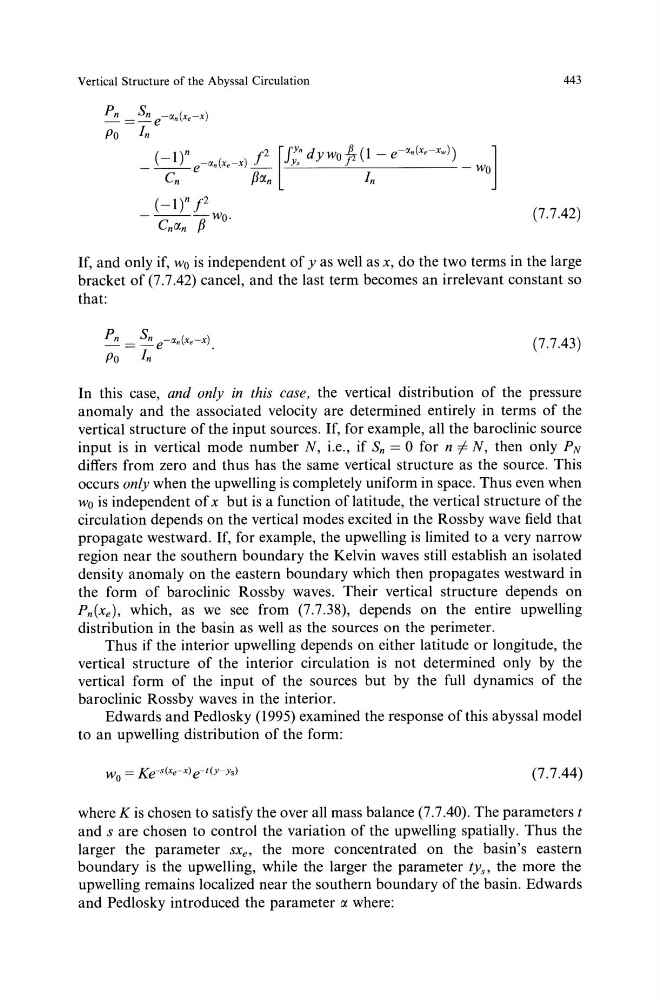
If, and only if, w0 is independent of y as well as x, do the two terms in the large
bracket of (7.7.42) cancel, and the last term becomes an irrelevant constant so
that:
Pn = Sn e-~n(x,-x)_
Po
In
(7.7.43)
In this case, and only in this case, the vertical distribution of the pressure
anomaly and the associated velocity are determined entirely in terms of the
vertical structure of the input sources. If, for example, all the baroclinic source
input is in vertical mode number N, i.e., if Sn = 0 for n -j. N, then only PN
differs from zero and thus has the same vertical structure as the source. This
occurs only when the upwelling is completely uniform in space. Thus even when
wo is independent of x but is a function of latitude, the vertical structure of the
circulation depends on the vertical modes excited in the Rossby wave field that
propagate westward. If, for example, the upwelling is limited to a very narrow
region near the southern boundary the Kelvin waves still establish an isolated
density anomaly on the eastern boundary which then propagates westward in
the form of baroclinic Rossby waves. Their vertical structure depends on
Pn(xe), which, as we see from (7.7.38), depends on the entire upwelling
distribution in the basin as well as the sources on the perimeter.
Thus if the interior upwelling depends on either latitude or longitude, the
vertical structure of the interior circulation is not determined only by the
vertical form of the input of the sources but by the full dynamics of the
baroclinic Rossby waves in the interior.
Edwards and Pedlosky (1995) examined the response of this abyssal model
to an upwelling distribution of the form:
(7.7.44)
where K is chosen to satisfy the over all mass balance (7.7.40). The parameters t
and s are chosen to control the variation of the upwelling spatially. Thus the
larger the parameter sxe, the more concentrated on the basin's eastern
boundary is the upwelling, while the larger the parameter ty" the more the
upwelling remains localized near the southern boundary of the basin. Edwards
and Pedlosky introduced the parameter rx where:
443
(7.7.42)
If, and only if, w0 is independent of y as well as x, do the two terms in the large
bracket of (7.7.42) cancel, and the last term becomes an irrelevant constant so
that:
Pn = Sn e-~n(x,-x)_
Po
In
(7.7.43)
In this case, and only in this case, the vertical distribution of the pressure
anomaly and the associated velocity are determined entirely in terms of the
vertical structure of the input sources. If, for example, all the baroclinic source
input is in vertical mode number N, i.e., if Sn = 0 for n -j. N, then only PN
differs from zero and thus has the same vertical structure as the source. This
occurs only when the upwelling is completely uniform in space. Thus even when
wo is independent of x but is a function of latitude, the vertical structure of the
circulation depends on the vertical modes excited in the Rossby wave field that
propagate westward. If, for example, the upwelling is limited to a very narrow
region near the southern boundary the Kelvin waves still establish an isolated
density anomaly on the eastern boundary which then propagates westward in
the form of baroclinic Rossby waves. Their vertical structure depends on
Pn(xe), which, as we see from (7.7.38), depends on the entire upwelling
distribution in the basin as well as the sources on the perimeter.
Thus if the interior upwelling depends on either latitude or longitude, the
vertical structure of the interior circulation is not determined only by the
vertical form of the input of the sources but by the full dynamics of the
baroclinic Rossby waves in the interior.
Edwards and Pedlosky (1995) examined the response of this abyssal model
to an upwelling distribution of the form:
(7.7.44)
where K is chosen to satisfy the over all mass balance (7.7.40). The parameters t
and s are chosen to control the variation of the upwelling spatially. Thus the
larger the parameter sxe, the more concentrated on the basin's eastern
boundary is the upwelling, while the larger the parameter ty" the more the
upwelling remains localized near the southern boundary of the basin. Edwards
and Pedlosky introduced the parameter rx where: