

Establishment of the Abyssal Circulation
HEIGiT - DEliA • 0.01
X
427
VEl.DCTY - DEliA • 0.01
~~------------------------~
: '
I
~ I
· I
I
I
I
I
I
• I
:
I
• I
I
• I I
I . . . . . . . . . . . . . . , , I I
\ • • • • • • • • • • • • - - , , I I
~ '-------------~~~//
- ~
~ )II )II~ • • I I I I I
1-------------. . . ,\
1 -------------~''''' - - - - - - - - - - - - -~ ' ' ' ' \
0
0
0
•
0
• •
0
•
..
..
..
..
...
'
\
\
•
0
I
•
;
. ' \
' I
' I
• I
• I
• I
b 1+---~r---~----~----~--~ o.o
o.z
0.4
0.1
o.e
LO
X
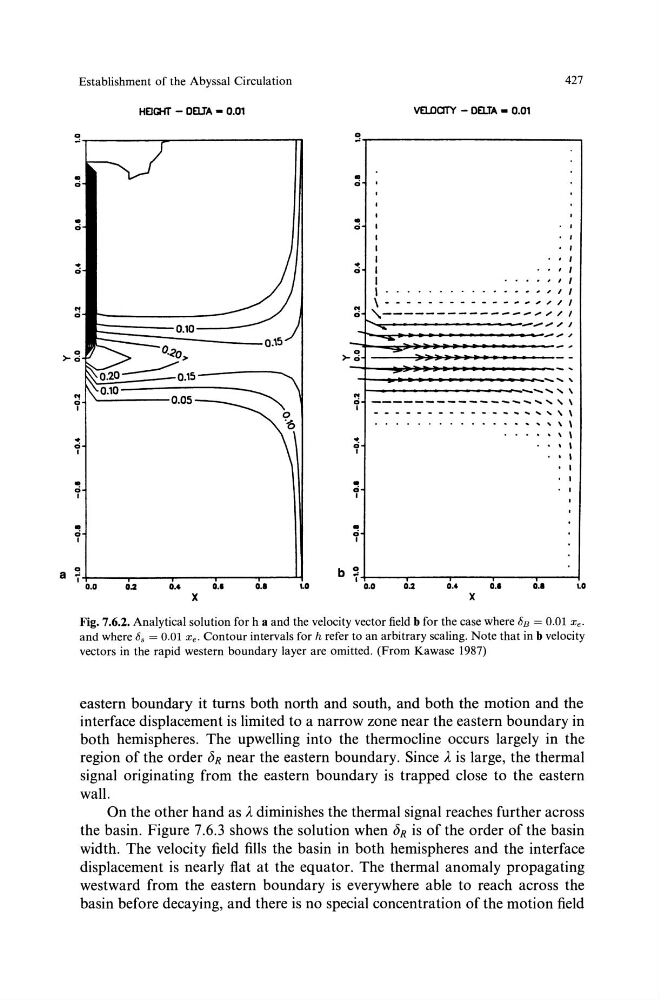
Fig. 7.6.2. Analytical solution for h a and the velocity vector field b for the case where 15n = 0.01 Xeand where 15, = 0.01 xe. Contour intervals for h refer to an arbitrary scaling. Note that in b velocity
vectors in the rapid western boundary layer are omitted. (From Kawase 1987)
eastern boundary it turns both north and south, and both the motion and the
interface displacement is limited to a narrow zone near the eastern boundary in
both hemispheres. The upwelling into the thermocline occurs largely in the
region of the order bR near the eastern boundary. Since A. is large, the thermal
signal originating from the eastern boundary is trapped close to the eastern
wall.
On the other hand as A. diminishes the thermal signal reaches further across
the basin. Figure 7.6.3 shows the solution when bR is of the order of the basin
width. The velocity field fills the basin in both hemispheres and the interface
displacement is nearly flat at the equator. The thermal anomaly propagating
westward from the eastern boundary is everywhere able to reach across the
basin before decaying, and there is no special concentration of the motion field
HEIGiT - DEliA • 0.01
X
427
VEl.DCTY - DEliA • 0.01
~~------------------------~
: '
I
~ I
· I
I
I
I
I
I
• I
:
I
• I
I
• I I
I . . . . . . . . . . . . . . , , I I
\ • • • • • • • • • • • • - - , , I I
~ '-------------~~~//
- ~
~ )II )II~ • • I I I I I
1-------------. . . ,\
1 -------------~''''' - - - - - - - - - - - - -~ ' ' ' ' \
0
0
0
•
0
• •
0
•
..
..
..
..
...
'
\
\
•
0
I
•
;
. ' \
' I
' I
• I
• I
• I
b 1+---~r---~----~----~--~ o.o
o.z
0.4
0.1
o.e
LO
X
Fig. 7.6.2. Analytical solution for h a and the velocity vector field b for the case where 15n = 0.01 Xeand where 15, = 0.01 xe. Contour intervals for h refer to an arbitrary scaling. Note that in b velocity
vectors in the rapid western boundary layer are omitted. (From Kawase 1987)
eastern boundary it turns both north and south, and both the motion and the
interface displacement is limited to a narrow zone near the eastern boundary in
both hemispheres. The upwelling into the thermocline occurs largely in the
region of the order bR near the eastern boundary. Since A. is large, the thermal
signal originating from the eastern boundary is trapped close to the eastern
wall.
On the other hand as A. diminishes the thermal signal reaches further across
the basin. Figure 7.6.3 shows the solution when bR is of the order of the basin
width. The velocity field fills the basin in both hemispheres and the interface
displacement is nearly flat at the equator. The thermal anomaly propagating
westward from the eastern boundary is everywhere able to reach across the
basin before decaying, and there is no special concentration of the motion field