

426
Abyssal Circulation
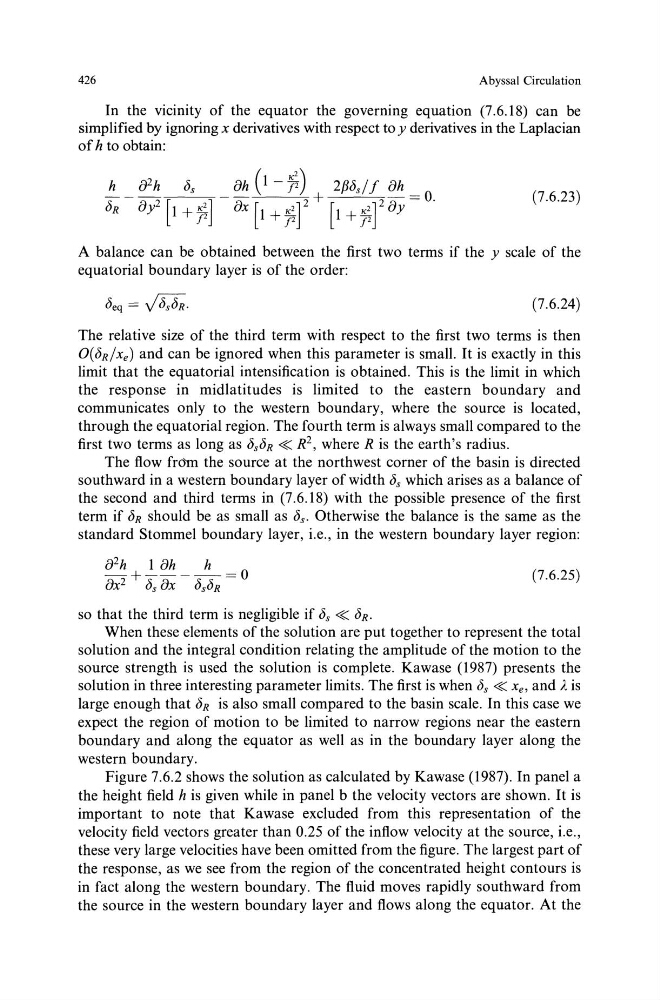
In the vicinity of the equator the governing equation (7.6.18) can be
simplified by ignoring x derivatives with respect toy derivatives in the Laplacian
of h to obtain:
(7.6.23)
A balance can be obtained between the first two terms if the y scale of the
equatorial boundary layer is of the order:
(7.6.24)
The relative size of the third term with respect to the first two terms is then
O({JR/xe) and can be ignored when this parameter is small. It is exactly in this
limit that the equatorial intensification is obtained. This is the limit in which
the response in midlatitudes is limited to the eastern boundary and
communicates only to the western boundary, where the source is located,
through the equatorial region. The fourth term is always small compared to the
first two terms as long as {Js{JR « R 2 , where R is the earth's radius.
The flow frdm the source at the northwest corner of the basin is directed
southward in a western boundary layer of width bs which arises as a balance of
the second and third terms in (7 .6.18) with the possible presence of the first
term if {JR should be as small as bs. Otherwise the balance is the same as the
standard Stommel boundary layer, i.e., in the western boundary layer region:
(7.6.25)
so that the third term is negligible if bs « {JR·
When these elements of the solution are put together to represent the total
solution and the integral condition relating the amplitude of the motion to the
source strength is used the solution is complete. Kawase (1987) presents the
solution in three interesting parameter limits. The first is when bs « Xe, and A. is
large enough that {JR is also small compared to the basin scale. In this case we
expect the region of motion to be limited to narrow regions near the eastern
boundary and along the equator as well as in the boundary layer along the
western boundary.
Figure 7.6.2 shows the solution as calculated by Kawase (1987). In panel a
the height field h is given while in panel b the velocity vectors are shown. It is
important to note that Kawase excluded from this representation of the
velocity field vectors greater than 0.25 of the inflow velocity at the source, i.e.,
these very large velocities have been omitted from the figure. The largest part of
the response, as we see from the region of the concentrated height contours is
in fact along the western boundary. The fluid moves rapidly southward from
the source in the western boundary layer and flows along the equator. At the
Abyssal Circulation
In the vicinity of the equator the governing equation (7.6.18) can be
simplified by ignoring x derivatives with respect toy derivatives in the Laplacian
of h to obtain:
(7.6.23)
A balance can be obtained between the first two terms if the y scale of the
equatorial boundary layer is of the order:
(7.6.24)
The relative size of the third term with respect to the first two terms is then
O({JR/xe) and can be ignored when this parameter is small. It is exactly in this
limit that the equatorial intensification is obtained. This is the limit in which
the response in midlatitudes is limited to the eastern boundary and
communicates only to the western boundary, where the source is located,
through the equatorial region. The fourth term is always small compared to the
first two terms as long as {Js{JR « R 2 , where R is the earth's radius.
The flow frdm the source at the northwest corner of the basin is directed
southward in a western boundary layer of width bs which arises as a balance of
the second and third terms in (7 .6.18) with the possible presence of the first
term if {JR should be as small as bs. Otherwise the balance is the same as the
standard Stommel boundary layer, i.e., in the western boundary layer region:
(7.6.25)
so that the third term is negligible if bs « {JR·
When these elements of the solution are put together to represent the total
solution and the integral condition relating the amplitude of the motion to the
source strength is used the solution is complete. Kawase (1987) presents the
solution in three interesting parameter limits. The first is when bs « Xe, and A. is
large enough that {JR is also small compared to the basin scale. In this case we
expect the region of motion to be limited to narrow regions near the eastern
boundary and along the equator as well as in the boundary layer along the
western boundary.
Figure 7.6.2 shows the solution as calculated by Kawase (1987). In panel a
the height field h is given while in panel b the velocity vectors are shown. It is
important to note that Kawase excluded from this representation of the
velocity field vectors greater than 0.25 of the inflow velocity at the source, i.e.,
these very large velocities have been omitted from the figure. The largest part of
the response, as we see from the region of the concentrated height contours is
in fact along the western boundary. The fluid moves rapidly southward from
the source in the western boundary layer and flows along the equator. At the