

Establishment of the Abyssal Circulation
425
In most cases of interest {Js « {JR:::; Xe. Indeed, outside of the western boundary
layer, and away from the equator, the terms inK in (7.6.18) are negligible, and
the dynamics reduces to a balance of the first two terms of the equation so that
almost everywhere the equation for h becomes:
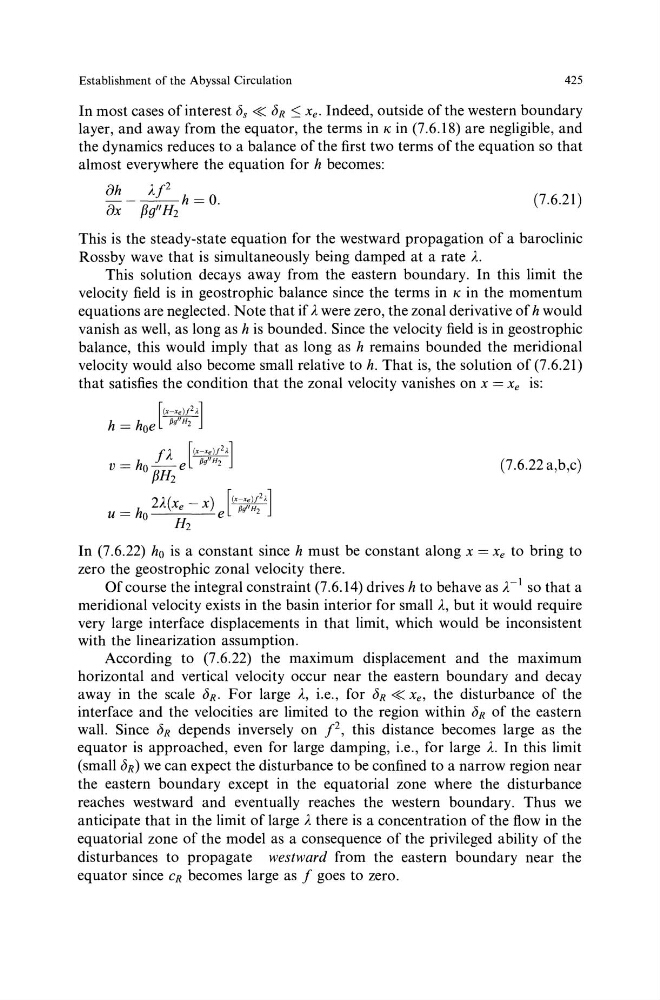
8h - ).f2 h = 0.
8x f3g"H2
(7.6.21)
This is the steady-state equation for the westward propagation of a baroclinic
Rossby wave that is simultaneously being damped at a rate A.
This solution decays away from the eastern boundary. In this limit the
velocity field is in geostrophic balance since the terms in K in the momentum
equations are neglected. Note that if A were zero, the zonal derivative of h would
vanish as well, as long as h is bounded. Since the velocity field is in geostrophic
balance, this would imply that as long as h remains bounded the meridional
velocity would also become small relative to h. That is, the solution of (7.6.21)
that satisfies the condition that the zonal velocity vanishes on x = Xe is:
[ (x-xe )! 2 . 1]
h =hoe pg"H2
J A [(x-x5Jt.l]
v =ho--e Prl 2
f3H2
2A(x - x) [(x-xe)/2.1]
U = ho
e
e pg"H2
H2
(7.6.22 a,b,c)
In (7.6.22) ho is a constant since h must be constant along x = Xe to bring to
zero the geostrophic zonal velocity there.
Of course the integral constraint (7 .6.14) drives h to behave as r 1 so that a
meridional velocity exists in the basin interior for small A, but it would require
very large interface displacements in that limit, which would be inconsistent
with the linearization assumption.
According to (7.6.22) the maximum displacement and the maximum
horizontal and vertical velocity occur near the eastern boundary and decay
away in the scale {JR· For large A, i.e., for {JR « Xe, the disturbance of the
interface and the velocities are limited to the region within {JR of the eastern
wall. Since {JR depends inversely on f 2 , this distance becomes large as the
equator is approached, even for large damping, i.e., for large A. In this limit
(small {JR) we can expect the disturbance to be confined to a narrow region near
the eastern boundary except in the equatorial zone where the disturbance
reaches westward and eventually reaches the western boundary. Thus we
anticipate that in the limit of large A there is a concentration of the flow in the
equatorial zone of the model as a consequence of the privileged ability of the
disturbances to propagate westward from the eastern boundary near the
equator since cR becomes large as f goes to zero.
425
In most cases of interest {Js « {JR:::; Xe. Indeed, outside of the western boundary
layer, and away from the equator, the terms inK in (7.6.18) are negligible, and
the dynamics reduces to a balance of the first two terms of the equation so that
almost everywhere the equation for h becomes:
8h - ).f2 h = 0.
8x f3g"H2
(7.6.21)
This is the steady-state equation for the westward propagation of a baroclinic
Rossby wave that is simultaneously being damped at a rate A.
This solution decays away from the eastern boundary. In this limit the
velocity field is in geostrophic balance since the terms in K in the momentum
equations are neglected. Note that if A were zero, the zonal derivative of h would
vanish as well, as long as h is bounded. Since the velocity field is in geostrophic
balance, this would imply that as long as h remains bounded the meridional
velocity would also become small relative to h. That is, the solution of (7.6.21)
that satisfies the condition that the zonal velocity vanishes on x = Xe is:
[ (x-xe )! 2 . 1]
h =hoe pg"H2
J A [(x-x5Jt.l]
v =ho--e Prl 2
f3H2
2A(x - x) [(x-xe)/2.1]
U = ho
e
e pg"H2
H2
(7.6.22 a,b,c)
In (7.6.22) ho is a constant since h must be constant along x = Xe to bring to
zero the geostrophic zonal velocity there.
Of course the integral constraint (7 .6.14) drives h to behave as r 1 so that a
meridional velocity exists in the basin interior for small A, but it would require
very large interface displacements in that limit, which would be inconsistent
with the linearization assumption.
According to (7.6.22) the maximum displacement and the maximum
horizontal and vertical velocity occur near the eastern boundary and decay
away in the scale {JR· For large A, i.e., for {JR « Xe, the disturbance of the
interface and the velocities are limited to the region within {JR of the eastern
wall. Since {JR depends inversely on f 2 , this distance becomes large as the
equator is approached, even for large damping, i.e., for large A. In this limit
(small {JR) we can expect the disturbance to be confined to a narrow region near
the eastern boundary except in the equatorial zone where the disturbance
reaches westward and eventually reaches the western boundary. Thus we
anticipate that in the limit of large A there is a concentration of the flow in the
equatorial zone of the model as a consequence of the privileged ability of the
disturbances to propagate westward from the eastern boundary near the
equator since cR becomes large as f goes to zero.