

424
Abyssal Circulation
thermal dissipation since K is generally considered small nearly everywhere.
The vertical velocity at any location depends then on the thermal anomaly
produced by the abyssal motion itself. In particular, in the absence of advection
in the model, the thermal anomaly introduced into the basin in the region of
the source propagates through the basin, and the consequences of the balance
of thermal propagation and dissipation determine the spatial structure of the
motion field in the model.
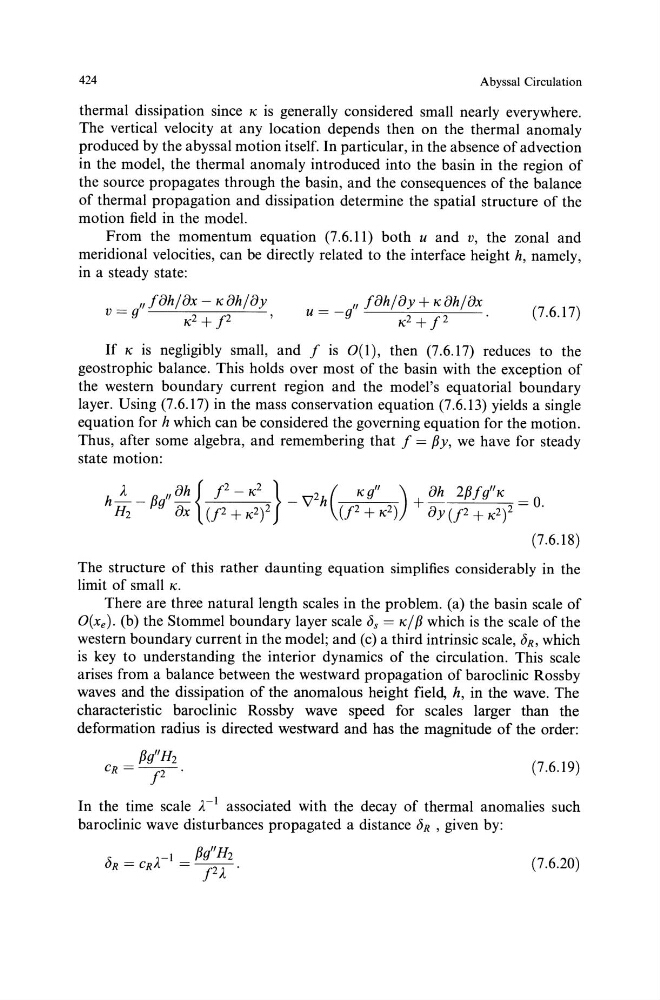
From the momentum equation (7 .6.11) both u and v, the zonal and
meridional velocities, can be directly related to the interface height h, namely,
in a steady state:
,,J8hj8x- Koh/oy
V = g
K2 + j2
'
(7.6.17)
If K is negligibly small, and f is 0(1), then (7.6.17) reduces to the
geostrophic balance. This holds over most of the basin with the exception of
the western boundary current region and the model's equatorial boundary
layer. Using (7.6.17) in the mass conservation equation (7.6.13) yields a single
equation for h which can be considered the governing equation for the motion.
Thus, after some algebra, and remembering that f = f3y, we have for steady
state motion:
The structure of this rather daunting equation simplifies considerably in the
limit of small K.
There are three natural length scales in the problem. (a) the basin scale of
O(xe)· (b) the Stommel boundary layer scale bs = K//3 which is the scale of the
western boundary current in the model; and (c) a third intrinsic scale, bR, which
is key to understanding the interior dynamics of the circulation. This scale
arises from a balance between the westward propagation of baroclinic Ross by
waves and the dissipation of the anomalous height field, h, in the wave. The
characteristic baroclinic Rossby wave speed for scales larger than the
deformation radius is directed westward and has the magnitude of the order:
f3g" H2
C R = ------p- .
(7.6.19)
In the time scale r 1 associated with the decay of thermal anomalies such
baroclinic wave disturbances propagated a distance [JR , given by:
_ 1
f3g"H2
bR=CRA = j2A ·
(7.6.20)
Abyssal Circulation
thermal dissipation since K is generally considered small nearly everywhere.
The vertical velocity at any location depends then on the thermal anomaly
produced by the abyssal motion itself. In particular, in the absence of advection
in the model, the thermal anomaly introduced into the basin in the region of
the source propagates through the basin, and the consequences of the balance
of thermal propagation and dissipation determine the spatial structure of the
motion field in the model.
From the momentum equation (7 .6.11) both u and v, the zonal and
meridional velocities, can be directly related to the interface height h, namely,
in a steady state:
,,J8hj8x- Koh/oy
V = g
K2 + j2
'
(7.6.17)
If K is negligibly small, and f is 0(1), then (7.6.17) reduces to the
geostrophic balance. This holds over most of the basin with the exception of
the western boundary current region and the model's equatorial boundary
layer. Using (7.6.17) in the mass conservation equation (7.6.13) yields a single
equation for h which can be considered the governing equation for the motion.
Thus, after some algebra, and remembering that f = f3y, we have for steady
state motion:
The structure of this rather daunting equation simplifies considerably in the
limit of small K.
There are three natural length scales in the problem. (a) the basin scale of
O(xe)· (b) the Stommel boundary layer scale bs = K//3 which is the scale of the
western boundary current in the model; and (c) a third intrinsic scale, bR, which
is key to understanding the interior dynamics of the circulation. This scale
arises from a balance between the westward propagation of baroclinic Ross by
waves and the dissipation of the anomalous height field, h, in the wave. The
characteristic baroclinic Rossby wave speed for scales larger than the
deformation radius is directed westward and has the magnitude of the order:
f3g" H2
C R = ------p- .
(7.6.19)
In the time scale r 1 associated with the decay of thermal anomalies such
baroclinic wave disturbances propagated a distance [JR , given by:
_ 1
f3g"H2
bR=CRA = j2A ·
(7.6.20)