

Establishment of the Abyssal Circulation
423
w=Ah
(7.6.12)
Kawase (see also Tziperman 1987) argues that (7.6.12) is the appropriate twolayer finite-difference analog of the equation of a continuously stratified model
representing a balance between vertical advection and heat conduction.
However, it is probably clearer and preferable to accept (7.6.12) on its own
terms as a model for the cross-isopycnal flux in the two-layer model. This
implies that if the thickness of the lower layer increases, a compensating mass
flux into the upper layer from the lower layer tends to act to damp the thickness
anomaly and drive the system towards its original state, eliminating the
thermal anomaly represented by the interface distortion. In fact, the continuity
equation, (7.6.4) now becomes:
ah + Hz [auz + av 2 ] = _ A.h
at
ax ay
(7.6.13)
in which the damping of the thermal anomaly associated with the interface
displacement is evident. The time scale for this thermal dissipation to restore
the interface to its undisturbed value, i.e., the time required to damp out the
thermal anomalies is r I.
We are particularly interested in steady solutions of the governing
equations (7.6.11) and (7.6.13). In the steady state the global departure of
the interface from its rest position is obtained by integrating (7.6.13) over the
basin and using the fact that a net flux, equal to Q, enters through the lateral
boundary:
;.f1 hdxdy= Q
(7.6.14)
where A is the total area of the basin. Since the problem is linear, the structure
of the solution is independent of the strength of the forcing, and (7.6.14) serves
only to determine the amplitude of the motion. The structure is determined by
the internal dynamics, and we focus our attention on this.
For diagnostic purposes it is useful to consider the potential vorticity
equation. If the vorticity equation is formed from the curl of the momentum
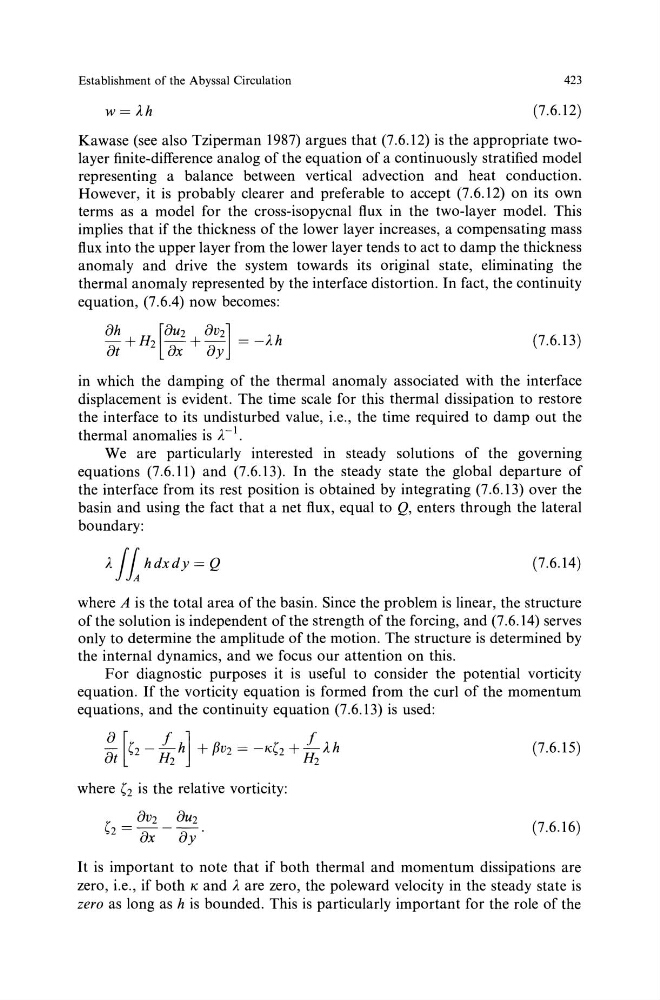
equations, and the continuity equation (7 .6.13) is used:
where (2 is the relative vorticity:
(z = avz - auz .
ax ay
(7.6.15)
(7.6.16)
It is important to note that if both thermal and momentum dissipations are
zero, i.e., if both K and ). are zero, the poleward velocity in the steady state is
zero as long as h is bounded. This is particularly important for the role of the
423
w=Ah
(7.6.12)
Kawase (see also Tziperman 1987) argues that (7.6.12) is the appropriate twolayer finite-difference analog of the equation of a continuously stratified model
representing a balance between vertical advection and heat conduction.
However, it is probably clearer and preferable to accept (7.6.12) on its own
terms as a model for the cross-isopycnal flux in the two-layer model. This
implies that if the thickness of the lower layer increases, a compensating mass
flux into the upper layer from the lower layer tends to act to damp the thickness
anomaly and drive the system towards its original state, eliminating the
thermal anomaly represented by the interface distortion. In fact, the continuity
equation, (7.6.4) now becomes:
ah + Hz [auz + av 2 ] = _ A.h
at
ax ay
(7.6.13)
in which the damping of the thermal anomaly associated with the interface
displacement is evident. The time scale for this thermal dissipation to restore
the interface to its undisturbed value, i.e., the time required to damp out the
thermal anomalies is r I.
We are particularly interested in steady solutions of the governing
equations (7.6.11) and (7.6.13). In the steady state the global departure of
the interface from its rest position is obtained by integrating (7.6.13) over the
basin and using the fact that a net flux, equal to Q, enters through the lateral
boundary:
;.f1 hdxdy= Q
(7.6.14)
where A is the total area of the basin. Since the problem is linear, the structure
of the solution is independent of the strength of the forcing, and (7.6.14) serves
only to determine the amplitude of the motion. The structure is determined by
the internal dynamics, and we focus our attention on this.
For diagnostic purposes it is useful to consider the potential vorticity
equation. If the vorticity equation is formed from the curl of the momentum
equations, and the continuity equation (7 .6.13) is used:
where (2 is the relative vorticity:
(z = avz - auz .
ax ay
(7.6.15)
(7.6.16)
It is important to note that if both thermal and momentum dissipations are
zero, i.e., if both K and ). are zero, the poleward velocity in the steady state is
zero as long as h is bounded. This is particularly important for the role of the