

Effect of Ridges and Gaps
413
velocity on the western side of the ridge where there is no boundary layer, and
the velocity is of the order l/J. Hence the condition (7.5.11) is equivalent, within
the boundary-layer approximation f> « Xe - x1, to the condition,
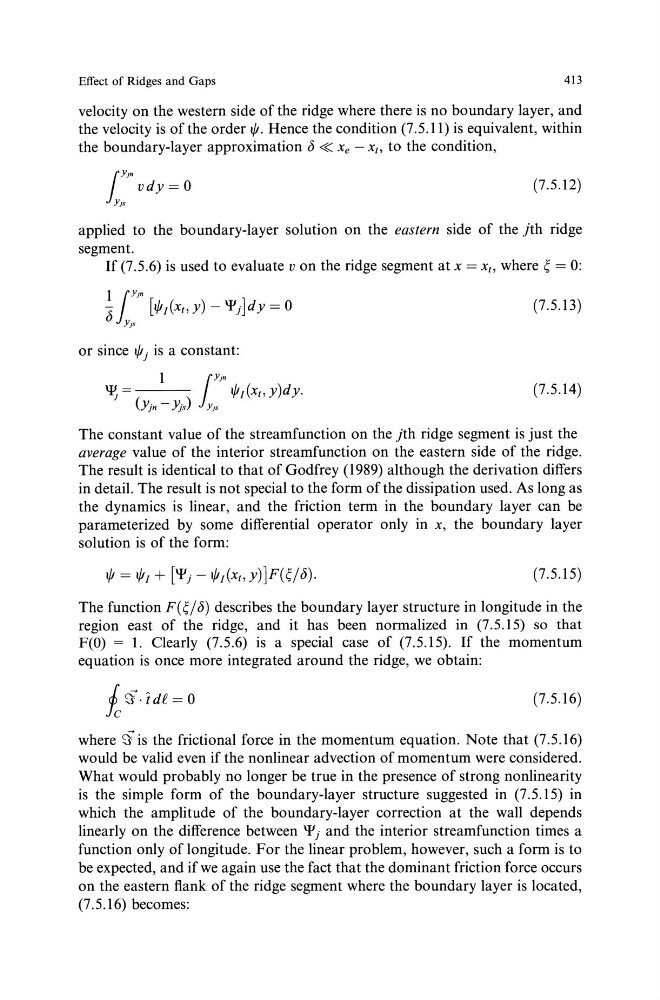
(7.5.12)
applied to the boundary-layer solution on the eastern side of the jth ridge
segment.
If (7.5.6) is used to evaluate von the ridge segment at x = x1, where ~ = 0:
(7.5.13)
or since ljJ 1 is a constant:
(7.5.14)
The constant value of the streamfunction on the jth ridge segment is just the
average value of the interior streamfunction on the eastern side of the ridge.
The result is identical to that of Godfrey (1989) although the derivation differs
in detail. The result is not special to the form of the dissipation used. As long as
the dynamics is linear, and the friction term in the boundary layer can be
parameterized by some differential operator only in x, the boundary layer
solution is of the form:
(7.5.15)
The function F( U b) describes the boundary layer structure in longitude in the
region east of the ridge, and it has been normalized in (7.5.15) so that
F(O) = 1. Clearly (7.5.6) is a special case of (7.5.15). If the momentum
equation is once more integrated around the ridge, we obtain:
i '5-td£=0
(7.5.16)
where '5 is the frictional force in the momentum equation. Note that (7.5.16)
would be valid even if the nonlinear advection of momentum were considered.
What would probably no longer be true in the presence of strong nonlinearity
is the simple form of the boundary-layer structure suggested in (7.5.15) in
which the amplitude of the boundary-layer correction at the wall depends
linearly on the difference between '¥ 1 and the interior streamfunction times a
function only of longitude. For the linear problem, however, such a form is to
be expected, and if we again use the fact that the dominant friction force occurs
on the eastern flank of the ridge segment where the boundary layer is located,
(7.5.16) becomes:
413
velocity on the western side of the ridge where there is no boundary layer, and
the velocity is of the order l/J. Hence the condition (7.5.11) is equivalent, within
the boundary-layer approximation f> « Xe - x1, to the condition,
(7.5.12)
applied to the boundary-layer solution on the eastern side of the jth ridge
segment.
If (7.5.6) is used to evaluate von the ridge segment at x = x1, where ~ = 0:
(7.5.13)
or since ljJ 1 is a constant:
(7.5.14)
The constant value of the streamfunction on the jth ridge segment is just the
average value of the interior streamfunction on the eastern side of the ridge.
The result is identical to that of Godfrey (1989) although the derivation differs
in detail. The result is not special to the form of the dissipation used. As long as
the dynamics is linear, and the friction term in the boundary layer can be
parameterized by some differential operator only in x, the boundary layer
solution is of the form:
(7.5.15)
The function F( U b) describes the boundary layer structure in longitude in the
region east of the ridge, and it has been normalized in (7.5.15) so that
F(O) = 1. Clearly (7.5.6) is a special case of (7.5.15). If the momentum
equation is once more integrated around the ridge, we obtain:
i '5-td£=0
(7.5.16)
where '5 is the frictional force in the momentum equation. Note that (7.5.16)
would be valid even if the nonlinear advection of momentum were considered.
What would probably no longer be true in the presence of strong nonlinearity
is the simple form of the boundary-layer structure suggested in (7.5.15) in
which the amplitude of the boundary-layer correction at the wall depends
linearly on the difference between '¥ 1 and the interior streamfunction times a
function only of longitude. For the linear problem, however, such a form is to
be expected, and if we again use the fact that the dominant friction force occurs
on the eastern flank of the ridge segment where the boundary layer is located,
(7.5.16) becomes: