

414
Abyssal Circulation
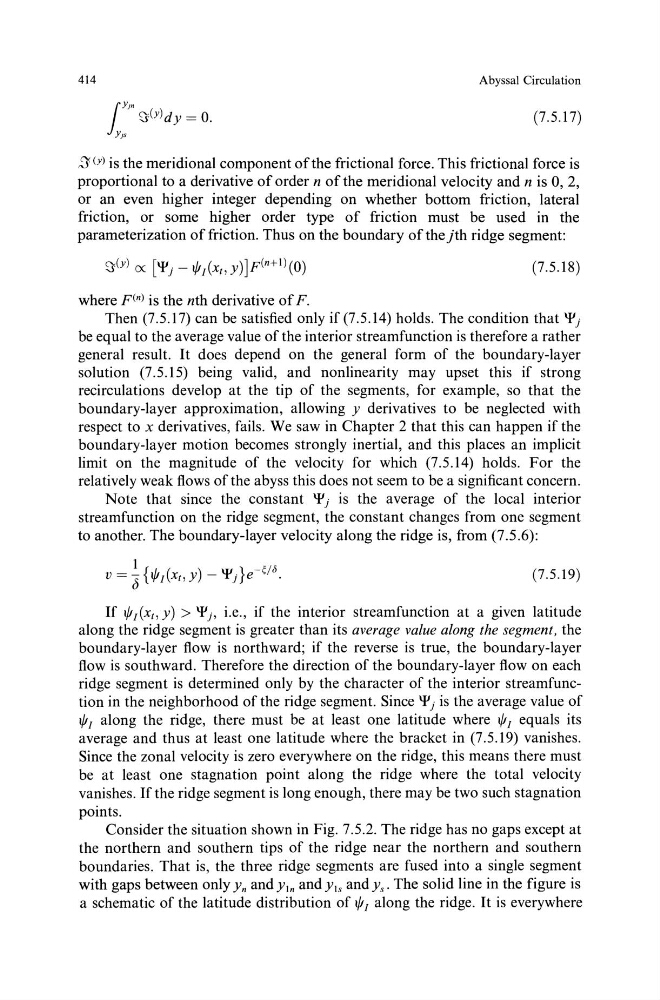
(7.5.17)
,3'CYl is the meridional component ofthe frictional force. This frictional force is
proportional to a derivative of order n of the meridional velocity and n is 0, 2,
or an even higher integer depending on whether bottom friction, lateral
friction, or some higher order type of friction must be used in the
parameterization of friction. Thus on the boundary of the jth ridge segment:
(7.5.18)
where FCnl is the nth derivative of F.
Then (7.5.17) can be satisfied only if (7.5.14) holds. The condition that 'Pi
be equal to the average value of the interior streamfunction is therefore a rather
general result. It does depend on the general form of the boundary-layer
solution (7.5.15) being valid, and nonlinearity may upset this if strong
recirculations develop at the tip of the segments, for example, so that the
boundary-layer approximation, allowing y derivatives to be neglected with
respect to x derivatives, fails. We saw in Chapter 2 that this can happen if the
boundary-layer motion becomes strongly inertial, and this places an implicit
limit on the magnitude of the velocity for which (7.5.14) holds. For the
relatively weak flows of the abyss this does not seem to be a significant concern.
Note that since the constant 'Pi is the average of the local interior
streamfunction on the ridge segment, the constant changes from one segment
to another. The boundary-layer velocity along the ridge is, from (7.5.6):
(7.5.19)
If ljl 1 (x1, y) >'Pi, i.e., if the interior streamfunction at a given latitude
along the ridge segment is greater than its average value along the segment, the
boundary-layer flow is northward; if the reverse is true, the boundary-layer
flow is southward. Therefore the direction of the boundary-layer flow on each
ridge segment is determined only by the character of the interior streamfunction in the neighborhood of the ridge segment. Since 'Pi is the average value of
ljl 1 along the ridge, there must be at least one latitude where 1/1 1 equals its
average and thus at least one latitude where the bracket in (7.5.19) vanishes.
Since the zonal velocity is zero everywhere on the ridge, this means there must
be at least one stagnation point along the ridge where the total velocity
vanishes. If the ridge segment is long enough, there may be two such stagnation
points.
Consider the situation shown in Fig. 7.5.2. The ridge has no gaps except at
the northern and southern tips of the ridge near the northern and southern
boundaries. That is, the three ridge segments are fused into a single segment
with gaps between only Yn andy1n andy1s andys. The solid line in the figure is
a schematic of the latitude distribution of 1/1 1 along the ridge. It is everywhere
Abyssal Circulation
(7.5.17)
,3'CYl is the meridional component ofthe frictional force. This frictional force is
proportional to a derivative of order n of the meridional velocity and n is 0, 2,
or an even higher integer depending on whether bottom friction, lateral
friction, or some higher order type of friction must be used in the
parameterization of friction. Thus on the boundary of the jth ridge segment:
(7.5.18)
where FCnl is the nth derivative of F.
Then (7.5.17) can be satisfied only if (7.5.14) holds. The condition that 'Pi
be equal to the average value of the interior streamfunction is therefore a rather
general result. It does depend on the general form of the boundary-layer
solution (7.5.15) being valid, and nonlinearity may upset this if strong
recirculations develop at the tip of the segments, for example, so that the
boundary-layer approximation, allowing y derivatives to be neglected with
respect to x derivatives, fails. We saw in Chapter 2 that this can happen if the
boundary-layer motion becomes strongly inertial, and this places an implicit
limit on the magnitude of the velocity for which (7.5.14) holds. For the
relatively weak flows of the abyss this does not seem to be a significant concern.
Note that since the constant 'Pi is the average of the local interior
streamfunction on the ridge segment, the constant changes from one segment
to another. The boundary-layer velocity along the ridge is, from (7.5.6):
(7.5.19)
If ljl 1 (x1, y) >'Pi, i.e., if the interior streamfunction at a given latitude
along the ridge segment is greater than its average value along the segment, the
boundary-layer flow is northward; if the reverse is true, the boundary-layer
flow is southward. Therefore the direction of the boundary-layer flow on each
ridge segment is determined only by the character of the interior streamfunction in the neighborhood of the ridge segment. Since 'Pi is the average value of
ljl 1 along the ridge, there must be at least one latitude where 1/1 1 equals its
average and thus at least one latitude where the bracket in (7.5.19) vanishes.
Since the zonal velocity is zero everywhere on the ridge, this means there must
be at least one stagnation point along the ridge where the total velocity
vanishes. If the ridge segment is long enough, there may be two such stagnation
points.
Consider the situation shown in Fig. 7.5.2. The ridge has no gaps except at
the northern and southern tips of the ridge near the northern and southern
boundaries. That is, the three ridge segments are fused into a single segment
with gaps between only Yn andy1n andy1s andys. The solid line in the figure is
a schematic of the latitude distribution of 1/1 1 along the ridge. It is everywhere