

412
Abyssal Circulation
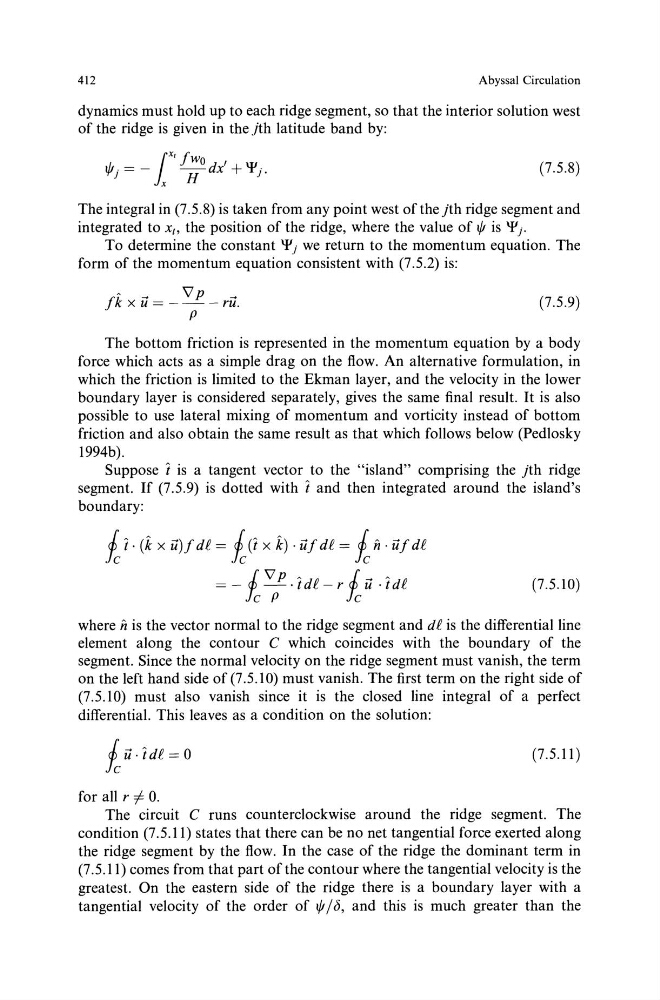
dynamics must hold up to each ridge segment, so that the interior solution west
of the ridge is given in the jth latitude band by:
l/1· = -
- 0 dx' + 'P ·
i
x'fw
J
X
H
]•
(7.5.8)
The integral in (7 .5.8) is taken from any point west of the jth ridge segment and
integrated to x1, the position of the ridge, where the value of 1/J is 'Pj.
To determine the constant 'Pj we return to the momentum equation. The
form of the momentum equation consistent with (7.5.2) is:
fk A -
'Vp
-
xu=---ru.
p
(7.5.9)
The bottom friction is represented in the momentum equation by a body
force which acts as a simple drag on the flow. An alternative formulation, in
which the friction is limited to the Ekman layer, and the velocity in the lower
boundary layer is considered separately, gives the same final result. It is also
possible to use lateral mixing of momentum and vorticity instead of bottom
friction and also obtain the same result as that which follows below (Pedlosky
1994b).
Suppose t is a tangent vector to the "island" comprising the jth ridge
segment. If (7.5.9) is dotted with t and then integrated around the island's
boundary:
£ t. (k x u)f d£ = £ (t x k) . uf d£ = £ n . uf d£
i
'VpA
t - A
= -
-
· tdf- r u · tdf
c p
c
(7.5.10)
where ii is the vector normal to the ridge segment and df is the differential line
element along the contour C which coincides with the boundary of the
segment. Since the normal velocity on the ridge segment must vanish, the term
on the left hand side of(7.5.10) must vanish. The first term on the right side of
(7.5.10) must also vanish since it is the closed line integral of a perfect
differential. This leaves as a condition on the solution:
i u· tdf = 0
for all r =/= 0.
(7.5.11)
The circuit C runs counterclockwise around the ridge segment. The
condition (7.5.11) states that there can be no net tangential force exerted along
the ridge segment by the flow. In the case of the ridge the dominant term in
(7 .5.11) comes from that part of the contour where the tangential velocity is the
greatest. On the eastern side of the ridge there is a boundary layer with a
tangential velocity of the order of l/1 / b, and this is much greater than the
Abyssal Circulation
dynamics must hold up to each ridge segment, so that the interior solution west
of the ridge is given in the jth latitude band by:
l/1· = -
- 0 dx' + 'P ·
i
x'fw
J
X
H
]•
(7.5.8)
The integral in (7 .5.8) is taken from any point west of the jth ridge segment and
integrated to x1, the position of the ridge, where the value of 1/J is 'Pj.
To determine the constant 'Pj we return to the momentum equation. The
form of the momentum equation consistent with (7.5.2) is:
fk A -
'Vp
-
xu=---ru.
p
(7.5.9)
The bottom friction is represented in the momentum equation by a body
force which acts as a simple drag on the flow. An alternative formulation, in
which the friction is limited to the Ekman layer, and the velocity in the lower
boundary layer is considered separately, gives the same final result. It is also
possible to use lateral mixing of momentum and vorticity instead of bottom
friction and also obtain the same result as that which follows below (Pedlosky
1994b).
Suppose t is a tangent vector to the "island" comprising the jth ridge
segment. If (7.5.9) is dotted with t and then integrated around the island's
boundary:
£ t. (k x u)f d£ = £ (t x k) . uf d£ = £ n . uf d£
i
'VpA
t - A
= -
-
· tdf- r u · tdf
c p
c
(7.5.10)
where ii is the vector normal to the ridge segment and df is the differential line
element along the contour C which coincides with the boundary of the
segment. Since the normal velocity on the ridge segment must vanish, the term
on the left hand side of(7.5.10) must vanish. The first term on the right side of
(7.5.10) must also vanish since it is the closed line integral of a perfect
differential. This leaves as a condition on the solution:
i u· tdf = 0
for all r =/= 0.
(7.5.11)
The circuit C runs counterclockwise around the ridge segment. The
condition (7.5.11) states that there can be no net tangential force exerted along
the ridge segment by the flow. In the case of the ridge the dominant term in
(7 .5.11) comes from that part of the contour where the tangential velocity is the
greatest. On the eastern side of the ridge there is a boundary layer with a
tangential velocity of the order of l/1 / b, and this is much greater than the