

Effect of Ridges and Gaps
411
(7.5.4)
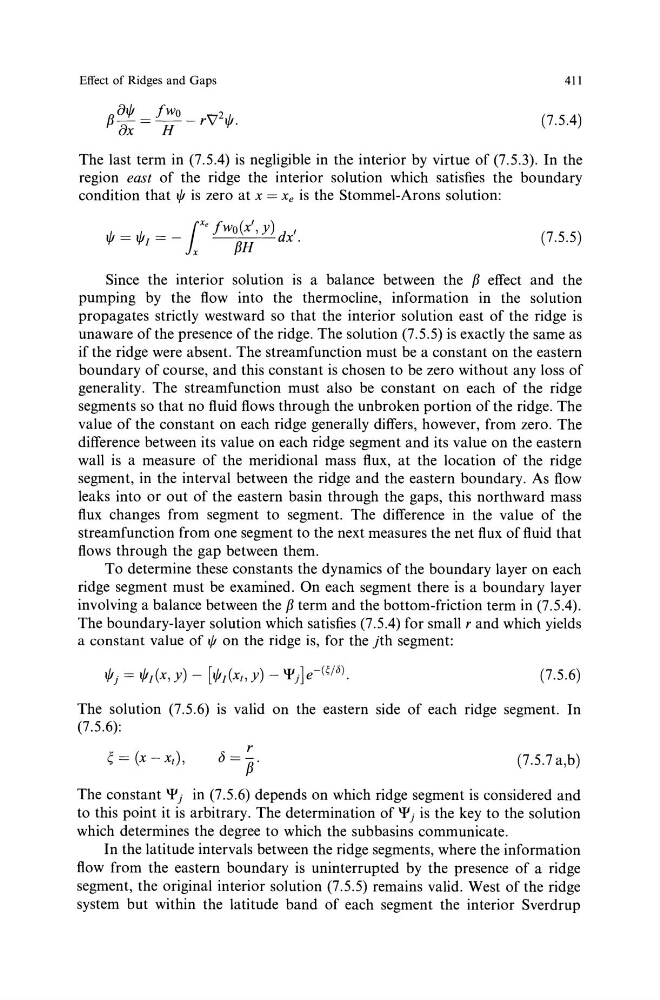
The last term in (7.5.4) is negligible in the interior by virtue of (7.5.3). In the
region east of the ridge the interior solution which satisfies the boundary
condition that ljJ is zero at x = Xe is the Stommel-Arons solution:
ljJ = l/11 = -1x, fwo(x', y) dx'.
X
PH
(7.5.5)
Since the interior solution is a balance between the p effect and the
pumping by the flow into the thermocline, information in the solution
propagates strictly westward so that the interior solution east of the ridge is
unaware of the presence of the ridge. The solution (7.5.5) is exactly the same as
if the ridge were absent. The streamfunction must be a constant on the eastern
boundary of course, and this constant is chosen to be zero without any loss of
generality. The streamfunction must also be constant on each of the ridge
segments so that no fluid flows through the unbroken portion of the ridge. The
value of the constant on each ridge generally differs, however, from zero. The
difference between its value on each ridge segment and its value on the eastern
wall is a measure of the meridional mass flux, at the location of the ridge
segment, in the interval between the ridge and the eastern boundary. As flow
leaks into or out of the eastern basin through the gaps, this northward mass
flux changes from segment to segment. The difference in the value of the
streamfunction from one segment to the next measures the net flux of fluid that
flows through the gap between them.
To determine these constants the dynamics of the boundary layer on each
ridge segment must be examined. On each segment there is a boundary layer
involving a balance between the p term and the bottom-friction term in (7.5.4).
The boundary-layer solution which satisfies (7.5.4) for small rand which yields
a constant value of ljJ on the ridge is, for the jth segment:
(7.5.6)
The solution (7.5.6) is valid on the eastern side of each ridge segment. In
(7.5.6):
(7.5.7 a,b)
The constant '1' 1 in (7.5.6) depends on which ridge segment is considered and
to this point it is arbitrary. The determination of '1' 1 is the key to the solution
which determines the degree to which the subbasins communicate.
In the latitude intervals between the ridge segments, where the information
flow from the eastern boundary is uninterrupted by the presence of a ridge
segment, the original interior solution (7.5.5) remains valid. West of the ridge
system but within the latitude band of each segment the interior Sverdrup
411
(7.5.4)
The last term in (7.5.4) is negligible in the interior by virtue of (7.5.3). In the
region east of the ridge the interior solution which satisfies the boundary
condition that ljJ is zero at x = Xe is the Stommel-Arons solution:
ljJ = l/11 = -1x, fwo(x', y) dx'.
X
PH
(7.5.5)
Since the interior solution is a balance between the p effect and the
pumping by the flow into the thermocline, information in the solution
propagates strictly westward so that the interior solution east of the ridge is
unaware of the presence of the ridge. The solution (7.5.5) is exactly the same as
if the ridge were absent. The streamfunction must be a constant on the eastern
boundary of course, and this constant is chosen to be zero without any loss of
generality. The streamfunction must also be constant on each of the ridge
segments so that no fluid flows through the unbroken portion of the ridge. The
value of the constant on each ridge generally differs, however, from zero. The
difference between its value on each ridge segment and its value on the eastern
wall is a measure of the meridional mass flux, at the location of the ridge
segment, in the interval between the ridge and the eastern boundary. As flow
leaks into or out of the eastern basin through the gaps, this northward mass
flux changes from segment to segment. The difference in the value of the
streamfunction from one segment to the next measures the net flux of fluid that
flows through the gap between them.
To determine these constants the dynamics of the boundary layer on each
ridge segment must be examined. On each segment there is a boundary layer
involving a balance between the p term and the bottom-friction term in (7.5.4).
The boundary-layer solution which satisfies (7.5.4) for small rand which yields
a constant value of ljJ on the ridge is, for the jth segment:
(7.5.6)
The solution (7.5.6) is valid on the eastern side of each ridge segment. In
(7.5.6):
(7.5.7 a,b)
The constant '1' 1 in (7.5.6) depends on which ridge segment is considered and
to this point it is arbitrary. The determination of '1' 1 is the key to the solution
which determines the degree to which the subbasins communicate.
In the latitude intervals between the ridge segments, where the information
flow from the eastern boundary is uninterrupted by the presence of a ridge
segment, the original interior solution (7.5.5) remains valid. West of the ridge
system but within the latitude band of each segment the interior Sverdrup