

The Stommel, Arons, and Faller Experiment
391
condition that the azimuthal (zonal) velocity vanish there, or equivalently that
n should be constant there. This holds unless there are sources of mass put in
directly at the eastern boundary. In such cases the interior zonal velocity must
accept the mass input with obvious alterations in the determination of n.
Thus except for the case of eastern sources n is a linear function of(} only.
Therefore the only geostrophic velocity is u, the radial velocity, and this is
given by:
g 1'/o
u - - - -
-
rO?T.
(7.2.10)
The velocity in the interior of the sector is always directed towards the apex
regardless of the position of the source. The radial (outward) mass flux is equal
to:
1
1io
g
1' /o
T1 =
dru d(} = - 2 0odo
Q
T
(7.2.11)
and its radial dependence depends only on d(r).The mass balance for the sector
as a whole requires that the rate at which the volume increases is given by the
source strength S, i.e.:
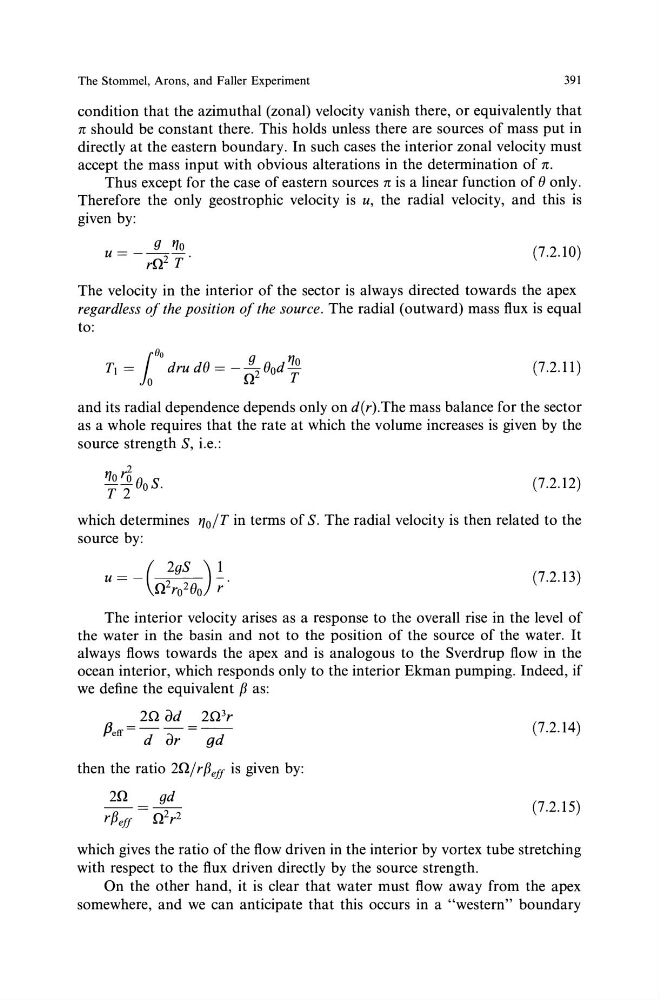
(7.2.12)
which determines 11ofT in terms of S. The radial velocity is then related to the
source by:
( 2gS ) 1
u = - il2ro20o -;:. ·
(7.2.13)
The interior velocity arises as a response to the overall rise in the level of
the water in the basin and not to the position of the source of the water. It
always flows towards the apex and is analogous to the Sverdrup flow in the
ocean interior, which responds only to the interior Ekman pumping. Indeed, if
we define the equivalent P as:
2Q ad 2Q 3 r
f3etr= dar = gd
then the ratio 2il/rPeff is given by:
2Q
gd
- - - - 2 -
rPeff Q r 2
(7.2.14)
(7.2.15)
which gives the ratio of the flow driven in the interior by vortex tube stretching
with respect to the flux driven directly by the source strength.
On the other hand, it is clear that water must flow away from the apex
somewhere, and we can anticipate that this occurs in a "western" boundary
391
condition that the azimuthal (zonal) velocity vanish there, or equivalently that
n should be constant there. This holds unless there are sources of mass put in
directly at the eastern boundary. In such cases the interior zonal velocity must
accept the mass input with obvious alterations in the determination of n.
Thus except for the case of eastern sources n is a linear function of(} only.
Therefore the only geostrophic velocity is u, the radial velocity, and this is
given by:
g 1'/o
u - - - -
-
rO?T.
(7.2.10)
The velocity in the interior of the sector is always directed towards the apex
regardless of the position of the source. The radial (outward) mass flux is equal
to:
1
1io
g
1' /o
T1 =
dru d(} = - 2 0odo
Q
T
(7.2.11)
and its radial dependence depends only on d(r).The mass balance for the sector
as a whole requires that the rate at which the volume increases is given by the
source strength S, i.e.:
(7.2.12)
which determines 11ofT in terms of S. The radial velocity is then related to the
source by:
( 2gS ) 1
u = - il2ro20o -;:. ·
(7.2.13)
The interior velocity arises as a response to the overall rise in the level of
the water in the basin and not to the position of the source of the water. It
always flows towards the apex and is analogous to the Sverdrup flow in the
ocean interior, which responds only to the interior Ekman pumping. Indeed, if
we define the equivalent P as:
2Q ad 2Q 3 r
f3etr= dar = gd
then the ratio 2il/rPeff is given by:
2Q
gd
- - - - 2 -
rPeff Q r 2
(7.2.14)
(7.2.15)
which gives the ratio of the flow driven in the interior by vortex tube stretching
with respect to the flux driven directly by the source strength.
On the other hand, it is clear that water must flow away from the apex
somewhere, and we can anticipate that this occurs in a "western" boundary