

390
Abyssal Circulation
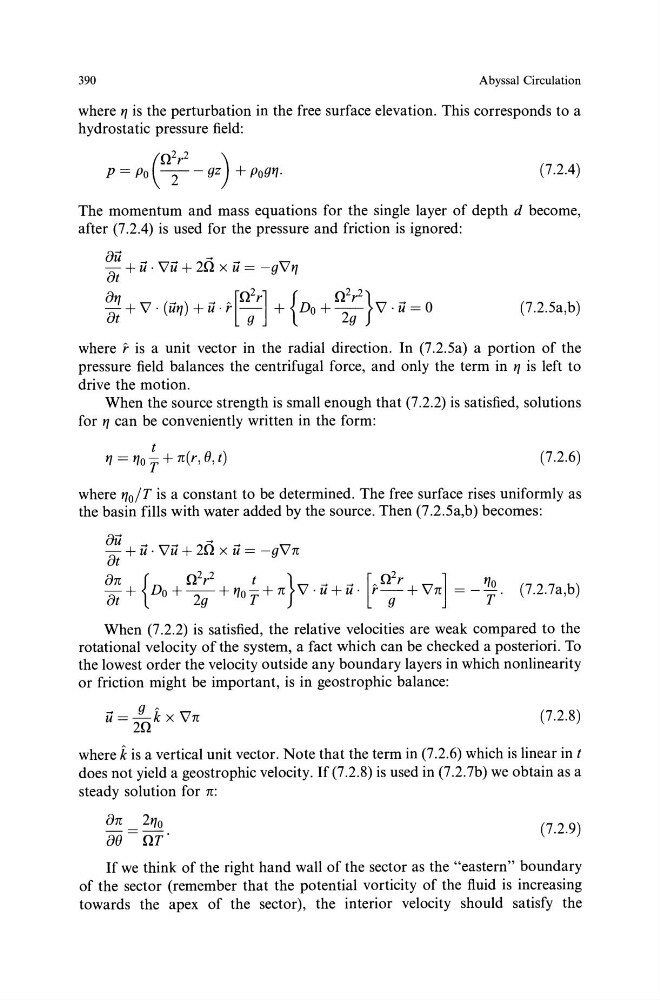
where 1J is the perturbation in the free surface elevation. This corresponds to a
hydrostatic pressure field:
(7.2.4)
The momentum and mass equations for the single layer of depth d become,
after (7.2.4) is used for the pressure and friction is ignored:
(7.2.5a,b)
where r is a unit vector in the radial direction. In (7.2.5a) a portion of the
pressure field balances the centrifugal force, and only the term in 1J is left to
drive the motion.
When the source strength is small enough that (7.2.2) is satisfied, solutions
for 1J can be conveniently written in the form:
t
1J = 1Jo T + n(r, 8, t)
(7.2.6)
where 1Jo/T is a constant to be determined. The free surface rises uniformly as
the basin fills with water added by the source. Then (7 .2.5a,b) becomes:
ail ~ n~ 2;:\ ~
n
at + U · v U + ~~ X U = -g v n
an {
Q 2 r2
t
}
[ nzr
]
-+ Do+--+ 1Jo-+ n \7 · il+ u· r-+ \ln
at
2g
r
g
1Jo
T
(7.2.7a,b)
When (7.2.2) is satisfied, the relative velocities are weak compared to the
rotational velocity of the system, a fact which can be checked a posteriori. To
the lowest order the velocity outside any boundary layers in which nonlinearity
or friction might be important, is in geostrophic balance:
(7.2.8)
where k is a vertical unit vector. Note that the term in (7.2.6) which is linear in t
does not yield a geostrophic velocity. If (7.2.8) is used in (7.2.7b) we obtain as a
steady solution for n:
an 21Jo
a8 QT
(7.2.9)
If we think of the right hand wall of the sector as the "eastern" boundary
of the sector (remember that the potential vorticity of the fluid is increasing
towards the apex of the sector), the interior velocity should satisfy the
Abyssal Circulation
where 1J is the perturbation in the free surface elevation. This corresponds to a
hydrostatic pressure field:
(7.2.4)
The momentum and mass equations for the single layer of depth d become,
after (7.2.4) is used for the pressure and friction is ignored:
(7.2.5a,b)
where r is a unit vector in the radial direction. In (7.2.5a) a portion of the
pressure field balances the centrifugal force, and only the term in 1J is left to
drive the motion.
When the source strength is small enough that (7.2.2) is satisfied, solutions
for 1J can be conveniently written in the form:
t
1J = 1Jo T + n(r, 8, t)
(7.2.6)
where 1Jo/T is a constant to be determined. The free surface rises uniformly as
the basin fills with water added by the source. Then (7 .2.5a,b) becomes:
ail ~ n~ 2;:\ ~
n
at + U · v U + ~~ X U = -g v n
an {
Q 2 r2
t
}
[ nzr
]
-+ Do+--+ 1Jo-+ n \7 · il+ u· r-+ \ln
at
2g
r
g
1Jo
T
(7.2.7a,b)
When (7.2.2) is satisfied, the relative velocities are weak compared to the
rotational velocity of the system, a fact which can be checked a posteriori. To
the lowest order the velocity outside any boundary layers in which nonlinearity
or friction might be important, is in geostrophic balance:
(7.2.8)
where k is a vertical unit vector. Note that the term in (7.2.6) which is linear in t
does not yield a geostrophic velocity. If (7.2.8) is used in (7.2.7b) we obtain as a
steady solution for n:
an 21Jo
a8 QT
(7.2.9)
If we think of the right hand wall of the sector as the "eastern" boundary
of the sector (remember that the potential vorticity of the fluid is increasing
towards the apex of the sector), the interior velocity should satisfy the