

392
Abyssal Circulation
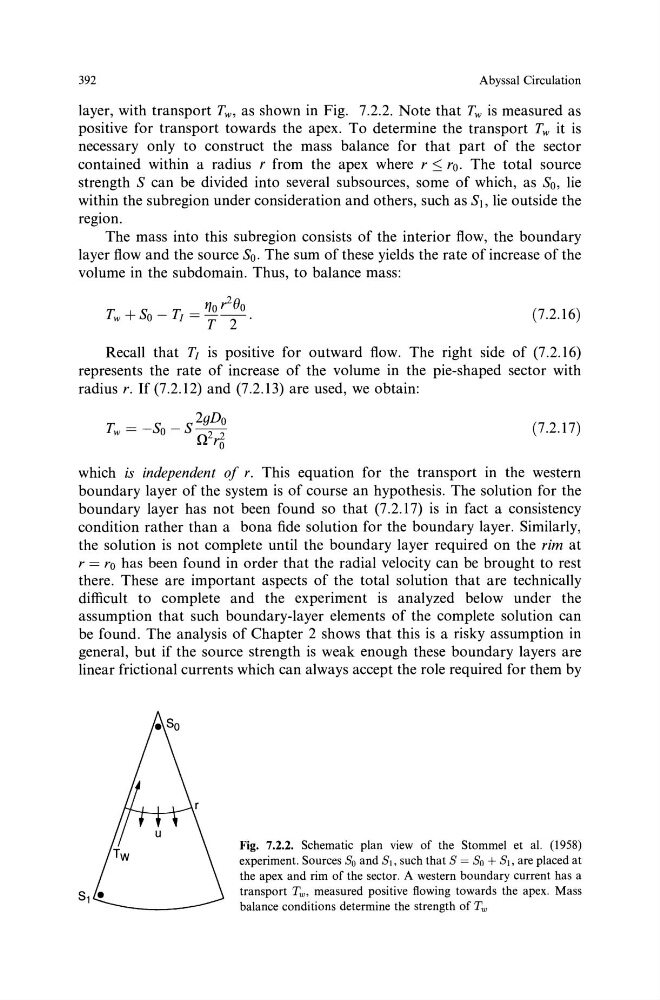
layer, with transport Tw, as shown in Fig. 7.2.2. Note that Tw is measured as
positive for transport towards the apex. To determine the transport Tw it is
necessary only to construct the mass balance for that part of the sector
contained within a radius r from the apex where r ::; r0 • The total source
strength S can be divided into several subsources, some of which, as S0, lie
within the subregion under consideration and others, such as S1, lie outside the
region.
The mass into this subregion consists of the interior flow, the boundary
layer flow and the source So. The sum of these yields the rate of increase of the
volume in the subdomain. Thus, to balance mass:
1'/o r 2 0o
Tw+So- T1 =rl·
(7.2.16)
Recall that T1 is positive for outward flow. The right side of (7.2.16)
represents the rate of increase of the volume in the pie-shaped sector with
radius r. If (7.2.12) and (7.2.13) are used, we obtain:
2gDo
Tw =-So -S 02 ~
0
(7.2.17)
which is independent of r. This equation for the transport in the western
boundary layer of the system is of course an hypothesis. The solution for the
boundary layer has not been found so that (7.2.17) is in fact a consistency
condition rather than a bona fide solution for the boundary layer. Similarly,
the solution is not complete until the boundary layer required on the rim at
r = r0 has been found in order that the radial velocity can be brought to rest
there. These are important aspects of the total solution that are technically
difficult to complete and the experiment is analyzed below under the
assumption that such boundary-layer elements of the complete solution can
be found. The analysis of Chapter 2 shows that this is a risky assumption in
general, but if the source strength is weak enough these boundary layers are
linear frictional currents which can always accept the role required for them by
Fig. 7.2.2. Schematic plan view of the Stommel et a!. (1958)
experiment. Sources S0 and S1, such that S = So + S1, are placed at
the apex and rim of the sector. A western boundary current has a
transport Tw, measured positive flowing towards the apex. Mass
balance conditions determine the strength of Tw
Abyssal Circulation
layer, with transport Tw, as shown in Fig. 7.2.2. Note that Tw is measured as
positive for transport towards the apex. To determine the transport Tw it is
necessary only to construct the mass balance for that part of the sector
contained within a radius r from the apex where r ::; r0 • The total source
strength S can be divided into several subsources, some of which, as S0, lie
within the subregion under consideration and others, such as S1, lie outside the
region.
The mass into this subregion consists of the interior flow, the boundary
layer flow and the source So. The sum of these yields the rate of increase of the
volume in the subdomain. Thus, to balance mass:
1'/o r 2 0o
Tw+So- T1 =rl·
(7.2.16)
Recall that T1 is positive for outward flow. The right side of (7.2.16)
represents the rate of increase of the volume in the pie-shaped sector with
radius r. If (7.2.12) and (7.2.13) are used, we obtain:
2gDo
Tw =-So -S 02 ~
0
(7.2.17)
which is independent of r. This equation for the transport in the western
boundary layer of the system is of course an hypothesis. The solution for the
boundary layer has not been found so that (7.2.17) is in fact a consistency
condition rather than a bona fide solution for the boundary layer. Similarly,
the solution is not complete until the boundary layer required on the rim at
r = r0 has been found in order that the radial velocity can be brought to rest
there. These are important aspects of the total solution that are technically
difficult to complete and the experiment is analyzed below under the
assumption that such boundary-layer elements of the complete solution can
be found. The analysis of Chapter 2 shows that this is a risky assumption in
general, but if the source strength is weak enough these boundary layers are
linear frictional currents which can always accept the role required for them by
Fig. 7.2.2. Schematic plan view of the Stommel et a!. (1958)
experiment. Sources S0 and S1, such that S = So + S1, are placed at
the apex and rim of the sector. A western boundary current has a
transport Tw, measured positive flowing towards the apex. Mass
balance conditions determine the strength of Tw